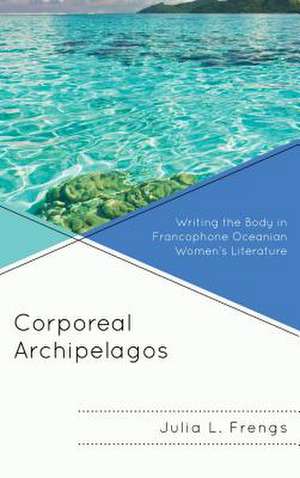
Corporeal Archipelagos: After the Empire: The Francophone World and Postcolonial France
Autor Julia Frengsen Limba Engleză Hardback – 27 dec 2017
Din seria After the Empire: The Francophone World and Postcolonial France
- 22%
 Preț: 375.48 lei
 - 29%
 Preț: 342.63 lei
 - 29%
 Preț: 343.67 lei
 - 35%
 Preț: 594.01 lei
 - 35%
 Preț: 594.73 lei
 - 29%
 Preț: 343.67 lei
 - 31%
 Preț: 529.40 lei
 - 25%
 Preț: 306.46 lei
 - 23%
 Preț: 335.60 lei
 - 35%
 Preț: 594.56 lei
 - 29%
 Preț: 561.12 lei
 - 26%
 Preț: 592.68 lei
 - 23%
 Preț: 320.82 lei
 - 24%
 Preț: 318.74 lei
 - 23%
 Preț: 321.63 lei
 - 30%
 Preț: 505.39 lei
 - 36%
 Preț: 565.57 lei
 - 29%
 Preț: 345.51 lei
 - 30%
 Preț: 564.34 lei
 - 29%
 Preț: 346.12 lei
 - 35%
 Preț: 594.73 lei
 - 29%
 Preț: 341.92 lei
 - 34%
 Preț: 568.23 lei
 - 33%
 Preț: 594.98 lei
 - 29%
 Preț: 342.93 lei
 - 23%
 Preț: 322.99 lei
 - 34%
 Preț: 552.85 lei
 - 22%
 Preț: 326.24 lei
 - 14%
 Preț: 633.75 lei
 - 35%
 Preț: 593.23 lei
 - 23%
 Preț: 319.28 lei
 - 23%
 Preț: 321.15 lei
 - 22%
 Preț: 327.05 lei
 - 35%
 Preț: 807.77 lei
 - 34%
 Preț: 568.84 lei
 - 25%
 Preț: 306.14 lei
 - 34%
 Preț: 608.79 lei
 - 36%
 Preț: 679.02 lei
 - 29%
 Preț: 344.06 lei
 - 23%
 Preț: 335.38 lei
Preț: 583.23 lei
Preț vechi: 864.01 lei
-32%
Puncte Express: 875
Carte tipărită la comandă
Livrare economică 28 noiembrie-12 decembrie
Livrare prin curier în România Termenul estimat este afișat lângă disponibilitate.
Transport gratuit pentru acest produs Plată online sau ramburs, în funcție de opțiunile comenzii.
Retur gratuit în 14 zile Comandă securizată și suport în română.
Specificații
ISBN-13: 9781498542296
ISBN-10: 1498542298
Pagini: 224
Dimensiuni: 157 x 235 x 18 mm
Greutate: 0.52 kg
Editura: Lexington Books
Colecția After the Empire: The Francophone World and Postcolonial France
Seria After the Empire: The Francophone World and Postcolonial France
Locul publicării:New York, United States
ISBN-10: 1498542298
Pagini: 224
Dimensiuni: 157 x 235 x 18 mm
Greutate: 0.52 kg
Editura: Lexington Books
Colecția After the Empire: The Francophone World and Postcolonial France
Seria After the Empire: The Francophone World and Postcolonial France
Locul publicării:New York, United States
Cuprins
Introduction: Writing the Body in Oceania
Chapter 1: The Instigation and the Perpetuation of the Mythical Oceanian Body
Chapter 2: Sexual Violence, Trauma, and the Damaged Oceanian Body
Chapter 3: Ecological Bodies: An Ecocritical Lens
Chapter 4: Writing Institutionalized Bodies: Breaking out of Confinement
Chapter 5: To Speak or not to Speak: Writing the Silent Body
Conclusion: Oceanian Literature, or The New Tattoo
Chapter 1: The Instigation and the Perpetuation of the Mythical Oceanian Body
Chapter 2: Sexual Violence, Trauma, and the Damaged Oceanian Body
Chapter 3: Ecological Bodies: An Ecocritical Lens
Chapter 4: Writing Institutionalized Bodies: Breaking out of Confinement
Chapter 5: To Speak or not to Speak: Writing the Silent Body
Conclusion: Oceanian Literature, or The New Tattoo
Recenzii
Julia Frengs's first monograph goes beyond being just a sum of its respective parts; it is an impressively extensive study of Francophone women's writing from French Polynesia and New Caledonia, a region that has not received enough attention in academic studies. . . Frengs masterfully analyzes the metaphoric and metonymic connection between the centrality of the female body and the land in this timely and scholarly manuscript. . . . Frengs offers a solid scholarly text that employs feminist, ecocritical, and literary theory and contains a wealth of evidence. It brings a number of valuable additions to the field, representing an exceptionally important scholarly source and essential reading for scholars of Francophone Women's Literature from French Polynesia and New Caledonia.
Corporeal Archipelagos is a profoundly significant and beautifully conceived study of the French-language work of four women from French Polynesia and New Caledonia that combines a thorough knowledge of this literature with a strong theoretical approach. Julia Frengs's expertise on Oceanian authors Déwé Gorodé, Claudine Jacques, Ari'irau, and Chantal Spitz comes through in an unprecedented examination of the centrality of the body to questions with ecological, historical, national, political, sexual, and social import in an oft-overlooked region of Francophone women's writing.
Anyone interested in Pacific Francophone literature should have this book, as it is a very complete work about the question of the Oceanian body in French speaking literature.
Corporeal Archipelagos is a profoundly significant and beautifully conceived study of the French-language work of four women from French Polynesia and New Caledonia that combines a thorough knowledge of this literature with a strong theoretical approach. Julia Frengs's expertise on Oceanian authors Déwé Gorodé, Claudine Jacques, Ari'irau, and Chantal Spitz comes through in an unprecedented examination of the centrality of the body to questions with ecological, historical, national, political, sexual, and social import in an oft-overlooked region of Francophone women's writing.
Anyone interested in Pacific Francophone literature should have this book, as it is a very complete work about the question of the Oceanian body in French speaking literature.