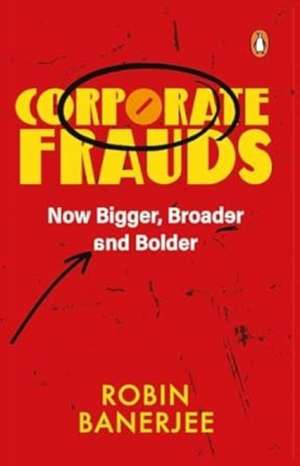
Corporate Frauds
Autor Robin Banerjeeen Limba Engleză Paperback – 15 aug 2024
Urgența de a înțelege mecanismele deșelăciunii în afaceri nu a fost niciodată mai mare; pe măsură ce reglementările se înăspresc, metodele de fraudă devin exponențial mai complexe și mai îndrăznețe. Găsim în Corporate Frauds un avertisment vital pentru orice profesionist, într-o eră în care crizele globale au deschis noi oportunități pentru infractorii cibernetici. Considerăm că această lucrare depășește simpla teorie, oferind o radiografie a modului în care cifrele contabile sunt falsificate și cum promisiunile de calitate sunt încălcate sistematic. Abordarea lui Robin Banerjee diferă de cea din Corporate Misconduct de Ronald R. Sims prin caracterul său intens aplicat; dacă volumul lui Sims analizează ramificațiile societale și legale în mod abstract, Corporate Frauds se concentrează pe demascarea „magicienilor” înșelătoriei și pe pașii concreți de prevenție. Structura cărții este una progresivă și exhaustivă: începe cu profilul etic al managerului, trece prin anatomia corupției și a schemelor Ponzi, culminând cu un capitol esențial despre semnele prevestitoare (Ominous Omens) ale dezastrelor financiare. Această progresie îi permite cititorului să dezvolte un instinct de detectare a anomaliilor înainte ca acestea să producă daune iremediabile. Ne-a atras atenția în mod deosebit secțiunea dedicată „artificiilor contabile”, unde experiența de expert contabil a autorului transformă concepte tehnice aride într-un ghid de supraviețuire corporativă.
Preț: 172.04 lei
Carte disponibilă
Livrare economică 17 noiembrie-01 decembrie
Livrare express 03-07 noiembrie pentru 23.64 lei
Specificații
ISBN-10: 0143464582
Pagini: 336
Dimensiuni: 127 x 201 x 23 mm
Greutate: 0.32 kg
Editura: Penguin Random House India Pvt.Ltd.
De ce să citești această carte
Recomandăm această carte liderilor de business și investitorilor care vor să își protejeze activele într-un mediu tot mai opac. Veți câștiga capacitatea de a anticipa tacticile șarlatanilor moderni, de la inginerii financiare la fraude bancare. Este un instrument pragmatic care vă învață să recunoașteți semnele de alarmă înainte ca o investiție sau un parteneriat să se transforme într-o pierdere masivă.
Despre autor
Robin Banerjee este un executiv de rang înalt cu o carieră impresionantă de peste 35 de ani desfășurată în peste 20 de țări. Expert contabil (Chartered Accountant) și secretar de companie, acesta deține o vastă experiență în management financiar și operațional. A ocupat funcții cheie în cadrul Hindustan Unilever, unde a gestionat diviziile de exporturi și fuziuni și achiziții (M&A), și a servit ca Director General și CFO pentru operațiunile din Germania ale gigantului Arcelor-Mittal. Expertiza sa tehnică și parcursul în corporații multinaționale îi conferă o perspectivă rară și extrem de autoritară asupra integrității financiare.
Descriere scurtă
The size and scale of business deceit is becoming murkier, messier and massive even as regulatory strictures are getting bolstered. On top of it, the coronavirus crisis brought new opportunities for the fraudsters with cybercrimes reaching unprecedented levels.
Awareness of how swindlers rip off and knowing their tricks will help unravel the hocus-pocus of the magicians of hoax. This book is an attempt to bring to fore the many lies and deceptions committed by the business world.
From the author for two bestsellers, Who Blunders and How (2019) and Who Cheats and How (2015), comes an exciting and pacy rundown of how cons and swindlers mint money. The book discusses the psyche and modus operandi of the defrauders. It stresses the impact and possible actions to avoid, prevent or protect against chicaneries.
Read this book to be aware, anticipate and avoid the business-world charlatans lurking around to con us.
Recenzii
As a banker, investor or anyone with interest in the financial services, the first rule is to avoid the fraud trap. At the heart of all analysis lie numbers and sometimes numbers that lie. The quality of your analysis and understanding of the company is driven by the genuineness of those numbers. The trap is of corporate artists who have perfected the art of presenting numbers that tell a beautiful tale. Good bankers, investors and analysts are those who can smell these numbers and sift the truth from the tale. If you have read Robin’s earlier books, then you would be familiar with what to expect. If not, then let him take you on a journey that gives you a detailed insight into the modus operandi of these elaborate corporate frauds. It is said that those who do not learn from history are condemned to repeat it. In his simple but straight-shooting style, Robin takes us through a crash course on the history of corporate frauds that will enable us to spot the next trap.
Robin’s well-researched and deeply insightful new book focuses on a subject that is rarely discussed, though it impacts global economies everywhere. While books on individual scams abound, the larger issues involved in white-collar crime have rarely been examined, and it is this that makes Banerjee’s work unique. Drawing on personal observations, anecdotes, intensive enquiry and his own visible concern over the issue, Robin takes an in-depth look at the growing deceit in the business arena, globally. He also delves into history and notes that companies down the ages have indulged in unethical behaviour. The author’s objective, however, goes beyond identifying corporate crimes and the people behind them; he also explores the compulsions that fuel such traits. In an era where crime is taking on increasingly sophisticated dimensions and technology is a double-edged sword that both enables it and offers solutions, this book is long overdue. It also serves as an important reminder that criminal activity, however suave it might be, may offer short-term gains, but it is good governance that ensures a company’s lasting value.
Robin Banerjee holds a mirror with a firm hand, again. As shareholders, professionals or even as consumers, we are impacted by wrongdoings of people and brands we trust—affected often in more ways than we may know. This book is an important service to keep our worldview open to the reality out there.
A cutting and incisive look at the corporate world and where the hidden secrets lie! Robin Banerjee has turned his magnifying glass towards the prevalent practice of ‘fraud’ in its many forms in the professional sphere. By understanding the real root causes behind unethical behaviour and classifying them in a way that is easy to understand and recall in our day-to-day activities, this book is an invaluable guide to avoiding the same mistakes that have led to many scandals in the corporate world. The book gives ample examples from the entire gamut of businesses of the way people and corporations are misled and shows us how to steer clear of these practices by being conscious of our actions.
Corporate Frauds, the latest creation of Robin, narrates the spectrum of frauds and its aftermath that continue to haunt the economy. In fact, this book should be taken as continuation of Robin’s previous book, Who Blunders and How? Both together qualify to be an indispensable part of any employee induction programme across organizations, whether small, medium or large. Going forward, governance is one of the sustenance pillars for companies along with environment and social (part of the ESG) themes. I love this book on governance, which is written in Robin’s inimitable style. I feel that every entrepreneur should live, imbibe and prosper through this book.
Robin’s book, Corporate Frauds, is a prescription for good corporate governance. I always believe you can learn either from your own mistakes or from somebody else’s mistakes. But corporate governance mistakes are so costly that, in fact, they can cost you your life, freedom and reputation and so it is much better to learn from somebody else’s mistakes. Therefore, I would definitely recommend this book as a standard reading material for all professionals and students of management. I would also like to compliment the author for the fast-paced language, almost like an addictive web series. It is definitely a very engrossing and interesting read.
Once again, Robin has picked up a tricky subject, corporate frauds, to push our boundaries of knowledge. As humans push the boundaries of innovation using technology, it appears that fraudsters and cheats are the first to monetize the benefits of the new technology by combining it with plain old trust building. Fraud has moved from a one-off act by a misunderstood loner to a planned action by groups of otherwise honest individuals. Packed with contemporary and popular examples, this book is a fast read written in a direct style.
Amazing reading! Dark side of the corporate world at its worst. The book seems like a fiction reading. A must-read for all.
Robin continues on his successful genre, with his third business non-fiction book. In this book on corporate frauds, he has dealt with different situations, as also the possible reasoning of the perpetrators. Robin’s books are always easy to read and great for understanding.
It is difficult to express this book in a few words. Every author brings all the glimpses and positive stories of the corporate world. It requires a third eye like ‘Shiva’ to see the darker side of the world where we, the so-called corporates, live our day-to-day lives. Many of us do not even notice it; some may, but they choose to remain silent, and we have these so-called who are actually a part of the game. The book to me is gripping, a page turner. The stories and facts shook me, took me to the darkest edge of certain dubious corporate conducts. Hopefully, this book will open the third eye wider and bring more discipline in corporate governance.
The book is just awesome. Every page is a learning experience. With every book of Robin, the narrative gets more gripping. It is a must-read for all: professionals, businessmen, students as well as housewives.
This is an amazing book which not only captures the past but also analyses the root cause which is responsible for bad corporate behaviour.
While greed and lust for money being unstoppable evils that exist right through the human history, I feel there is still hope for minimizing pain and sufferings of innocents in the world. Robin Banerjee’s book on corporate frauds has a purpose to help people understand patterns of business crimes that cause them the pain, and it carries warnings to be careful. No matter how strict laws you make and develop technologies to stop frauds, the fraudsters find their ways to finally cheat innocent people. Robin’s book is a pill or medicine to minimize people’s ignorance. The narration of his huge research that he has done over global scams looks focused on creating awareness among people. The book is a must-read for every individual who keeps even a few coins in the pocket, because there could be someone around who is planning to snatch away the coins.
As they say history repeats for those who do not read it. This book serves as a lighthouse to understand the past so that the future errors can be avoided. There is a myth that government bodies and public sector organizations are more corrupt than their counterparts in the private sector. This myth is effectively debunked in Robin Banerjee’s book on malfeasance and unbridled greed in corporate conglomerates and privately owned entities across the world and in India. From delving into individual psychology (why rich people indulge in petty thievery) to examining what motivates owners and representatives of large companies to cut corners, defraud customers and shareholders, and bypass laws and regulations (while maximizing profits and garnering market shares)—Banerjee’s book has it all. The book is not just an insider’s account of corporate corruption by an author who had earlier scrutinized how company balance sheets are fudged and legal loopholes exploited, Banerjee meticulously compiles facts about frauds and crimes committed by corporations that are household names across the globe. The author moves seamlessly across time, from recounting stories about the worst corporate crimes committed during the colonial era in Africa and India to Ponzi schemes, the misuse of tax havens in idyllic islands to launder the proceeds of crime and how technology has changed the character of corruption. Is it possible to be ethical in business practices? And should one distinguish between the more corrupt and the less corrupt, the corrupt and efficient and the corrupt and inefficient? These are not simple questions and their answers have to be necessarily nuanced without being excessively cynical. Read on.
Robin Banerjee has done a commendable job of comprehensively drawing up a compendium of all types of frauds occurring in the world today. In addition, he adds his insights on how to prevent and spot them based on detailed analysis of how they were perpetrated. It is a sad reflection of our times that such white-collar crimes are growing exponentially on a global basis and it calls for a clear need to inculcate ethical and moral behaviour in our society. It is a necessity for businesses to be run on the principles of trusteeship in a selfless manner as propounded by Mahatma Gandhi.
Frank, informative, interesting, gripping and mischievously thought-provoking. A financial thriller everyone must read.
Cuprins
Introduction
The (Un)Ethical Manager
Corporate Con Artists
Corruption and Corporations
Technology Tall Tales
Cybercrimes
Banking Deceits
The Art of Hiding Shady Wealth
Ponzi Schemes
Stock and Commodity Market Swindles
Insurance Imposture
Accounting Artifice
Ominous Omens of Financial Frauds
Epilogue
Index
Descriere
An expose on what unethical businesses are prepared to do to enhance profits and reputation.