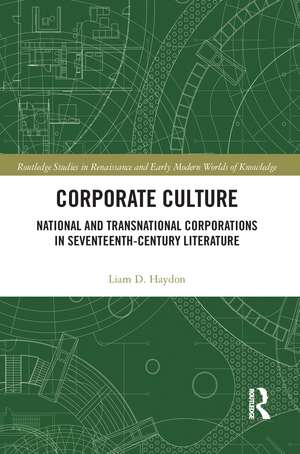
Corporate Culture: National and Transnational Corporations in Seventeenth-Century Literature: Routledge Studies in Renaissance and Early Modern Worlds of Knowledge
Autor Liam D. Haydonen Limba Engleză Paperback – 30 iun 2021
Drawing on a wide range of genres – including corporate publications, letters, and minute books; dramatic works; epic poetry and sermons – this study shows how widely corporate rhetoric spread, and how embedded it was in the early modern social imagination.
Din seria Routledge Studies in Renaissance and Early Modern Worlds of Knowledge
-
 Preț: 417.16 lei
 -
 Preț: 403.17 lei
 - 18%
 Preț: 1071.66 lei
 -
 Preț: 422.44 lei
 -
 Preț: 353.16 lei
 -
 Preț: 390.70 lei
 -
 Preț: 421.13 lei
 - 18%
 Preț: 1089.23 lei
 -
 Preț: 352.31 lei
 -
 Preț: 417.85 lei
 -
 Preț: 421.13 lei
 -
 Preț: 384.78 lei
 -
 Preț: 390.13 lei
 -
 Preț: 353.56 lei
 -
 Preț: 389.60 lei
 -
 Preț: 418.73 lei
 -
 Preț: 390.13 lei
 -
 Preț: 418.06 lei
 -
 Preț: 414.90 lei
 -
 Preț: 417.33 lei
 -
 Preț: 419.52 lei
 -
 Preț: 414.10 lei
 -
 Preț: 396.04 lei
 - 18%
 Preț: 1017.55 lei
 -
 Preț: 390.70 lei
 -
 Preț: 408.85 lei
 -
 Preț: 399.49 lei
 - 18%
 Preț: 1067.90 lei
 - 18%
 Preț: 1075.81 lei
Preț: 414.63 lei
Puncte Express: 622
Carte tipărită la comandă
Livrare economică 06-20 iunie
Specificații
ISBN-13: 9781032094991
ISBN-10: 1032094990
Pagini: 204
Ilustrații: 1 Illustrations, black and white
Dimensiuni: 152 x 229 x 11 mm
Greutate: 0.29 kg
Ediția:1
Editura: Taylor & Francis
Colecția Routledge
Seria Routledge Studies in Renaissance and Early Modern Worlds of Knowledge
Locul publicării:Oxford, United Kingdom
ISBN-10: 1032094990
Pagini: 204
Ilustrații: 1 Illustrations, black and white
Dimensiuni: 152 x 229 x 11 mm
Greutate: 0.29 kg
Ediția:1
Editura: Taylor & Francis
Colecția Routledge
Seria Routledge Studies in Renaissance and Early Modern Worlds of Knowledge
Locul publicării:Oxford, United Kingdom
Public țintă
PostgraduateCuprins
Introduction 1. The Corporate Public Sphere 2. Trusting the Corporation 3. The World’s Exchange 4. Epic, Nationalism, and the Corporation 5. The Corporation of Heaven. Coda
Notă biografică
Liam D. Haydon is a postdoctoral fellow in the Centre for the Political Economies of International Commerce at the University of Kent.
Descriere
This book demonstrates how the ideas and ideals of the corporation, such as trust, exchange, and the common good, circulated in early modern society. Literary texts engaged with these ideas to develop new forms of national identity, social politics, and religious expression modelled on the idea of the corporate collective.