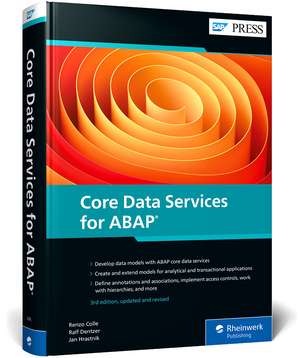
Core Data Services for ABAP: SAP Press Englisch
Autor Renzo Colle, Ralf Dentzer, Jan Hrastniken Limba Engleză Hardback – 6 mar 2024
Dezvoltarea aplicațiilor moderne în ecosistemul SAP S/4HANA impune o stăpânire precisă a Core Data Services, elementul central al noii arhitecturi de date. Problema tehnică pe care o rezolvăm prin acest volum este tranziția de la modelarea tradițională a bazei de date către un model semantic bogat, capabil să susțină atât cerințe analitice, cât și tranzacționale. Subliniem faptul că ediția a treia este actualizată pentru SAP S/4HANA 2023, oferind specificații concrete pentru sintaxa CDS, de la câmpuri cheie și operațiuni de tip 'cast', până la funcții de agregare SQL și gestionarea clienților. Structura volumului urmărește o progresie logică, pornind de la implementarea primelor vederi CDS și avansând către concepte complexe precum asocierile și adnotările care definesc logica de business. Cititorul care a aplicat deja conceptele de bază din Complete ABAP va găsi aici specializarea necesară pentru a construi un Virtual Data Model (VDM) robust. De asemenea, spre deosebire de Full Stack Development with SAP, care se concentrează pe extinderea și deployment-ul aplicațiilor, Core Data Services for ABAP sondează în profunzime stratul de modelare, explicând cum să integrăm controalele de acces și funcțiile SAP HANA. Reținem atenția acordată detaliilor de execuție: autorii detaliază utilizarea variabilelor de sesiune, a uniunilor și a funcțiilor de conversie pentru monede și unități de măsură. Partea finală a cărții se concentrează pe stabilitatea soluției, oferind metodologii pentru testarea automată și depanare, esențiale în proiectele de anvergură enterprise.
Din seria SAP Press Englisch
- 20%
 Preț: 498.30 lei
 - 8%
 Preț: 531.17 lei
 - 8%
 Preț: 555.09 lei
 - 20%
 Preț: 572.67 lei
 - 20%
 Preț: 559.11 lei
 - 20%
 Preț: 397.01 lei
 - 20%
 Preț: 629.08 lei
 - 8%
 Preț: 592.24 lei
 - 20%
 Preț: 445.86 lei
 - 20%
 Preț: 400.07 lei
 - 20%
 Preț: 653.14 lei
 - 20%
 Preț: 649.45 lei
 - 20%
 Preț: 664.42 lei
 - 20%
 Preț: 530.81 lei
 - 8%
 Preț: 547.17 lei
 - 20%
 Preț: 435.19 lei
 - 20%
 Preț: 452.40 lei
 - 20%
 Preț: 480.92 lei
 - 20%
 Preț: 505.55 lei
 - 20%
 Preț: 640.26 lei
 - 20%
 Preț: 540.18 lei
 - 20%
 Preț: 659.08 lei
 - 20%
 Preț: 402.39 lei
 - 9%
 Preț: 775.27 lei
 - 20%
 Preț: 697.04 lei
 - 20%
 Preț: 620.76 lei
 - 8%
 Preț: 534.89 lei
 - 20%
 Preț: 486.65 lei
 - 20%
 Preț: 558.22 lei
 - 8%
 Preț: 556.57 lei
 - 20%
 Preț: 638.55 lei
 - 8%
 Preț: 540.88 lei
 - 20%
 Preț: 639.44 lei
 - 20%
 Preț: 605.46 lei
 - 8%
 Preț: 412.12 lei
 - 20%
 Preț: 423.56 lei
 - 8%
 Preț: 515.14 lei
 - 20%
 Preț: 683.97 lei
 - 20%
 Preț: 160.12 lei
 - 20%
 Preț: 515.48 lei
 - 20%
 Preț: 571.29 lei
 - 20%
 Preț: 562.79 lei
 - 20%
 Preț: 450.06 lei
 - 20%
 Preț: 453.39 lei
 - 20%
 Preț: 610.03 lei
 - 8%
 Preț: 418.29 lei
 - 20%
 Preț: 633.34 lei
 - 20%
 Preț: 405.55 lei
 - 20%
 Preț: 408.42 lei
Preț: 563.14 lei
Preț vechi: 703.92 lei
-20%
Carte disponibilă
Livrare economică 09-23 noiembrie
Livrare express 23-29 octombrie pentru 78.54 lei
Specificații
ISBN-10: 1493223763
Pagini: 754
Dimensiuni: 185 x 259 x 50 mm
Greutate: 1.74 kg
Ediția:3. Auflage
Editura: Rheinwerk Verlag GmbH
Seria SAP Press Englisch
V-ar putea interesa
-
 The Data Model Resource Book, Volume 1Len Silverston-20%Preț: 498.45 lei623.05 lei
 -
 Data Modelling for SAP HANA 2.0Anil Bavaraju-20%Preț: 758.71 lei948.38 lei
 -
 ABAP Programming Model for SAP FioriStefan Haas-20%Preț: 501.33 lei626.66 lei
 -
 SAP S/4HANA Financial Accounting Certification GuideStefanos Pougkas-20%Preț: 400.07 lei500.09 lei
 -
 Sqlscript for SAP HanaJörg Brandeis-20%Preț: 391.64 lei489.55 lei
 -
 Complete ABAPKiran Bandari-20%Preț: 480.92 lei601.15 lei
 -
 SAP S/4hana AdministrationMark Mergaerts-20%Preț: 478.17 lei597.71 lei
 -
 Account Determination in SAP S/4HANAAbdullah Galal-20%Preț: 423.56 lei529.46 lei
 -
 -20%Preț: 570.62 lei713.27 lei
 -
 SAP Integration Suite Certification GuideJaspreet Bagga-8%Preț: 418.29 lei454.67 lei
 -
 Architecting EDI for SAP S/4HANAAgasthuri Doss-20%Preț: 453.39 lei566.73 lei
 -
 SAP Gateway and ODataCarsten Bönnen-20%Preț: 571.29 lei714.12 lei
 -
 Application Development with SAP Analytics CloudJosef Hampp-20%Preț: 420.05 lei525.06 lei
 -
 Controlling with SAP S/4HANA: Business User GuideJanet Salmon-20%Preț: 465.78 lei582.23 lei
 -
 SAP Fiori Apps for SAP S/4HANAAnand Seetharaju-20%Preț: 355.46 lei444.32 lei
 -
 ABAP CookbookFabian Lupa-20%Preț: 431.06 lei538.83 lei
 -
 Analyzing Data with Power BI and Power Pivot for ExcelAlberto FerrariPreț: 222.58 lei
 -
 Mastering ASP.NET Core 10Mabrouk Mahdhi-20%Preț: 250.42 lei313.02 lei
De ce să citești această carte
Recomandăm această resursă consultanților și dezvoltatorilor care doresc să stăpânească inima dezvoltării în SAP S/4HANA. Veți câștiga expertiza necesară pentru a construi modele de date performante și sigure, utilizând cele mai noi funcționalități din versiunea 2023. Este ghidul tehnic definitiv pentru implementarea corectă a modelelor tranzacționale RAP și a vederilor analitice complexe.
Despre autor
Renzo Colle, Ralf Dentzer și Jan Hrastnik sunt experți recunoscuți în ecosistemul SAP, cu o vastă experiență în dezvoltarea și arhitectura sistemelor enterprise. Contribuția lor colectivă se concentrează pe evoluția limbajului ABAP și integrarea tehnologiilor SAP HANA. Ca autori în cadrul seriei SAP Press Englisch, aceștia reușesc să traducă specificațiile tehnice complexe în ghiduri practice, fiind implicați direct în definirea standardelor de modelare a datelor în cadrul comunității globale de dezvoltatori SAP.
Notă biografică
Cuprins
... Structure of the Book ... 19
... Acknowledgments ... 22
1 ... Modeling Your First CDS Views ... 23
1.1 ... Define the Data Model of the Application ... 24
1.2 ... Implement the Data Model of the Application ... 26
1.3 ... Summary ... 52
2 ... Fundamentals of CDS Data Modeling ... 53
2.1 ... Overview of CDS Models ... 54
2.2 ... Overview of CDS View Syntax ... 58
2.3 ... Key Fields ... 61
2.4 ... Cast Operations ... 62
2.5 ... Typed Literals ... 64
2.6 ... Simple Types ... 66
2.7 ... Case Statements ... 68
2.8 ... Session Variables ... 69
2.9 ... Client Handling ... 71
2.10 ... Select Distinct Statements ... 72
2.11 ... Union Views ... 73
2.12 ... Intersect and Except Statements ... 79
2.13 ... Joins ... 81
2.14 ... SQL Aggregation Functions ... 87
2.15 ... Projection Fields ... 89
2.16 ... Parameters ... 91
2.17 ... Reference Fields ... 96
2.18 ... Conversion Functions for Currencies and Quantity Units ... 99
2.19 ... Provider Contracts ... 102
2.20 ... Entity Buffer Definitions ... 104
2.21 ... Summary ... 106
3 ... Associations ... 107
3.1 ... Define Associations ... 108
3.2 ... Expose Associations ... 111
3.3 ... Model Compositional Relations ... 111
3.4 ... Model M:N Relations ... 114
3.5 ... Project Associations ... 117
3.6 ... Use Associations in CDS Views ... 118
3.7 ... Use Associations in ABAP Code ... 129
3.8 ... Summary ... 129
4 ... Annotations ... 131
4.1 ... Annotation Definitions ... 132
4.2 ... Effects of Annotations ... 143
4.3 ... Propagation Logic for Annotations ... 145
4.4 ... Metadata Extensions ... 155
4.5 ... Active Annotations ... 158
4.6 ... Summary ... 160
5 ... Access Controls ... 161
5.1 ... Fundamentals of Access Controls ... 162
5.2 ... Mode of Action of Access Controls ... 166
5.3 ... Implementation Patterns for Access Controls ... 171
5.4 ... Test Access Controls ... 207
5.5 ... Summary ... 210
6 ... Business Services ... 211
6.1 ... Projection Views ... 212
6.2 ... Service Definitions ... 216
6.3 ... Service Bindings ... 221
6.4 ... Testing Business Services ... 230
6.5 ... Summary ... 233
7 ... Native SAP HANA Functions in CDS ... 235
7.1 ... Implementation of a CDS Table Function ... 236
7.2 ... Application Scenarios ... 244
7.3 ... Improve Performance and Avoid Errors ... 245
7.4 ... Summary ... 247
8 ... Modeling Application Data ... 249
8.1 ... Application Architecture in SAP S/4HANA ... 250
8.2 ... Field Labels ... 253
8.3 ... Field Semantics ... 257
8.4 ... Foreign Key Relations ... 262
8.5 ... Text Relations ... 267
8.6 ... Composition Relations ... 270
8.7 ... Time-Dependent Data ... 272
8.8 ... Summary ... 274
9 ... The Virtual Data Model of SAP S/4HANA ... 275
9.1 ... Why a Virtual Data Model? ... 276
9.2 ... SAP Object Types and Object Node Types ... 277
9.3 ... Categories of CDS Entities in the Virtual Data Model ... 280
9.4 ... Naming in the Virtual Data Model ... 285
9.5 ... Basic Interface View for the Sales Order ... 288
9.6 ... Tips for Finding Virtual Data Model Views ... 295
9.7 ... Summary ... 301
10 ... Modeling Analytical Applications ... 303
10.1 ... Analytics in SAP S/4HANA ... 303
10.2 ... Analytical Views ... 305
10.3 ... Analytical Queries ... 325
10.4 ... Analytical Infrastructure ... 356
10.5 ... Summary ... 359
11 ... Modeling Transactional Applications ... 361
11.1 ... Transactional Applications ... 362
11.2 ... Transactional Infrastructure in SAP S/4HANA ... 363
11.3 ... Transactional Object Models ... 366
11.4 ... Behavior Definitions ... 372
11.5 ... Transactional Projection Object Models ... 467
11.6 ... Define Interface Behavior Definition ... 477
11.7 ... Define Projection Behavior Definition ... 484
11.8 ... Runtime Orchestration ... 492
11.9 ... SAP Fiori and OData Consumption ... 498
11.10 ... SAP Event Mesh and Local Event Handlers ... 510
11.11 ... Summary ... 513
12 ... Hierarchies in CDS ... 515
12.1 ... Hierarchy Categories and Basics ... 516
12.2 ... Annotation-Based Parent-Child Hierarchies ... 517
12.3 ... CDS Hierarchies ... 526
12.4 ... Summary ... 548
13 ... CDS-Based Search Functionality ... 549
13.1 ... Modeling Value Helps ... 550
13.2 ... Free-Text Search Functionality in OData Services ... 570
13.3 ... Enterprise Search Functionality ... 578
13.4 ... Summary ... 583
14 ... Lifecycle and Stability ... 585
14.1 ... Stability Contracts ... 586
14.2 ... Lifecycle of Development Objects ... 590
14.3 ... Deprecation of Development Objects ... 592
14.4 ... Use of CDS Models and Supported Capabilities ... 594
14.5 ... Summary ... 598
15 ... Extensions of CDS Views and Other Entities ... 599
15.1 ... Solution Variants and ABAP Language Versions ... 600
15.2 ... Stable CDS Extensions ... 602
15.3 ... Extensions of Transactional Models ... 615
15.4 ... Summary ... 628
16 ... Automated Testing ... 631
16.1 ... Test Logic of Data Selections ... 631
16.2 ... Test Logic of Transactional Applications ... 658
16.3 ... Summary ... 670
17 ... Troubleshooting ... 671
17.1 ... Performance Aspects ... 671
17.2 ... Pitfalls ... 687
17.3 ... Troubleshoot Implementations of CDS Models ... 698
17.4 ... Troubleshoot Activation Issues ... 706
17.5 ... Examine ABAP RESTful Application Programming Model Applications ... 711
17.6 ... Summary ... 714
... Appendices ... 715
A ... CDS Annotation Reference ... 717
B ... Migration to the ABAP RESTful Application Programming Model ... 729
C ... The Authors ... 737
... Index ... 739