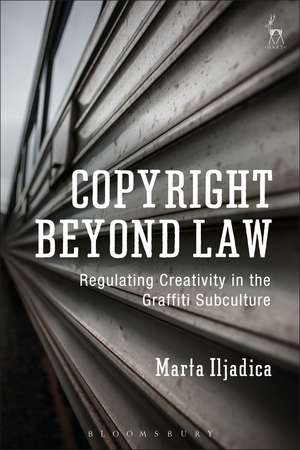
Copyright Beyond Law: Regulating Creativity in the Graffiti Subculture
Autor Marta Iljadicaen Limba Engleză Hardback – 17 noi 2016
The 'graffiti rules' and their copyright law parallels include: the requirement of writing letters (subject matter) and appropriate placement (public policy and morality exceptions for copyright subsistence and the enforcement of copyright), originality and the prohibition of copying (originality and infringement by reproduction), and the prohibition of damage to another writer's works (the moral right of integrity). The intersection between the 'graffiti rules' and copyright law sheds light on the creation of subculture-specific commons and the limits of copyright law in incentivising and regulating the production and location of creativity.
Preț: 617.02 lei
Preț vechi: 912.66 lei
-32%
Puncte Express: 926
Carte tipărită la comandă
Livrare economică 16-30 noiembrie
Livrare prin curier în România Termenul estimat este afișat lângă disponibilitate.
Transport gratuit pentru acest produs Plată online sau ramburs, în funcție de opțiunile comenzii.
Retur gratuit în 14 zile Comandă securizată și suport în română.
Specificații
ISBN-13: 9781849467773
ISBN-10: 1849467773
Pagini: 328
Dimensiuni: 156 x 234 x 30 mm
Greutate: 0.64 kg
Editura: Bloomsbury Publishing
Colecția Hart Publishing
Locul publicării:London, United Kingdom
ISBN-10: 1849467773
Pagini: 328
Dimensiuni: 156 x 234 x 30 mm
Greutate: 0.64 kg
Editura: Bloomsbury Publishing
Colecția Hart Publishing
Locul publicării:London, United Kingdom
V-ar putea interesa
-
 Principles of Lender LiabilityParker Hood-33%Preț: 2653.14 lei3952.53 lei
 -
 -14%Preț: 1673.37 lei1945.77 lei
 -
 Fixing U.S. International TaxationDaniel N. Shaviro-30%Preț: 503.73 lei720.90 lei
 -
 Standards of Investment ProtectionAugust Reinisch-28%Preț: 478.14 lei668.39 lei
 -
 Obama's BankMichael B. LikoskyPreț: 294.05 lei
 -
 Private-Sector Health Insurance: A PrimerStephen Maxwell Mathis-27%Preț: 1024.07 lei1396.15 lei
 -
 Cases and Materials on Marine Insurance LawSusan Hodges-18%Preț: 998.43 lei1217.60 lei
Cuprins
Panel I: Context
1. Graffiti History and Development
2. Copyright, Creativity and Commons
3. Methodology: Reflections on Fieldwork
Panel II: Form
4. Copyright-Subject Matter
5. Graffiti Rules-Write Letters, Choose Spots
Panel III: Copying
6. Copyright-Originality and Infringement
7. Graffiti Rules-Be Original, Don't Bite
Panel IV: Reputation
8. Moral Rights
9. Graffiti Rules-Don't Go Over
Panel V: Interactions
10. Graffiti Rules and Copyright Law
1. Graffiti History and Development
2. Copyright, Creativity and Commons
3. Methodology: Reflections on Fieldwork
Panel II: Form
4. Copyright-Subject Matter
5. Graffiti Rules-Write Letters, Choose Spots
Panel III: Copying
6. Copyright-Originality and Infringement
7. Graffiti Rules-Be Original, Don't Bite
Panel IV: Reputation
8. Moral Rights
9. Graffiti Rules-Don't Go Over
Panel V: Interactions
10. Graffiti Rules and Copyright Law
Recenzii
Copyright Beyond Law: Regulating Creativity in the Graffiti Subculture makes a strong contribution to the intellectual property scholarship by offering a highly illuminating and compulsively readable legal discussion that dares to move outside the boundaries of the law and ask what lessons we could learn from self-governed, outlaw communities compelled to forbear copyright protection
Copyright Beyond Law is the type of book I fantasise about writing. It combines empirical research with structured analysis to present a nuanced view of copyright, cultural norms and IP protection beyond IP rights, with just the right touch of interdisciplinarity. I would have really liked to see images of graffiti in the book, but the author is right to respect her understanding of their copyright. Copyright scholars, sociologists and lawyers involved in graffiti cases will find this book most useful.
All in all, Iljadica's book manages brilliantly to narrate how graffiti creativity works and is regulated from the inside.
Iljadica artfully weaves themes through the book, moving between empirical, historical, quasi-sociological, and doctrinal discussion in a way that rewards a linear reading...Iljadica's work provides much-needed comparative analysis with important implications for assessing the proper role and need for moral rights.
Copyright Beyond Law is the type of book I fantasise about writing. It combines empirical research with structured analysis to present a nuanced view of copyright, cultural norms and IP protection beyond IP rights, with just the right touch of interdisciplinarity. I would have really liked to see images of graffiti in the book, but the author is right to respect her understanding of their copyright. Copyright scholars, sociologists and lawyers involved in graffiti cases will find this book most useful.
All in all, Iljadica's book manages brilliantly to narrate how graffiti creativity works and is regulated from the inside.
Iljadica artfully weaves themes through the book, moving between empirical, historical, quasi-sociological, and doctrinal discussion in a way that rewards a linear reading...Iljadica's work provides much-needed comparative analysis with important implications for assessing the proper role and need for moral rights.