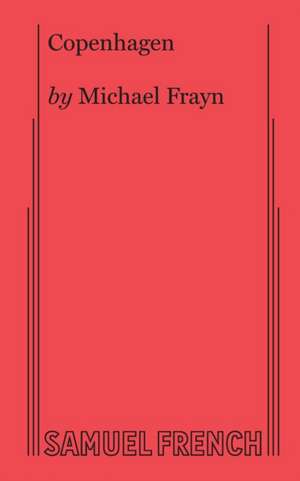
Copenhagen
Autor Michael Fraynen Limba Engleză Paperback – 30 noi 2010
| Toate formatele și edițiile | Preț | Express |
|---|---|---|
| Paperback (4) | 53.36 lei 3-5 săpt. | +42.06 lei 7-11 zile |
| Bloomsbury Publishing – 4 iun 1998 | 53.36 lei 3-5 săpt. | +42.06 lei 7-11 zile |
| Bloomsbury Publishing – 16 oct 2003 | 76.77 lei 3-5 săpt. | +29.48 lei 7-11 zile |
| Random House LLC US – aug 2000 | 88.06 lei 3-5 săpt. | +24.61 lei 7-11 zile |
| Samuel French, Inc. – 30 noi 2010 | 108.48 lei 3-5 săpt. |
Preț: 108.48 lei
Puncte Express: 163
Preț estimativ în valută:
19.21€ • 22.36$ • 16.68£
19.21€ • 22.36$ • 16.68£
Carte disponibilă
Livrare economică 03-17 februarie
Preluare comenzi: 021 569.72.76
Specificații
ISBN-13: 9780573627521
ISBN-10: 0573627525
Pagini: 138
Dimensiuni: 127 x 203 x 8 mm
Greutate: 0.18 kg
Editura: Samuel French, Inc.
ISBN-10: 0573627525
Pagini: 138
Dimensiuni: 127 x 203 x 8 mm
Greutate: 0.18 kg
Editura: Samuel French, Inc.
V-ar putea interesa
-
 A Short Introduction to Classical MythBarry B. PowellPreț: 94.87 lei
 -
 EdenEugene O'Brien-19%Preț: 80.49 lei98.92 lei
 -
 Lucky OnesCharlotte EilenbergPreț: 80.83 lei
 -
 Mappa MundiShelagh Stephenson-18%Preț: 80.93 lei99.19 lei
 -
 Through The LeavesVivis Anthony-19%Preț: 79.66 lei98.47 lei
 -
 Strictly DandiaMs Kristine Landon-Smith-28%Preț: 80.30 lei111.04 lei
 -
 Ghost CityGary Owen-18%Preț: 80.93 lei99.19 lei
 -
 Stone City BlueEd Thomas-18%Preț: 81.12 lei99.29 lei
 -
 BecketJean AnouilhPreț: 80.83 lei
 -
 Frayn, M: Matchbox TheatreMichael FraynPreț: 82.31 lei
 -
 Listen to ThisMichael FraynPreț: 88.68 lei
 -
 The Ugly OneMarius von Mayenburg-19%Preț: 80.40 lei98.88 lei
 -
 The Crimson Hotel and AudienceMichael Frayn-21%Preț: 80.80 lei102.26 lei
 -
 Where Is JusticeFrazier, MalikhaPreț: 139.34 lei
 -
 Geezer Gals Gone WildGipson, AnniePreț: 76.49 lei
 -
 Pinky SwearFord, GarretPreț: 88.88 lei
 -
 Eyes of PainJay AaronPreț: 94.55 lei
 -
 Faces in the CrowdFrier, BobPreț: 63.85 lei
 -
 FrankensteinCosca, PaulPreț: 63.91 lei
 -
 Getting MarriedGeorge Bernard ShawPreț: 54.87 lei
 -
 O'Flaherty V.CGeorge Bernard ShawPreț: 38.52 lei
Descriere
Descriere de la o altă ediție sau format:
In 1941 the German physicist Werner Heisenberg made a strange trip to Copenhagen to see his Danish counterpart, Niels Bohr. They were old friends and close colleagues, and they had revolutionised atomic physics in the 1920s with their work together on quantum mechanics and the uncertainty principle. But now the world had changed, and the two men were on opposite sides in a world war. The meeting was fraught with danger and embarrassment, and ended in disaster.
Why the German physicist Heisenberg went to Copenhagen in 1941 and what he wanted to say to the Danish physicist Bohr are questions which have exercised historians of nuclear physics ever since. In Michael Frayn's new play Heisenberg meets Bohr and his wife Margrethe once again to look for the answers, and to work out, just as they had once worked out the internal functioning of the atom, how we can ever know why we do what we do.
'Michael Frayn's tremendous play is a piece of history, an intellectual thriller, a psychological investigation and a moral tribunal in full session.' Sunday Times
In 1941 the German physicist Werner Heisenberg made a strange trip to Copenhagen to see his Danish counterpart, Niels Bohr. They were old friends and close colleagues, and they had revolutionised atomic physics in the 1920s with their work together on quantum mechanics and the uncertainty principle. But now the world had changed, and the two men were on opposite sides in a world war. The meeting was fraught with danger and embarrassment, and ended in disaster.
Why the German physicist Heisenberg went to Copenhagen in 1941 and what he wanted to say to the Danish physicist Bohr are questions which have exercised historians of nuclear physics ever since. In Michael Frayn's new play Heisenberg meets Bohr and his wife Margrethe once again to look for the answers, and to work out, just as they had once worked out the internal functioning of the atom, how we can ever know why we do what we do.
'Michael Frayn's tremendous play is a piece of history, an intellectual thriller, a psychological investigation and a moral tribunal in full session.' Sunday Times
Recenzii
"I think it's probably the best play about science ever written in English drama, because what it does is explicate science, the nuclear process, and relate it to a highly volatile emotional situation and more."
'It's [the] newborn sense of uncertainty - of strangeness, subjectivity and mystery at the heart of mathematics and science - that drives Michael Frayn's magnificent 1998 play Copenhagen.'
'Forget the physics. The greatest experiment in Michael Frayn's threehander is the dramatic form itself.'
'Michael Frayn is one of the great playwrights of our time.'
'It's [the] newborn sense of uncertainty - of strangeness, subjectivity and mystery at the heart of mathematics and science - that drives Michael Frayn's magnificent 1998 play Copenhagen.'
'Forget the physics. The greatest experiment in Michael Frayn's threehander is the dramatic form itself.'
'Michael Frayn is one of the great playwrights of our time.'