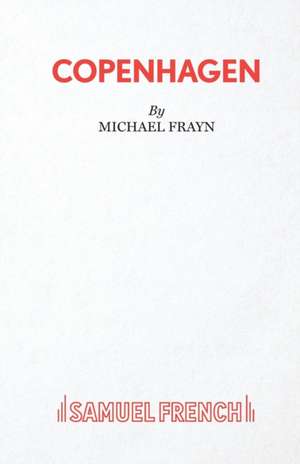
Copenhagen
Autor Michael Fraynen Limba Engleză Paperback – 16 ian 2020
Preț: 171.15 lei
Puncte Express: 257
Carte tipărită la comandă
Livrare economică 02-08 decembrie
Livrare prin curier în România Termenul estimat este afișat lângă disponibilitate.
Transport gratuit de la 400.00 lei Plată online sau ramburs, în funcție de opțiunile comenzii.
Retur gratuit în 14 zile Comandă securizată și suport în română.
Specificații
ISBN-13: 9780573132124
ISBN-10: 0573132127
Pagini: 154
Dimensiuni: 140 x 216 x 9 mm
Greutate: 0.2 kg
Editura: Samuel French Ltd
ISBN-10: 0573132127
Pagini: 154
Dimensiuni: 140 x 216 x 9 mm
Greutate: 0.2 kg
Editura: Samuel French Ltd
V-ar putea interesa
-
 A Short Introduction to Classical MythBarry B. PowellPreț: 94.87 lei
 -
 Physics and PhilosophyWerner HeisenbergPreț: 62.95 lei
 -
 -22%Preț: 157.14 lei202.12 lei
 -
 The Quantum Story: A history in 40 momentsJim Baggott-15%Preț: 101.48 lei119.68 lei
 -
 Niels Bohr: A Very Short IntroductionJ. L. Heilbron-19%Preț: 57.46 lei71.12 lei
 -
 The Einstein VendettaThomas HardingPreț: 163.86 lei
 -
 A Scandal in KönigsbergChristopher ClarkPreț: 156.53 lei
 -
 The Quantum UniverseBrian Cox-30%Preț: 64.77 lei92.86 lei
 -
 Thirty Years that Shook PhysicsGeorge Gamow-18%Preț: 108.30 lei132.42 lei
 -
 Physical Principles of the Quantum TheoryWerner Heisenberg-19%Preț: 64.04 lei78.92 lei
 -
 Rosencrantz and Guildenstern Are DeadTom StoppardPreț: 77.73 lei
 -
 SpiesMichael FraynPreț: 71.82 lei
 -
 Why Nobody Understands Quantum PhysicsCeline BroeckaertPreț: 160.03 lei
 -
 Preț: 207.35 lei
 -
 -21%Preț: 167.68 lei212.83 lei
 -
 Paradise RegainedJohn MiltonPreț: 144.24 lei
 -
 NucleusRory Clements-24%Preț: 60.56 lei80.06 lei
 -
 Crick: A Mind in Motion – from DNA to the BrainProfessor Matthew Cobb-16%Preț: 195.89 lei234.30 lei
 -
 The Rigor of AngelsWilliam EggintonPreț: 93.66 lei
 -
 Farm HallKatherine MoarPreț: 77.87 lei
 -
 Introducing Quantum TheoryJ. P. McEvoyPreț: 63.10 lei
 -
 -23%Preț: 727.04 lei944.20 lei
 -
 -23%Preț: 727.04 lei944.20 lei
 -
 Wolfram von EschenbachKarl Lachmann-23%Preț: 1560.54 lei2026.67 lei
 -
 Die ProsaikerFranz Hermann-23%Preț: 839.18 lei1089.84 lei
 -
 A Short Sketch of English LiteratureEl. Mann-23%Preț: 729.67 lei947.63 lei
 -
 Schulgrammatik der französischen SpracheE. Gerlach-23%Preț: 835.92 lei1085.61 lei
 -
 Der epische Cyclus oder die Homerischen Dichter, Teil 1F. G. Welcker-23%Preț: 904.49 lei1174.67 lei
 -
 Die romantische Schule in FrankreichGeorg Brandes-23%Preț: 904.49 lei1174.67 lei
 -
 Die Reaktion in FrankreichGeorg Brandes-23%Preț: 736.70 lei956.74 lei
Recenzii
"I think it's probably the best play about science ever written in English drama, because what it does is explicate science, the nuclear process, and relate it to a highly volatile emotional situation and more."
'It's [the] newborn sense of uncertainty - of strangeness, subjectivity and mystery at the heart of mathematics and science - that drives Michael Frayn's magnificent 1998 play Copenhagen.'
'Forget the physics. The greatest experiment in Michael Frayn's threehander is the dramatic form itself.'
'Michael Frayn is one of the great playwrights of our time.'
'It's [the] newborn sense of uncertainty - of strangeness, subjectivity and mystery at the heart of mathematics and science - that drives Michael Frayn's magnificent 1998 play Copenhagen.'
'Forget the physics. The greatest experiment in Michael Frayn's threehander is the dramatic form itself.'
'Michael Frayn is one of the great playwrights of our time.'
Descriere
Descriere de la o altă ediție sau format:
'Michael Frayn's tremendous play is a piece of history, an intellectual thriller, a psychological investigation and a moral tribunal in full session.' Sunday Times
In 1941 the German physicist Werner Heisenberg made a strange trip to Copenhagen to see his Danish counterpart, Niels Bohr. They were old friends and close colleagues, and they had revolutionised atomic physics in the 1920s with their work together on quantum mechanics and the uncertainty principle. But now the world had changed, and the two men were on opposite sides in a world war. The meeting was fraught with danger and embarrassment, and ended in disaster.
Why the German physicist Heisenberg went to Copenhagen in 1941 and what he wanted to say to the Danish physicist Bohr are questions which have exercised historians of nuclear physics ever since. In Michael Frayn's new play Heisenberg meets Bohr and his wife Margrethe once again to look for the answers, and to work out, just as they had once worked out the internal functioning of the atom, how we can ever know why we do what we do.
'Michael Frayn's tremendous play is a piece of history, an intellectual thriller, a psychological investigation and a moral tribunal in full session.' Sunday Times
In 1941 the German physicist Werner Heisenberg made a strange trip to Copenhagen to see his Danish counterpart, Niels Bohr. They were old friends and close colleagues, and they had revolutionised atomic physics in the 1920s with their work together on quantum mechanics and the uncertainty principle. But now the world had changed, and the two men were on opposite sides in a world war. The meeting was fraught with danger and embarrassment, and ended in disaster.
Why the German physicist Heisenberg went to Copenhagen in 1941 and what he wanted to say to the Danish physicist Bohr are questions which have exercised historians of nuclear physics ever since. In Michael Frayn's new play Heisenberg meets Bohr and his wife Margrethe once again to look for the answers, and to work out, just as they had once worked out the internal functioning of the atom, how we can ever know why we do what we do.
Notă biografică
Michael Frayn was born in London in 1933 and began his career as a journalist on the Guardian and the Observer. He has written seventeen plays, including Noises Off, Copenhagen, and Democracy, translated Chekhov's last four plays, and adapted his first as Wild Honey. His screenplays include Clockwise, starring John Cleese, and among his eleven novels are The Tin Men, Towards the End of the Morning, Headlong, Spies, and Skios. Collections of articles include Collected Columns, Stage Directions, and Travels with a Typewriter. He has also published two philosophical works, Constructions and The Human Touch, and a memoir, My Father's Fortune. His most recent publications are three collections of short entertainments, Matchbox Theatre, Pocket Playhouse, and Magic Mobile. He is married to the writer Claire Tomalin.