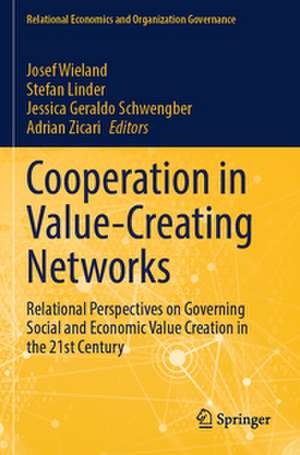
Cooperation in Value-Creating Networks
Editat de Josef Wieland, Stefan Linder, Jessica Geraldo Schwengber, Adrian Zicarien Limba Engleză Paperback – mar 2025
Preț: 847.73 lei
Preț vechi: 1115.44 lei
-24%
Puncte Express: 1272
Carte tipărită la comandă
Livrare economică 05-12 octombrie
Livrare prin curier în România Termenul estimat este afișat lângă disponibilitate.
Transport gratuit pentru acest produs Plată online sau ramburs, în funcție de opțiunile comenzii.
Retur gratuit în 14 zile Comandă securizată și suport în română.
Specificații
ISBN-13: 9783031507205
ISBN-10: 3031507207
Pagini: 264
Dimensiuni: 155 x 235 x 15 mm
Greutate: 0.41 kg
Editura: Springer
ISBN-10: 3031507207
Pagini: 264
Dimensiuni: 155 x 235 x 15 mm
Greutate: 0.41 kg
Editura: Springer
Cuprins
Part I. Global Value Networks & Polycentricity.- Chapter 1. Resilience and innovation in regio-global value networks - conception and de-sign (Josef Wieland).- Chapter 2. The new ethical values of the relational market economy: Value change in the private business world and the movement towards sustainable development goals in business and economics (Jacob Dahl Rendtorff).- Chapter 3. Environmental Disclosure in Italian SMEs: A Theory of Planned Behaviour Approach (Edoardo Crocco).- Chapter 4. Comparing Classifications of inter-organizational Relationships and inter-organizational Networks (Lucio Biggiero).- Part II. Relational Leadership & Management.- Chapter 5. Cultural Complexity and Relational Leadership (Derick de Jongh).- Chapter 6. Values and Cultural Risk Management Through Transcultural Learning. The Cases of the EU, Chinese BRI and ASEAN (Josef Wieland).- Chapter 7. Constructing the Capacity for Viable Multicultural Organizations (Milton J. Bennett).- Part III. Relational Philosophy & Economic Thought.- Chapter 8. Relationizing Normative Economics: Some Insights from Africa (Thaddeus Metz).- Chapter 9. Value Dimensions of the Transaction (Michael Schramm).- Chapter 10. The Markets of Truth (Jan Söffner).- Chapter 11. Relationality in Aristotle's Economy (Birger P. Priddat)
Notă biografică
Josef Wieland is a Professor of Institutional Economics, Organizational Governance, Integrity Management, and Transcultural Leadership at Zeppelin University in Friedrichshafen (Germany) and Director of the Leadership Excellence Institute Zeppelin (LEIZ). His research focuses on Relational Economics & Corporate Governance, Values & Strategic Stakeholder Management, Leadership & Cultural Complexity.
Stefan Linder is a Professor and Co-Head of the Accounting and Management Control Department at ESSEC Business School in Paris (France). He studies the relations among management control, entrepreneurship, and well-being and has published, among others, in the European Accounting Review, Journal of Business Ethics, and Journal of Management.
Jessica Geraldo Schwengber is a post-doc researcher and lecturer at the chair of Institutional Economics and Transcultural Leadership at Zeppelin University (Germany) and project manager of the Transcultural Caravan at leadership Excellence Institute Zeppelin (LEIZ). Her research focuses on organizational and transcultural learning, organization theory and relational economic, inter alia.
Adrián Zicari is a Teaching Professor in the Accounting and Management Control Department at ESSEC Business School in Paris (France). His research interests include measurement systems in sustainability. His work appears in several academic journals: Journal of Business Ethics, Journal of Cleaner Production, and Social and Environmental Accountability Journal.
Stefan Linder is a Professor and Co-Head of the Accounting and Management Control Department at ESSEC Business School in Paris (France). He studies the relations among management control, entrepreneurship, and well-being and has published, among others, in the European Accounting Review, Journal of Business Ethics, and Journal of Management.
Jessica Geraldo Schwengber is a post-doc researcher and lecturer at the chair of Institutional Economics and Transcultural Leadership at Zeppelin University (Germany) and project manager of the Transcultural Caravan at leadership Excellence Institute Zeppelin (LEIZ). Her research focuses on organizational and transcultural learning, organization theory and relational economic, inter alia.
Adrián Zicari is a Teaching Professor in the Accounting and Management Control Department at ESSEC Business School in Paris (France). His research interests include measurement systems in sustainability. His work appears in several academic journals: Journal of Business Ethics, Journal of Cleaner Production, and Social and Environmental Accountability Journal.
Textul de pe ultima copertă
This volume embarks on a research journey that focuses on the processes of economic and social value creation in the 21st century. Given that value creation is increasingly organized in networks consisting of businesses, governments, academia, civil society, and other societal stakeholders, the contributions address various aspects of and challenges in governing cooperation in value-creating networks. Exploring topics such as relational rationality, cultural complexity, shared value creation, and relational contracts, this book reveals the mechanisms and processes involved in governing the complexities of inter-sectoral relationships in a networked society. Given its scope and focus, this book will appeal to scholars of economics, economic sociology, organizational studies, and related fields.
Caracteristici
Offers new insights into the complexities of inter-sectoral relationships in a networked society Explores topics such as relational rationality, cultural complexity, and relational contracts Highlights the complexities of inter-sectoral relationships in a networked society