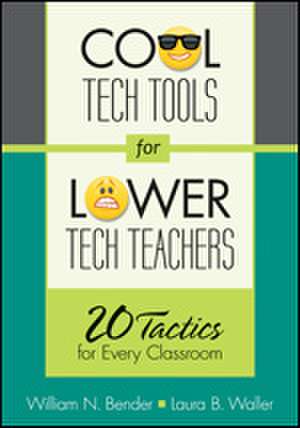
Cool Tech Tools for Lower Tech Teachers: 20 Tactics for Every Classroom
Autor William N. Bender, Laura B. Walleren Limba Engleză Paperback – 27 noi 2012
William Bender and Laura Waller put technology within your reach by:
Framing each tool in the context of what you need to know
Defining the tool in easy-to-understand language; there's no tech-speak
Guiding you through implementation step by step
Providing sample lesson plans to get you started
Explaining how some tools can also be used for professional development
With Cool Tech Tools for Lower Tech Teachers, Bender and Waller prove that technology can be painless and productive. What's more, you'll even come to love it!
Preț: 275.24 lei
Carte tipărită la comandă
Livrare economică 06-20 octombrie
Specificații
ISBN-10: 1452235538
Pagini: 248
Ilustrații: Illustrations
Dimensiuni: 178 x 254 x 15 mm
Greutate: 0.5 kg
Ediția:1
Editura: SAGE Publications
Colecția Corwin
Locul publicării:Thousand Oaks, United States
V-ar putea interesa
-
 Design for How People LearnJulie DirksenPreț: 260.26 lei
 -
 Preț: 103.37 lei
 -
 Language and Literacy in Science EducationJerry Wellington-30%Preț: 179.99 lei255.42 lei
 -
 Meaning Making in Secondary Science ClassroomsEduardo Mortimer-27%Preț: 198.43 lei272.47 lei
 -
 Technology Leadership for School ImprovementRosemary Papa-23%Preț: 975.12 lei1266.40 lei
 -
 Empowering Students With TechnologyAlan NovemberPreț: 234.78 lei
 -
 Teaching Digital Natives: Partnering for Real LearningMarc R. PrenskyPreț: 288.00 lei
 -
 Preț: 300.31 lei
 -
 Digital Learning for All, NowJonathan P. Costa Sr.Preț: 283.15 lei
 -
 Apps for LearningHarry J. DickensPreț: 203.03 lei
 -
 Worlds of MakingLaura FlemingPreț: 84.53 lei
 -
 -25%Preț: 179.65 lei240.78 lei
Recenzii
"This is one of the most important tools that today’s teachers could have in their toolbox. There are great descriptions of the tools, and excellent ideas about how to easily put them to work."
"This book provides a wealth of ideas for teachers who would like to use technology but do not know where to begin. Each chapter provides a lens into specific categories of use and websites associated with the use. An encyclopedia of practical tools for the low-tech classroom!"
"Cool Tech Tools for the Lower-Tech Teacher is a great manual for all educators. Each of us can benefit from adding new technology tools in our classrooms, which speak to the instructional variety that our digital learners come to our classrooms with each day.
Our digital revolution is now, this book should be one of your tools as you set about designing a creative, collaborative, social and self-directed classroom! "
"Every educator interested in bringing their classroom into the 21st century should get this book. It not only tells what the new technology is and how to use it, but it creates an invaluable vision for the future of education in which students are not only consumers of information but creators. This resource could help revolutionize education as we know it, if every teacher implemented the tech tools in this book!"
"This is a much needed, delightful, inviting, tech plain speak compendium of cool tech, Common Core tools, any teacher can infuse using the steps and differentiating strategies suggested by the authors. This demystifies cool tech tools for the non techie teacher."
Cuprins
About the Authors
Introduction
Part I. Four Tools to Start With
Tech Tool 1: Web Access, Laptops, Mobile Devices
Tech Tool 2: Webquests
Tech Tool 3: Blogs
Tech Tool 4: Wikis
Part II. Tools for Student Engagement and Empowerment
Tech Tool 5: Cloud Computing
Tech Tool 6: The Flipped Classroom and Khan Academy
Tech Tool 7: Wiffiti
Tech Tool 8: Jing
Tech Tool 9: Gaming, ARGs, and Virtual World Instruction
Tech Tool 10: Diigo
Part III. Tech Tools for Student Creation and Collaboration
Tech Tool 11: Glogs
Tech Tool 12: Podcasts
Tech Tool 13: Scribd
Tech Tool 14: Comic Life
Tech Tool 15: Google Apps
Tech Tool 16: Vokis, Avatars, and Animation!
Tech Tool 17: Vlogs
Tech Tool 18: Animoto
Part IV. Tools for Social Learning and Networking
Tech Tool 19: Facebook
Tech Tool 20: Twitter
Part V. The Teaching Revolution and a Brave New World for the 21st Century
Index
Notă biografică
William N. Bender, PhD, has had a long and distinguished career in education, teaching in public school for several years and in higher education for some 26 years at Blue?eld State College in West Virginia, Rutgers University in New Jersey, and the University of Georgia. He has written 36 books in special and general education. With his retirement, he has stepped back from his rigorous workshop schedule, which as recently as 2016 included some 40 workshop days per year. While the COVID-19 pandemic impacted his work, he has written four historical ?ction novels and several educational books in recent years. He has delivered several professional development projects, including most recently a keynote for a virtual conference on project-based learning in Brazil in conjunction with his Corwin book Project-Based Learning (2012).