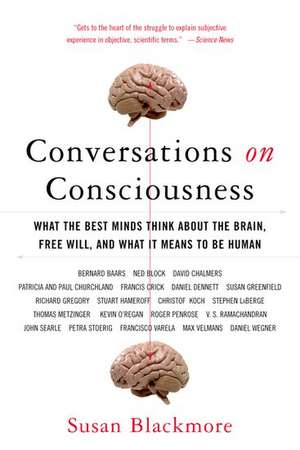
Conversations on Consciousness
Autor Susan Blackmoreen Limba Engleză Paperback – 8 ian 2007
Notăm cu interes cum Conversations on Consciousness reușește să transforme dilemele teoretice ale minții în aplicații practice pentru înțelegerea condiției umane. Structura volumului nu este una academică rigidă, ci se bazează pe o serie de douăzeci de dialoguri vii, purtate de Susan Blackmore cu unii dintre cei mai influenți gânditori ai secolului XXI. Această abordare oferă cititorului acces direct la laboratorul de idei al unor experți care încearcă să explice cum procesele fizice din creier generează experiența subiectivă. Putem afirma că valoarea pedagogică a cărții rezidă în capacitatea de a prezenta perspective divergente asupra unor concepte complexe precum liberul arbitru, existența „zombiilor” filosofici sau impactul meditației asupra conștiinței. Merită menționat că textul include un glosar extensiv și o introducere riguroasă, instrumente esențiale pentru navigarea unui domeniu aflat la intersecția dintre biologie și filosofie. Cartea reprezintă o alternativă dinamică la Philosophers on Consciousness pentru cursurile de neuroștiințe cognitive sau filosofia minții, având avantajul unui stil colocvial care dezvăluie personalitatea cercetătorilor, nu doar teoriile lor. În contextul operei sale, Susan Blackmore continuă aici explorarea mecanismelor replicării ideilor începută în The Meme Machine, însă mută accentul de la unitatea de informație (mema) către observatorul conștient. Rezultatul este o radiografie autentică a modului în care știința contemporană se confruntă cu „marea problemă” a existenței.
Preț: 126.21 lei
Carte disponibilă
Livrare economică 13-27 noiembrie
Specificații
ISBN-10: 0195179595
Pagini: 288
Dimensiuni: 141 x 216 x 27 mm
Greutate: 0.38 kg
Editura: Oxford University Press
V-ar putea interesa
-
 ConsciousAnnaka HarrisPreț: 122.68 lei
 -
 Consciousness ExplainedDaniel C. Dennett-28%Preț: 78.82 lei108.76 lei
 -
 A Day in the Life of the Brain: The Neuroscience of Consciousness from Dawn Till DuskBaroness Susan Greenfield-19%Preț: 75.30 lei93.07 lei
 -
 Think: A Compelling Introduction to PhilosophySimon Blackburn-18%Preț: 76.99 lei93.80 lei
 -
 What Is It Like to Be a Bat?Thomas Nagel-15%Preț: 88.51 lei104.65 lei
 -
 Consciousness: A Very Short IntroductionSusan Blackmore-19%Preț: 57.43 lei71.28 lei
 -
 The Mind's I: Fantasies And Reflections On Self & SoulDaniel DennettPreț: 204.66 lei
 -
 Making SenseSam Harris-17%Preț: 66.54 lei80.43 lei
 -
 Being YouAnil SethPreț: 93.51 lei
 -
 Consciousness: An IntroductionSusan Blackmore-8%Preț: 455.64 lei495.27 lei
 -
 -27%Preț: 67.74 lei92.76 lei
 -
 -23%Preț: 80.93 lei104.94 lei
 -
 The Essential Book of ConsciousnessAnne RooneyPreț: 92.97 lei
 -
 -27%Preț: 56.19 lei77.40 lei
 -
 One Hand ClappingNikolay KukushkinPreț: 159.17 lei
 -
 ConsciousnessJohn ParringtonPreț: 78.52 lei
 -
 The Man Who Mapped ConsciousnessDavid R. Hawkins-19%Preț: 86.76 lei107.24 lei
 -
 Introducing ConsciousnessDavid PapineauPreț: 63.53 lei
 -
 -62%Preț: 55.24 lei144.06 lei
 -
 -25%Preț: 90.43 lei121.08 lei
De ce să citești această carte
Această lucrare este esențială pentru studenții și pasionații de neuroștiințe care doresc să înțeleagă miza dezbaterilor actuale despre minte. Dincolo de rigoarea științifică, cititorul câștigă o perspectivă clară asupra modului în care gândesc liderii domeniului, totul într-un format accesibil. Glosarul inclus și introducerea clară fac din acest volum un punct de plecare ideal pentru oricine vrea să exploreze legătura dintre creier și experiența conștientă.
Despre autor
Susan Blackmore este scriitoare independentă, conferențiar și realizatoare de emisiuni, deținând titlul de Visiting Lecturer la University of the West of England, Bristol. Interesele sale de cercetare sunt vaste, acoperind teoria memeticii, evoluționismul, conștiința și practica meditației. Este cunoscută la nivel internațional pentru lucrarea sa The Meme Machine, unde dezvoltă conceptul de „memă” introdus de Richard Dawkins. Cu peste șaptezeci de articole academice publicate, Blackmore este o voce respectată care reușește să pună în dialog rigoarea științifică cu întrebările fundamentale ale filosofiei existențiale.
Notă biografică
Recenzii
Descriere scurtă
Paired with an introduction and extensive glossary that provide helpful background information, these provocative conversations illuminate how some of the greatest minds tackle some of the most difficult questions about human nature.
Descriere
Conversations on Consciousness is just that - a series of twenty lively and challenging conversations between Sue Blackmore and some of the world's leading philosophers and scientists. Written in a colloquial and engaging style the book records the conversations Sue had when she met these influential thinkers, whether at conferences in Arizona or Antwerp, or in their labs or homes in Oxford or San Diego. The conversations bring out their very different personalities and styles and reveal a wealth of fascinating detail about their theories and beliefs. Why is consciousness such a special and difficult issue for twenty-first century science? Sue, herself a researcher into this controversial and difficult topic, begins by asking each of her colleagues this simple question and is immediately plunged into the depths of the debate: How do the subjective experiences we call consciousness arise from the physical brain? Is this even the right question to ask? Can zombies - people who behave outwardly just like others but have no inner mental life - exist? What can dreams tell us about consciousness? Should we all be learning to meditate? Do we have free will, and if not is it possible to live without it? With an introduction setting out the broad structure of the debate on consciousness, and an extensive glossary, this book provides an engaging and accessible account of the most challenging problem of all, through the words of some of the leading figures involved in seeking to solve it.