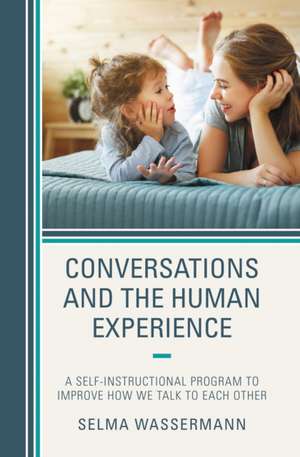
Conversations and the Human Experience: A Self-Instructional Program to Improve How We Talk to Each Other
Autor Selma Wassermannen Limba Engleză Hardback – 27 aug 2022
The materials in the book provide readers with opportunities to examine and reflect on the relationship between human interactions and the development of positive human relationships, specifically how conversations work to enable positive relationships or diminish them.
These include being able to "tune in" to what the other person is saying, freeing oneself from the need to judge, being respectful, and having a clear and non-defensive idea of what is coming out of one's mouth.
The materials in the book also provide a self-instructional program to develop one's skills in using human interactions that build more positive relationships.
Preț: 364.32 lei
Preț vechi: 460.27 lei
-21%
Puncte Express: 546
Carte tipărită la comandă
Livrare economică 07-21 decembrie
Livrare prin curier în România Termenul estimat este afișat lângă disponibilitate.
Transport gratuit de la 400.00 lei Plată online sau ramburs, în funcție de opțiunile comenzii.
Retur gratuit în 14 zile Comandă securizată și suport în română.
Specificații
ISBN-13: 9781475867534
ISBN-10: 1475867530
Pagini: 112
Dimensiuni: 140 x 218 x 14 mm
Greutate: 0.29 kg
Editura: Bloomsbury Publishing
Colecția Rowman & Littlefield
Locul publicării:New York, United States
ISBN-10: 1475867530
Pagini: 112
Dimensiuni: 140 x 218 x 14 mm
Greutate: 0.29 kg
Editura: Bloomsbury Publishing
Colecția Rowman & Littlefield
Locul publicării:New York, United States
Cuprins
Preface
Acknowledgements
Introduction
What's the good of it? (It's not about the cheese)
How the book is organized
Part One:The Essential Components of Effective Human Interactions
Chapter 1: Listening: "tuning in"
Key conditions in active listening
Developing active listening skills
Chapter 2: Responding
The overarching condition of respect
Selecting appropriate responses
Paraphrasing
End notes
One final word
Chapter 3: The art of the question
Questions that should be avoided
More productive questions
Turning questions into statements of inquiry
The well-orchestrated discussion
Conclusion
Chapter 4: Once more with feeling
Conclusion
Chapter 5: Caveats: When the divide is too great
Part Two
Chapter 6: Introduction to the skill development materials
Chapter 7: Introduction to facilitative interactions: Task 1
Studying the conversations
Thinking about conversations #1
Thinking about conversation #2
Thinking about conversation #3
Thinking about conversation #4
Reflecting on interpersonal facilitative responding
Conclusion
Figure 1: Analyzing Responses in Human Discourse
Chapter 8: Practice in choosing appropriate responses
Practice task
Self-evaluation of your responses
Conclusion
Chapter 9: Practice in attending and responding with respect (encore)
Task
Self-evaluation of your responses
Conclusion
Chapter 10: Creating your own scenario
Self-evaluation of your conversation
Conclusion
Chapter 11: One-on one practice in attending and responding with respect (A)
Pre-conditions
Task
Conclusion
Chapter 12: One-on-one practice in attending and responding with respect (B)
Points to remember in interpersonal discussions
Pre-conditions
Task
Conclusion
Chapter 13: Practice in attending and responding (Encore)
Conclusion
Chapter 14: Using effective interpersonal skills in real situations
Chapter 15: Last Words
Just one more thing
Bibliography
Acknowledgements
Introduction
What's the good of it? (It's not about the cheese)
How the book is organized
Part One:The Essential Components of Effective Human Interactions
Chapter 1: Listening: "tuning in"
Key conditions in active listening
Developing active listening skills
Chapter 2: Responding
The overarching condition of respect
Selecting appropriate responses
Paraphrasing
End notes
One final word
Chapter 3: The art of the question
Questions that should be avoided
More productive questions
Turning questions into statements of inquiry
The well-orchestrated discussion
Conclusion
Chapter 4: Once more with feeling
Conclusion
Chapter 5: Caveats: When the divide is too great
Part Two
Chapter 6: Introduction to the skill development materials
Chapter 7: Introduction to facilitative interactions: Task 1
Studying the conversations
Thinking about conversations #1
Thinking about conversation #2
Thinking about conversation #3
Thinking about conversation #4
Reflecting on interpersonal facilitative responding
Conclusion
Figure 1: Analyzing Responses in Human Discourse
Chapter 8: Practice in choosing appropriate responses
Practice task
Self-evaluation of your responses
Conclusion
Chapter 9: Practice in attending and responding with respect (encore)
Task
Self-evaluation of your responses
Conclusion
Chapter 10: Creating your own scenario
Self-evaluation of your conversation
Conclusion
Chapter 11: One-on one practice in attending and responding with respect (A)
Pre-conditions
Task
Conclusion
Chapter 12: One-on-one practice in attending and responding with respect (B)
Points to remember in interpersonal discussions
Pre-conditions
Task
Conclusion
Chapter 13: Practice in attending and responding (Encore)
Conclusion
Chapter 14: Using effective interpersonal skills in real situations
Chapter 15: Last Words
Just one more thing
Bibliography
Recenzii
I wish that my parents, my teachers, supervisors, and even many of my colleagues had read this book before I entered kindergarten and the work place. I also wish that I had read it and learned its lessons before I became a parent, before I entered high school and university. I would have been a better parent, student, supervisor, and colleague.
The four pillars of the language arts are reading, writing, speaking, and listening. While the last two are most frequently employed, they are the most neglected in the curriculum of our schools where the emphasis is on reading and writing. With her new book, Conversations, Selma Wassermann brings the spotlight back on speaking and listening with a program to raise awareness of the ways we talk to each other with activities for their improvement. Words have the power to hurt or help. Wassermann shows us how to make them help.
Renowned author Selma Wassermann is once again at the forefront! Conversations brings to professionals and new learners in education, counselling, and associated human services domains, a most contemporary roadmap for consolidating and advancing those effective interpersonal interactions found at the heart of all conversations. Based on the most powerful of human relations research and practice, it will not only enrich the work of the most seasoned counsellors and teachers, as well as parents and other adults, but also inspire and guide all who embrace the mission of helping others.
Conversations' is an invitation to re-examine how we speak and listen to one another, especially in difficult times. Working through the exercises was eye-opening! They helped me to reflect on my own communication skills, and gave me concrete steps for improving. Selma's wisdom shared here will undoubtedly impact my interactions with students, colleagues, and my own family.
Almost fifty years ago I was given the opportunity to learn the skills presented in this book in a course masterfully designed and taught by Dr. Selma Wassermann. It was the last semester of my teacher education program. I remember working very hard to absorb and integrate the skills taught in that course. The skills I learned by following almost exactly the steps described in this book, have stood me in good stead throughout my career and my life. This book was a reminder to me of the importance of attending and responding in thoughtful, caring, and respectful ways. It was like receiving a gift for second time, all the more precious for having had the experience of trying to live what was once learned. If you believe that listening and responding respectfully are powerful tools to build and maintain positive relationships, and if you do the work prescribed in this book, you will NEVER be sorry.
The four pillars of the language arts are reading, writing, speaking, and listening. While the last two are most frequently employed, they are the most neglected in the curriculum of our schools where the emphasis is on reading and writing. With her new book, Conversations, Selma Wassermann brings the spotlight back on speaking and listening with a program to raise awareness of the ways we talk to each other with activities for their improvement. Words have the power to hurt or help. Wassermann shows us how to make them help.
Renowned author Selma Wassermann is once again at the forefront! Conversations brings to professionals and new learners in education, counselling, and associated human services domains, a most contemporary roadmap for consolidating and advancing those effective interpersonal interactions found at the heart of all conversations. Based on the most powerful of human relations research and practice, it will not only enrich the work of the most seasoned counsellors and teachers, as well as parents and other adults, but also inspire and guide all who embrace the mission of helping others.
Conversations' is an invitation to re-examine how we speak and listen to one another, especially in difficult times. Working through the exercises was eye-opening! They helped me to reflect on my own communication skills, and gave me concrete steps for improving. Selma's wisdom shared here will undoubtedly impact my interactions with students, colleagues, and my own family.
Almost fifty years ago I was given the opportunity to learn the skills presented in this book in a course masterfully designed and taught by Dr. Selma Wassermann. It was the last semester of my teacher education program. I remember working very hard to absorb and integrate the skills taught in that course. The skills I learned by following almost exactly the steps described in this book, have stood me in good stead throughout my career and my life. This book was a reminder to me of the importance of attending and responding in thoughtful, caring, and respectful ways. It was like receiving a gift for second time, all the more precious for having had the experience of trying to live what was once learned. If you believe that listening and responding respectfully are powerful tools to build and maintain positive relationships, and if you do the work prescribed in this book, you will NEVER be sorry.