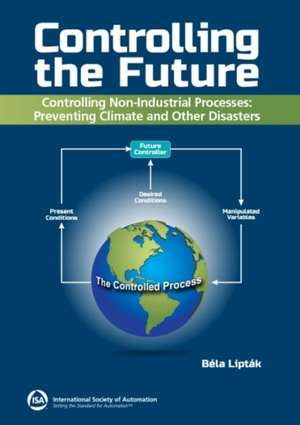
Controlling the Future - Controlling Nonindustrial Processes
Autor Béla Liptáken Limba Engleză Hardback – 26 iul 2023
To control a process, we must fully understand it. Global warming is analyzed here as a heat balance process in which Earth is warmed by the Sun and cooled by outer space. For a million years these heat flows were in balance, but burning fossil fuels has upset the radiative equilibrium as combustion products accumulated in the atmosphere.
The process-control-based analysis shows that Earth's heating should be reduced and its cooling increased, yet the opposite is occurring: Earth's temperature is rising faster than ever before, and the greenhouse effect that blocks some of Earth's radiation from escaping into outer space is larger than any time in centuries. The analysis also shows that global warming will accelerate when the tipping points of the gigantic feedback loops (ocean degassing, ice cover melting, permafrost methane release, clouding increase, etc.) are triggered.
Using the well-established process control principles, Lipták evaluates the time constants and inertias and determines the dynamic characteristics of the global warming process, identifies the subprocesses that sustain or escalate warming, and ultimately determines not only what needs to be done, but also describes the technology and infrastructure needed to do it.
While the book describes the consequences of this out-of-control global warming process, it also describes the role artificial intelligence can play in stopping it. In addition, the book provides the timeframe-based on the actual gains and inertias of this process-for converting today's energy economy into a safe, free, and inexhaustible one by 2050.
Today mankind is at a crossroad! One sign at this fork reads "Trust Science." This sign shows the direction towards protecting the only home we have and caring about the future of our children. We must shake off complacency, stop living in delusion, and do what needs to be done to protect the planet. The other sign reads "It's a Hoax!" We must not find out where this second road leads, because the threat is the size of life itself.
Preț: 857.10 lei
Preț vechi: 1113.11 lei
-23%
Puncte Express: 1286
Carte disponibilă
Livrare economică 13-27 noiembrie
Livrare express 30 octombrie-05 noiembrie pentru 58.08 lei
Livrare prin curier în România Termenul estimat este afișat lângă disponibilitate.
Transport gratuit pentru acest produs Plată online sau ramburs, în funcție de opțiunile comenzii.
Retur gratuit în 14 zile Comandă securizată și suport în română.
Specificații
ISBN-13: 9781643311425
ISBN-10: 1643311425
Pagini: 532
Dimensiuni: 185 x 263 x 36 mm
Greutate: 1.16 kg
Editura: Wiley
ISBN-10: 1643311425
Pagini: 532
Dimensiuni: 185 x 263 x 36 mm
Greutate: 1.16 kg
Editura: Wiley
V-ar putea interesa
-
 -30%Preț: 848.36 lei1215.04 lei
 -
 The Ecological Constitution: Reframing Environmental LawLynda Collins-15%Preț: 428.02 lei503.55 lei
 -
 Preț: 361.56 lei
 -
 -18%Preț: 1107.84 lei1351.03 lei
 -
 -15%Preț: 431.85 lei508.05 lei
 -
 Effective Forms of Environmental DiplomacyLeila NicolasPreț: 468.53 lei
 -
 Asian Mobilities Consumption in a Changing ArcticYoung-Sook Lee-18%Preț: 1117.60 lei1362.94 lei
 -
 Preț: 370.76 lei
 -
 True Cost Accounting for Food: Balancing the ScaleBarbara Gemmill-Herren-18%Preț: 1118.30 lei1363.78 lei
 -
 -15%Preț: 433.54 lei510.05 lei
 -
 -15%Preț: 443.90 lei522.23 lei
 -
 -18%Preț: 1112.48 lei1356.68 lei
 -
 -15%Preț: 447.52 lei526.50 lei
 -
 -15%Preț: 428.02 lei503.55 lei
 -
 International Environmental Law Compliance in Context: Mechanisms and Case StudiesBelen Olmos Giupponi-18%Preț: 1124.57 lei1371.44 lei
 -
 -18%Preț: 1113.77 lei1358.26 lei
 -
 Control and Treatment of Landfill Leachate for Sanitary Waste DisposalHamidi Abdul Aziz-18%Preț: 1296.50 lei1581.10 lei
 -
 An Introduction to Incinerator Emissions and PermittingJ. Paul GuyerPreț: 106.52 lei
 -
 Ecomobilities: Driving the Anthropocene in Popular CinemaMichael W. Pesses-33%Preț: 514.88 lei767.13 lei
 -
 Storm Water Pollution Prevention Plan Risk ManagementCpesc Mike L. Peters QsdPreț: 92.29 lei
 -
 An Introduction to Disposal of Hazardous SoilJ. Paul GuyerPreț: 169.34 lei
 -
 An Introduction to Oily Wastewater SludgeJ. Paul GuyerPreț: 169.34 lei
 -
 Air Quality HandbookBernie Goldman-18%Preț: 682.87 lei832.77 lei
 -
 Encyclopedia of Air PollutionRaven Brennan-18%Preț: 732.77 lei893.62 lei
 -
 Modelling and Control of Air PollutionRaven Brennan-15%Preț: 630.80 lei742.12 lei
Notă biografică
Béla Lipták was born in 1936 in Hungary. As a Technical University student, he participated in the revolution against the Soviet occupation. He escaped and entered the United States as a refugee in 1956. In 1959, he received an engineering degree from Stevens Institute of Technology; he received a master's degree from the City College of New York in 1962; and later, he did graduate work at Pratt Institute.
In 1960, he became the chief instrument engineer at Crawford and Russell, where he led the automation of dozens of industrial plants for more than a decade. In 1969, he published the multivolume Instrument and Automation Engineers' Handbook, which is currently in its fifth edition. In 1975, he received his professional engineering license and founded a consulting firm named Béla Lipták Associates PC, which provides design and consulting services in the fields of energy-related automation and industrial safety. Over the years, he lectured at many universities around the world, including Yale University, where he was an adjunct professor in 1987.
Béla Lipták published more than 300 technical articles on climate change, global warming, and the automation of the new infrastructure they require (www.controlglobal.com/voices/liptak.html), as well as more than 20 books on various aspects of automation, safety, and energy technology.
In 1973, he was elected a Fellow of the International Society of Automation (ISA); in 1995, he received ISA's Technical Achievement Award; and in 2001, he was inducted into Control magazine's Process Automation Hall of Fame. He was also the keynote speaker at many domestic and overseas conventions.
In 1960, he became the chief instrument engineer at Crawford and Russell, where he led the automation of dozens of industrial plants for more than a decade. In 1969, he published the multivolume Instrument and Automation Engineers' Handbook, which is currently in its fifth edition. In 1975, he received his professional engineering license and founded a consulting firm named Béla Lipták Associates PC, which provides design and consulting services in the fields of energy-related automation and industrial safety. Over the years, he lectured at many universities around the world, including Yale University, where he was an adjunct professor in 1987.
Béla Lipták published more than 300 technical articles on climate change, global warming, and the automation of the new infrastructure they require (www.controlglobal.com/voices/liptak.html), as well as more than 20 books on various aspects of automation, safety, and energy technology.
In 1973, he was elected a Fellow of the International Society of Automation (ISA); in 1995, he received ISA's Technical Achievement Award; and in 2001, he was inducted into Control magazine's Process Automation Hall of Fame. He was also the keynote speaker at many domestic and overseas conventions.
Cuprins
About the Author
Introduction
1. Controlling AI
1.1 Adapting to an Artificial Environment
1.2 Neural Networks
1.3 AI in Cybersecurity
1.4 Robots
1.5 Smart Electric Cars
1.6 Drones
1.7 Opportunities and Risks
1.8 Conclusions
2. Global Warming Processes
2.1 Introduction
2.2 Cycle of Life on Earth
2.3 Greenhouse Gases
2.4 Oceanic Processes
2.5 Ice on Land
2.6 Atmospheric Processes
2.7 GW Effects Already Being Felt
2.8 Conclusions
3. Green Energy Sources
3.1 Green Energy
3.2 Solar Collector Designs
3.3 Wind Energy
3.4 Geothermal Energy
3.5 Nuclear Energy
3.6 Hydropower
3.7 Ocean Energy Plants
3.8 Bioenergy
3.9 Conclusions
4. Storing Green Energy
4.1 Introduction
4.2 Compressed-Air Energy Storage
4.3 Pumped Storage Hydropower
4.4 Battery Storage
4.5 The Hydrogen Age
4.6 Summary
5. Summary of the Process Control Analysis
5.1 Nonindustrial Processes
5.2 Evolution of Artificial Intelligence
5.3 The GW Process
5.4 We Can Fix Things
6. Data Summary
6.1 Prefixes
6.2 Units and Conversions
6.3 Albedo
6.4 Areas on Earth
6.5 Carbon Dioxide-Related Data
6.6 Energy
6.7 Electricity
6.8 Hydrogen Age
6.9 Ice
6.10 Oceans
6.11 Solar Energy
6.12 Temperature and GW
6.13 Wind Energy
7. Conclusions
7.1 The Present
7.2 AI and the Cultural Environment
7.3 Physical Environment (Climate and GW)
7.4 Transition to Green Energy
7.5 The Hydrogen Age
7.6 The Bottom Line
Index
Introduction
1. Controlling AI
1.1 Adapting to an Artificial Environment
1.2 Neural Networks
1.3 AI in Cybersecurity
1.4 Robots
1.5 Smart Electric Cars
1.6 Drones
1.7 Opportunities and Risks
1.8 Conclusions
2. Global Warming Processes
2.1 Introduction
2.2 Cycle of Life on Earth
2.3 Greenhouse Gases
2.4 Oceanic Processes
2.5 Ice on Land
2.6 Atmospheric Processes
2.7 GW Effects Already Being Felt
2.8 Conclusions
3. Green Energy Sources
3.1 Green Energy
3.2 Solar Collector Designs
3.3 Wind Energy
3.4 Geothermal Energy
3.5 Nuclear Energy
3.6 Hydropower
3.7 Ocean Energy Plants
3.8 Bioenergy
3.9 Conclusions
4. Storing Green Energy
4.1 Introduction
4.2 Compressed-Air Energy Storage
4.3 Pumped Storage Hydropower
4.4 Battery Storage
4.5 The Hydrogen Age
4.6 Summary
5. Summary of the Process Control Analysis
5.1 Nonindustrial Processes
5.2 Evolution of Artificial Intelligence
5.3 The GW Process
5.4 We Can Fix Things
6. Data Summary
6.1 Prefixes
6.2 Units and Conversions
6.3 Albedo
6.4 Areas on Earth
6.5 Carbon Dioxide-Related Data
6.6 Energy
6.7 Electricity
6.8 Hydrogen Age
6.9 Ice
6.10 Oceans
6.11 Solar Energy
6.12 Temperature and GW
6.13 Wind Energy
7. Conclusions
7.1 The Present
7.2 AI and the Cultural Environment
7.3 Physical Environment (Climate and GW)
7.4 Transition to Green Energy
7.5 The Hydrogen Age
7.6 The Bottom Line
Index
Descriere
Using a model-based control approach, this book analyses the dynamics and characteristics of global warming, identifies the subprocesses that sustain and escalate it, and ultimately determines what can be done.