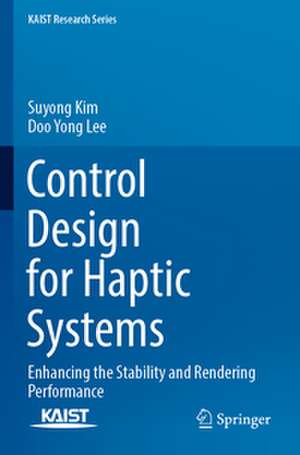
Control Design for Haptic Systems: KAIST Research Series
Autor Suyong Kim, Doo Yong Leeen Limba Engleză Paperback – 8 mai 2025
Recomandăm Control Design for Haptic Systems studenților din anii terminali, masteranzilor și inginerilor practicieni din domeniile mecanică, electronică și calculatoare care dețin deja baze solide în teoria controlului. Într-o eră în care simulările de realitate virtuală și aplicațiile din metavers necesită o interacțiune tactilă tot mai precisă, lucrarea semnată de Suyong Kim și Doo Yong Lee oferă o abordare riguroasă și aplicată a sistemelor haptice. Ne-a atras atenția în mod deosebit modul în care autorii trec de la descrierea componentelor hardware la modelarea matematică complexă, punând un accent major pe metricile de stabilitate și transparență.
Ca și Matja¿ Mihelj în Haptics for Virtual Reality and Teleoperation, autorii distilează experiență reală în principii acționabile, însă acest titlu se diferențiază prin introducerea sistematică a teoriei stabilității intrare-stare (Input-to-State Stability - ISS). Remarcăm structura logică a cuprinsului: după o introducere necesară în ecosistemul haptic, volumul evoluează către formularea controlului în cadrul ISS și rezolvarea problemelor critice de latență. Spre deosebire de lucrările cu caracter general, precum cele care tratează haptica drept un mediu de comunicare, acest manual se concentrează pe „cum” să proiectezi algoritmi de control care să garanteze fidelitatea senzației tactile chiar și în prezența întârzierilor de timp variabile, specifice sistemelor operate de la distanță. Exemplele experimentale detaliate pas cu pas validează conceptele teoretice, oferind cititorului un instrumentar tehnic complet pentru dezvoltarea interfețelor de ultimă generație.



Preț: 708.38 lei
Preț vechi: 932.08 lei
-24%
Carte tipărită la comandă
Livrare economică 02-08 decembrie
Specificații
ISBN-10: 9819986001
Pagini: 156
Dimensiuni: 155 x 235 x 9 mm
Greutate: 0.25 kg
Editura: Springer
Colecția KAIST Research Series
Seria KAIST Research Series
V-ar putea interesa
-
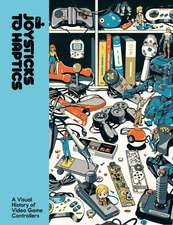 Joysticks to HapticsLost in CultPreț: 266.56 lei
 -
 Introduction to Real-Time Computing for Mechanical Engineers, AnJoseph L. Garbini-16%Preț: 518.06 lei617.19 lei
 -
 Sabiston Textbook of Surgery: The Biological Basis of Modern Surgical PracticeDouglas Scott Tyler-29%Preț: 1169.15 lei1645.26 leiRecomandat
 -
 -23%Preț: 175.25 lei227.99 lei
 -
 Optimal Control and EstimationRobert F. Stengel-19%Preț: 214.50 lei264.50 lei
 -
 Introduction to Robotics, Global EditionJohn Craig-9%Preț: 596.70 lei655.72 lei
 -
 MechatronicsW. Bolton-11%Preț: 667.57 lei750.07 lei
 -
 -11%Preț: 674.61 lei758.00 lei
 -
 -20%Preț: 1255.74 lei1569.68 lei
 -
 The Design of High Performance Mechatronics - 3rd Revised EditionR. Munnig Schmidt-9%Preț: 1068.30 lei1173.95 lei
 -
 Preț: 330.77 lei
 -
 Engineering Haptic DevicesThorsten A. Kern-20%Preț: 338.26 lei422.82 lei
 -
 Robust and Adaptive ControlEugene LavretskyPreț: 542.07 lei
 -
 Signals and Systems with MATLAB® and Simulink®Farzin AsadiPreț: 431.01 lei
 -
 A Stable and Transparent Framework for Adaptive Shared Control of RobotsRibin Balachandran-24%Preț: 681.71 lei896.98 lei
 -
 Advances in Haptics and Virtual RealityJianbo Su-20%Preț: 1498.00 lei1872.50 lei
 -
 Components Operationally: Reversibility and System EngineeringClaudio Antares Mezzina-20%Preț: 389.32 lei486.66 lei
 -
 Advanced Control Methods for Industrial ProcessesPablo A. López-Pérez-23%Preț: 701.54 lei911.09 lei
De ce să citești această carte
Această resursă tehnică este esențială pentru inginerii care doresc să depășească limitările metodelor clasice de control în robotică și VR. Cititorul câștigă o înțelegere profundă a cadrului ISS aplicat sistemelor haptice, învățând să optimizeze transparența și să gestioneze instabilitățile cauzate de latența rețelei. Este un ghid practic pentru oricine proiectează sisteme de teleoperare sau dispozitive de feedback tactil pentru metavers.
Despre autor
Suyong Kim și Doo Yong Lee sunt cercetători afiliați prestigioasei instituții KAIST (Korea Advanced Institute of Science and Technology), un centru de excelență recunoscut la nivel mondial în robotică și inginerie. Expertiza lor se concentrează pe intersecția dintre teoria controlului și sistemele haptice, contribuind activ la dezvoltarea tehnologiilor de interacțiune om-mașină. Prin această publicație în cadrul KAIST Research Series, autorii aduc în fața comunității academice și industriale rezultatele celor mai recente cercetări privind stabilitatea sistemelor complexe de feedback senzorial.
Cuprins
Notă biografică
Doo Yong Lee received the B.S. degree from Department of Control and Instrumentation Engineering, Seoul National University, Korea in 1985, and the M.S. and Ph.D. degrees from Department of Electrical, Computer, and Systems Engineering, Rensselaer Polytechnic Institute, Troy, NY, USA in 1987 and 1993, respectively. He was a Postdoctoral Research Associate at Rensselaer Polytechnic Institute from 1993 to 1994. He joined Department of Mechanical Engineering, Korea Advanced Institute of Science and Technology (KAIST) in 1994, and is POSCO Endowed Chair Professor of KAIST. He was Director of Health Technology Infrastructure of Korea Health Industry Development Institute from 2010 to 2012, and Head of Department of Mechanical Engineering, KAIST from 2017 to 2021. He was President of Institute of Control, Robotics, and Systems (ICROS) in 2021. His research interests include robotics and simulation with medical applications, especially robotic medical devices, and high-fidelity interactive medical simulation with haptic interface for training and planning purposes. He is a member of National Academy of Engineering of Korea, and Fellow of ICROS. He received Korea Prime Minister’s Commendation in 2018 for technical contributions to the field.