
Control as Movement: Cambridge Studies in Linguistics, cartea 126
Autor Cedric Boeckx, Norbert Hornstein, Jairo Nunesen Limba Engleză Hardback – 25 aug 2010
Din seria Cambridge Studies in Linguistics
-
 Preț: 349.94 lei
 -
 Preț: 297.49 lei
 -
 Preț: 290.79 lei
 -
 Preț: 294.46 lei
 -
 Preț: 252.26 lei
 -
 Preț: 327.06 lei
 - 14%
 Preț: 741.36 lei
 -
 Preț: 316.82 lei
 -
 Preț: 224.18 lei
 - 11%
 Preț: 413.23 lei
 -
 Preț: 412.48 lei
 -
 Preț: 193.04 lei
 - 11%
 Preț: 516.44 lei
 -
 Preț: 293.74 lei
 -
 Preț: 378.19 lei
 -
 Preț: 292.26 lei
 -
 Preț: 291.15 lei
 -
 Preț: 334.11 lei
 -
 Preț: 290.01 lei
 - 14%
 Preț: 720.59 lei
 -
 Preț: 294.31 lei
 -
 Preț: 224.91 lei
 -
 Preț: 221.57 lei
 -
 Preț: 202.21 lei
 - 14%
 Preț: 902.26 lei
 -
 Preț: 292.43 lei
 -
 Preț: 331.58 lei
 -
 Preț: 331.60 lei
 -
 Preț: 408.56 lei
 -
 Preț: 335.34 lei
 - 11%
 Preț: 462.53 lei
 - 14%
 Preț: 711.90 lei
 - 14%
 Preț: 738.04 lei
 -
 Preț: 408.02 lei
 -
 Preț: 292.63 lei
 -
 Preț: 387.45 lei
 -
 Preț: 417.13 lei
 -
 Preț: 296.71 lei
 - 14%
 Preț: 829.82 lei
Preț: 742.66 lei
Preț vechi: 863.56 lei
-14%
Puncte Express: 1114
Carte tipărită la comandă
Livrare economică 13-27 iulie
Livrare prin curier în România Termenul estimat este afișat lângă disponibilitate.
Transport gratuit pentru acest produs Plată online sau ramburs, în funcție de opțiunile comenzii.
Retur gratuit în 14 zile Comandă securizată și suport în română.
Specificații
ISBN-13: 9780521195454
ISBN-10: 0521195454
Pagini: 274
Dimensiuni: 155 x 229 x 20 mm
Greutate: 0.57 kg
Editura: Cambridge University Press
Colecția Cambridge University Press
Seria Cambridge Studies in Linguistics
Locul publicării:Cambridge, United Kingdom
ISBN-10: 0521195454
Pagini: 274
Dimensiuni: 155 x 229 x 20 mm
Greutate: 0.57 kg
Editura: Cambridge University Press
Colecția Cambridge University Press
Seria Cambridge Studies in Linguistics
Locul publicării:Cambridge, United Kingdom
V-ar putea interesa
-
 Latin: A Linguistic IntroductionRenato Oniga-13%Preț: 304.00 lei350.30 lei
 -
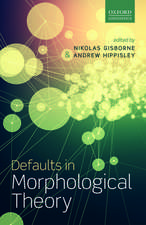 Defaults in Morphological TheoryNikolas Gisborne-34%Preț: 734.22 lei1104.35 lei
 -
 -34%Preț: 748.26 lei1127.18 lei
 -
 -34%Preț: 684.81 lei1031.61 lei
 -
 The Oxford Handbook of InflectionMatthew Baerman-11%Preț: 336.85 lei380.26 lei
 -
 Are Some Languages Better than Others?R. M. W. Dixon-18%Preț: 187.50 lei227.61 lei
 -
 -8%Preț: 356.39 lei388.96 lei
 -
 Bare SyntaxCedric Boeckx-22%Preț: 375.67 lei483.44 lei
 -
 Lexical RelatednessAndrew Spencer-34%Preț: 877.08 lei1322.03 lei
 -
 English LexicogenesisD. Gary Miller-14%Preț: 843.46 lei980.76 lei
 -
 Changing Valency: Case Studies in TransitivityR. M. W. DixonPreț: 388.23 lei
 -
 The Syntax of Argument StructureLeonard H. BabbyPreț: 311.50 lei
 -
 Preț: 307.75 lei
 -
 Verb MovementDavid LightfootPreț: 336.10 lei
 -
 Syntax: Basic Concepts and ApplicationsRobert FreidinPreț: 342.85 lei
 -
 A Theory of Syntax: Minimal Operations and Universal GrammarNorbert HornsteinPreț: 327.97 lei
 -
 Understanding English Grammar: A Linguistic IntroductionThomas E. PaynePreț: 360.61 lei
 -
 Grammatical Categories: Variation in Romance LanguagesM. Rita Manzini-14%Preț: 755.72 lei878.74 lei
 -
 Symmetry in Syntax: Merge, Move and LabelsBarbara Citko-14%Preț: 740.60 lei861.16 lei
 -
 -14%Preț: 743.76 lei864.83 lei
 -
 Experimental Syntax and Island EffectsJon Sprouse-14%Preț: 799.58 lei929.74 lei
 -
 Data and Evidence in LinguisticsAndrás Kertész-14%Preț: 714.85 lei831.22 lei
 -
 Grammar of the Sanskrit LanguageCharles Wilkins-19%Preț: 511.57 lei631.56 lei
 -
 Preț: 251.70 lei
 -
 Preț: 376.50 lei
Cuprins
1. Introduction; 2. Some historical background; 3. Basic properties of the Movement Theory of Control; 4. Empirical advantages; 5. Empirical challenges and solutions; 6. On non-obligatory control; 7. Some notes on semantic approaches to control; 8. The movement theory of control and the minimalist program.
Descriere
Presents the main arguments for and against the Movement Theory of Control.