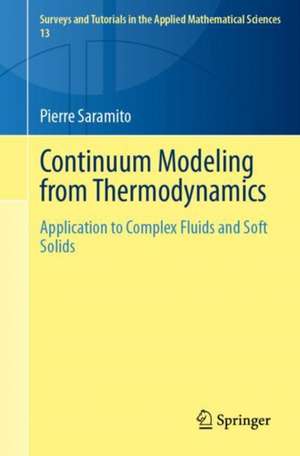
Continuum Modeling from Thermodynamics: Surveys and Tutorials in the Applied Mathematical Sciences, cartea 13
Autor Pierre Saramitoen Limba Engleză Paperback – 5 mar 2024




Preț: 497.19 lei
Preț vechi: 584.94 lei
-15%
Puncte Express: 746
Carte tipărită la comandă
Livrare economică 26 noiembrie-10 decembrie
Livrare prin curier în România Termenul estimat este afișat lângă disponibilitate.
Transport gratuit pentru acest produs Plată online sau ramburs, în funcție de opțiunile comenzii.
Retur gratuit în 14 zile Comandă securizată și suport în română.
Specificații
ISBN-13: 9783031510113
ISBN-10: 3031510119
Pagini: 172
Ilustrații: XVI, 153 p. 33 illus., 16 illus. in color.
Dimensiuni: 155 x 235 x 10 mm
Greutate: 0.27 kg
Ediția:2024
Editura: Springer
Colecția Surveys and Tutorials in the Applied Mathematical Sciences
Seria Surveys and Tutorials in the Applied Mathematical Sciences
Locul publicării:Cham, Switzerland
ISBN-10: 3031510119
Pagini: 172
Ilustrații: XVI, 153 p. 33 illus., 16 illus. in color.
Dimensiuni: 155 x 235 x 10 mm
Greutate: 0.27 kg
Ediția:2024
Editura: Springer
Colecția Surveys and Tutorials in the Applied Mathematical Sciences
Seria Surveys and Tutorials in the Applied Mathematical Sciences
Locul publicării:Cham, Switzerland
Cuprins
Conservation equations.- Objectivity.- Strain and stress.- Framework.- Examples.
Notă biografică
Pierre Saramito was born in Reims, France and studied applied mathematics and computer science. He then obtained a PhD in mechanics from the University of Grenoble, which stimulated his interest in interacting with physics. In 1995, he joined the CNRS, the "Centre National de la Recherche Scientifique", where he is now a senior researcher, working at the J. Kuntzmann laboratory in Grenoble. Saramito is the author of numerous research papers and books. He published in 2016 a Springer book on complex fluids. His research focuses on the development of continuous mathematical models in physics and biology and their numerical resolution.
Textul de pe ultima copertă
This book presents a novel comprehensive thermodynamic framework, suitable for the design of new macroscopic models, as well as the combination of existing models. Our goal is to popularize thermodynamics for model designers. The example series of models includes very classic solid and fluid models, such as Newtonian, viscoplastic and viscoelastic materials, but also new heat effects and original combinations of existing models. The aim of the new proposed framework is to allow a clear and easy development of constitutive equations that automatically satisfy the second principle. Instead of writing directly constitutive relations, model designers are encouraged to first specify the energy. This book is primarily intended for graduate students and researchers in applied mathematics, engineering sciences, computational mechanics and physics. The reader is assumed to be familiar with classical mechanics, together with matrix and tensors algebra.
Caracteristici
Provides a ready-to-use thermodynamics framework for the development of constitutive equations Provides a catalog of old and new constitutive equations of practical interest Based on an axiomatized theory in a precise mathematical language