
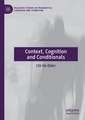
Context, Cognition and Conditionals: Palgrave Studies in Pragmatics, Language and Cognition
Autor Chi-Hé Elderen Limba Engleză Hardback – 8 iul 2019
Din seria Palgrave Studies in Pragmatics, Language and Cognition
- 15%
 Preț: 623.98 lei
 -
 Preț: 432.57 lei
 -
 Preț: 378.44 lei
 - 15%
 Preț: 618.76 lei
 -
 Preț: 391.74 lei
 -
 Preț: 370.17 lei
 - 15%
 Preț: 611.57 lei
 -
 Preț: 367.39 lei
 -
 Preț: 415.21 lei
 -
 Preț: 367.85 lei
 - 15%
 Preț: 621.42 lei
 -
 Preț: 371.57 lei
 -
 Preț: 432.35 lei
 - 15%
 Preț: 722.33 lei
 -
 Preț: 437.61 lei
 - 18%
 Preț: 924.32 lei
 - 18%
 Preț: 949.02 lei
 - 9%
 Preț: 896.15 lei
 - 20%
 Preț: 877.34 lei
 - nou
 Preț: 774.59 lei
Preț: 573.59 lei
Preț vechi: 623.48 lei
-8%
Puncte Express: 860
Carte tipărită la comandă
Livrare economică 20-26 noiembrie
Livrare prin curier în România Termenul estimat este afișat lângă disponibilitate.
Transport gratuit pentru acest produs Plată online sau ramburs, în funcție de opțiunile comenzii.
Retur gratuit în 14 zile Comandă securizată și suport în română.
Specificații
ISBN-13: 9783030137984
ISBN-10: 3030137988
Pagini: 296
Ilustrații: XV, 279 p. 7 illus.
Dimensiuni: 153 x 216 x 21 mm
Greutate: 0.46 kg
Ediția:1st ed. 2019
Editura: Springer International Publishing
Colecția Palgrave Studies in Pragmatics, Language and Cognition
Seria Palgrave Studies in Pragmatics, Language and Cognition
Locul publicării:Cham, Switzerland
ISBN-10: 3030137988
Pagini: 296
Ilustrații: XV, 279 p. 7 illus.
Dimensiuni: 153 x 216 x 21 mm
Greutate: 0.46 kg
Ediția:1st ed. 2019
Editura: Springer International Publishing
Colecția Palgrave Studies in Pragmatics, Language and Cognition
Seria Palgrave Studies in Pragmatics, Language and Cognition
Locul publicării:Cham, Switzerland
Cuprins
Chapter 1: Introduction.- Chapter 2: Conditional sentences, conditional thoughts.- Chapter 3: Biscuit conditionals, conditional speech acts and speech-act conditionals.- Chapter 4: Beyond the conditional sentence and towards cognitive reality.- Chapter 5: In search of linguistic and contextual constraints on primary meanings.- Chapter 6: Routes to enrichment.- Chapter 7: Towards a pragmatic category of conditionals.- 8. The need for a contextualist outlook on the study of conditionals.
Textul de pe ultima copertă
This book proposes a semantic theory of conditionals that can account for (i) the variability in usages that conditional sentences can be put; and (ii) both conditional sentences of the form ‘if p, q’ and those conditional thoughts that are expressed without using ‘if’. It presents theoretical arguments as well as empirical evidence from English and other languages in support of the thesis that an adequate study of conditionals has to go beyond an analysis of specific sentence forms or lexical items. The resulting perspective on conditionals is one in which conditionality is located at a higher level than that of the sentence; namely, at the level of thought. The author argues that it is only through adopting such a perspective, and with it, a commitment to context-dependent semantics, that we can successfully represent conditional utterances as they are used and understood by ordinary language users. It will be of interest to students and scholars working on the semantics of conditionals in the fields of linguistics (especially semantics and pragmatics) and philosophy of language.
Chi-Hé Elder is Lecturer in Linguistics in the School of Politics, Philosophy and Language and Communication Studies at the University of East Anglia, UK. Her research interests lie in the relationship between post-Gricean pragmatics and interactional pragmatics, with a particular focus on the semantics and pragmatics of conditionals.
Caracteristici
Foregrounds the importance of analysing meaning in interaction at the level of thought, using conditionals as a case study Offers a fresh perspective on the way that conditionality should be conceptualised by focusing on the way that conditionals are used and expressed in ordinary discourse Proposes a semantic theory of conditionals that can account for variability in usages of conditional sentences, including both conditional sentences of the form 'if p, q' and conditional expressions which don't use 'if'