
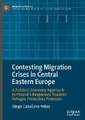
Contesting Migration Crises in Central Eastern Europe: Mobility & Politics
Autor Diego Caballero-Vélezen Limba Engleză Paperback – feb 2025
Din seria Mobility & Politics
-
 Preț: 396.24 lei
 - 15%
 Preț: 484.05 lei
 -
 Preț: 397.48 lei
 -
 Preț: 368.43 lei
 -
 Preț: 431.25 lei
 -
 Preț: 432.79 lei
 -
 Preț: 431.91 lei
 -
 Preț: 399.89 lei
 -
 Preț: 397.91 lei
 -
 Preț: 431.89 lei
 -
 Preț: 461.08 lei
 -
 Preț: 361.95 lei
 - 18%
 Preț: 892.88 lei
 -
 Preț: 381.92 lei
 -
 Preț: 497.49 lei
 -
 Preț: 466.80 lei
 -
 Preț: 395.95 lei
 - 18%
 Preț: 697.89 lei
 -
 Preț: 330.79 lei
 - 15%
 Preț: 719.34 lei
 -
 Preț: 363.25 lei
 - 15%
 Preț: 720.27 lei
 -
 Preț: 370.07 lei
 - 18%
 Preț: 979.42 lei
 -
 Preț: 368.79 lei
 -
 Preț: 401.07 lei
 -
 Preț: 336.20 lei
 - nou
 Preț: 318.30 lei
 -
-
-
Preț: 675.37 lei
Preț vechi: 742.16 lei
-9%
Puncte Express: 1013
Carte tipărită la comandă
Livrare economică 25 noiembrie-01 decembrie
Livrare prin curier în România Termenul estimat este afișat lângă disponibilitate.
Transport gratuit pentru acest produs Plată online sau ramburs, în funcție de opțiunile comenzii.
Retur gratuit în 14 zile Comandă securizată și suport în română.
Specificații
ISBN-13: 9783031440397
ISBN-10: 3031440390
Pagini: 188
Dimensiuni: 148 x 210 x 11 mm
Greutate: 0.25 kg
Editura: Springer International Publishing
Colecția Mobility & Politics
Seria Mobility & Politics
ISBN-10: 3031440390
Pagini: 188
Dimensiuni: 148 x 210 x 11 mm
Greutate: 0.25 kg
Editura: Springer International Publishing
Colecția Mobility & Politics
Seria Mobility & Politics
Cuprins
Chapter 1.- Introduction.-PART I.- The political economy innate in migration governance.-Chapter 2.- International cooperation in public goods provision.-Chapter 3.- Constructing public goods: actors’ rationale behind actions.-Chapter 4.- “Unpacking” international migration governance: embeddedness and political economy.-PART II.- Forced migration in Central Eastern Europe.-Chapter 5.- Security or humanitarianism? The paradigm of refugee protection on Central Eastern European borders.-Chapter 6.- Poland: nation-building, populism and ethnicity.-PART III.- Research analysis.-Chapter 7.- Modelling preferences towards refugee protection: the case of the Polish government.-Chapter 8.- Empirical results: the provision of goods.-9.- Conclusions.
Textul de pe ultima copertă
During the 2015 and 2016 refugee crisis the EU called on the Member States to engage in protection burden-sharing. This proposal found strong opposition from some of the Visegrad Group countries, including Poland, which expressed their reluctance to the relocation scheme securitizing the political narrative towards refugees. On the contrary, in 2022, during the Russian military aggression against Ukraine, Poland strengthened an “open door policy”, showing a humanitarian approach towards Ukrainian refugees.
This book uses a public goods theoretical framework to examine the various public goods characteristics of refugee protection in such scenarios. It is argued that the publicness and character of refugee protection is socially shaped by norms and identities. States perceive refugee protection, including benefits and costs, in different ways. The author focuses his analysis on the security/humanitarian dichotomy in states’ perceptions of refugees to investigate the accompanying vision of the inherent costs and benefits. The conceptual part of the book provides conclusive support of an alternative constructivist mode in public goods theory for understanding refugee protection burden-sharing.
Diego Caballero Vélez is a postdoctoral researcher in the Centre of Migration Research at the University of Warsaw. His research interests include international migration governance, political economy, European integration, EU foreign policy and mixed-methods.
This book uses a public goods theoretical framework to examine the various public goods characteristics of refugee protection in such scenarios. It is argued that the publicness and character of refugee protection is socially shaped by norms and identities. States perceive refugee protection, including benefits and costs, in different ways. The author focuses his analysis on the security/humanitarian dichotomy in states’ perceptions of refugees to investigate the accompanying vision of the inherent costs and benefits. The conceptual part of the book provides conclusive support of an alternative constructivist mode in public goods theory for understanding refugee protection burden-sharing.
Diego Caballero Vélez is a postdoctoral researcher in the Centre of Migration Research at the University of Warsaw. His research interests include international migration governance, political economy, European integration, EU foreign policy and mixed-methods.
Caracteristici
Offers a major contribution to better understanding states’ rationale for contesting future migration crises Proposes a new method for assessing the variables in the security-humanitarian relationship Shows how the perception of costs of providing refugee protection differ depending on the state’s identity