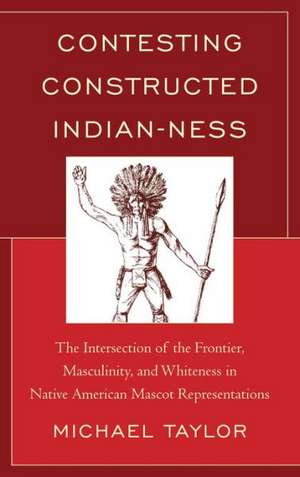
Contesting Constructed Indian-ness
Autor Michael Tayloren Limba Engleză Hardback – 16 mai 2013
Preț: 526.12 lei
Preț vechi: 618.96 lei
-15%
Puncte Express: 789
Carte tipărită la comandă
Livrare economică 21 august-04 septembrie
Livrare prin curier în România Termenul estimat este afișat lângă disponibilitate.
Transport gratuit pentru acest produs Plată online sau ramburs, în funcție de opțiunile comenzii.
Retur gratuit în 14 zile Comandă securizată și suport în română.
Specificații
ISBN-13: 9780739178645
ISBN-10: 0739178644
Pagini: 154
Dimensiuni: 157 x 235 x 13 mm
Greutate: 0.38 kg
Editura: Bloomsbury Publishing
ISBN-10: 0739178644
Pagini: 154
Dimensiuni: 157 x 235 x 13 mm
Greutate: 0.38 kg
Editura: Bloomsbury Publishing
V-ar putea interesa
-
 -17%Preț: 357.90 lei432.30 lei
 -
 Singularities and OscillationsJeffrey Rauch-15%Preț: 613.02 lei721.20 lei
 -
 Race, Racism and Psychology: Towards a Reflexive HistoryGraham Richards-15%Preț: 480.51 lei565.30 lei
 -
 Achieving Our Humanity: The Idea of the Postracial FutureEmmanuel C. Eze-15%Preț: 427.62 lei503.07 lei
 -
 Community, Anarchy, and LibertyMichael TaylorPreț: 183.08 lei
 -
 -18%Preț: 268.35 lei325.90 lei
 -
 -18%Preț: 1227.84 lei1497.37 lei
 -
 Global Coloniality of Power in Guatemala: Racism, Genocide, CitizenshipEgla Martínez Salazar-30%Preț: 670.67 lei959.99 lei
 -
 -24%Preț: 321.01 lei422.50 lei
 -
 Changing The Subject: Women In Higher EducationJocey Quinn-15%Preț: 406.84 lei478.63 lei
 -
 -28%Preț: 272.24 lei377.86 lei
 -
 Savage PerilsPatrick B. SharpPreț: 194.67 lei
 -
 Derek WalcottViola Julia DavisPreț: 97.79 lei
 -
 The Case for Affirmative Action on Campus: Concepts of Equity, Considerations for PracticeEboni M. Zamani-GallaherPreț: 321.16 lei
 -
 Purpose in the PainFreshun E WilsonPreț: 268.49 lei
 -
 Blacks in the Marine CorpsHenry I. ShawPreț: 146.92 lei
 -
 -18%Preț: 1082.95 lei1320.67 lei
 -
 -9%Preț: 852.42 lei936.73 lei
 -
 Comparable worth and gender discriminationMorley GundersonPreț: 183.08 lei
 -
 Answering the Business QuestionsMichael TaylorPreț: 51.22 lei
Cuprins
Introduction Chapter 1: The Frontier as Place/Space Chapter 2: Gender, Masculinity, and Male Identity Chapter 3: White Identity, White Ideologies, and Conditions of Whiteness Chapter 4: Constructing the Native Voice Conclusions Bibliography
Descriere
Contesting Constructed Indian-ness seeks to highlight the investment of white American males with the history of their relationship with the ideas of the Indian. This book documents the investments of white men with that of the ideal Indian, while disregarding the reality of Native Americans in this country.
Recenzii
Careful. Deliberate. Thoughtful. Nuanced. Revealing. Anthropologist and Native American studies scholar Taylor delivers an important contribution with this artfully crafted examination of Native American mascots. His analytical skill resituates the debate about how Native Americans are represented in the broader US culture in a multilayered discussion connecting gender, race, and place, noting how Native voices are opposed to, defend against, and are drowned out by a white majority intent on reinforcing the boundaries between the conquered and the conquerors. The mythic frontier serves as a backdrop, the dynamics of which are played out on football fields around the US. Taylor begins and ends his book with an account of sitting in his own high school bleachers watching a Seneca student don buckskin and headdress to dance as the team mascot, and sensing the shared confusion of other Seneca students amid a majority white crowd and their realization of the magnitude of self-betrayal in which they are being asked to participate. It is an arresting, haunting depiction of the painful and complicated pathways that young Native students travel in a white world, making choices that may appear to be their own but are actually those that others have set before them. Summing Up: Highly recommended. All levels/libraries.
Contesting Constructed Indian-ness: The Intersection of the Frontier, Masculinity, and Whiteness in Native American Mascot Representations continues all the important dialogue and analysis on Native American mascots. . . .Overall, the book contributes a critical dialogue on the issue of American mascots. Most Americans do not know the history of this issue and why it continues to be detrimental to not only Native people, but to all peoples. The book contributes to the growing scholarship and hopefully to the national dialogue on the ending the use of Native American mascots in schools, colleges, and professional organizations, and therefore is recommended for both universities and the general public.
Taylor clearly illuminates the moral justification of claims to land, the erasure of Native presence, and with it, any guilt over a violent conquest.
Taylor offers an important contribution to ongoing discussions of Native American mascots. At the same time, he enhances our understanding of how American society has imagined indigenous peoples and in turn how they have challenged these inventions. His fresh reading of the creation and contestation of popular renderings of Indianness brings race, gender, and place into the dialogue. Drawing on the voices and perspectives of Native Americans, he produces a counter-anthropology of sorts, unsettling taken-for-granted ideas and images. One of the most valuable elements of this counter-anthropology is the intimate reading of social practices and cultural politics.
This carefully crafted study of Indian sports team mascots breaks new ground in several critical areas. It considers the issue of mascot imagery at all levels and types of educational settings ranging from high school to college-Native to Euro-American institutions alike. It provides an inside, Native American perspective on why Native children fight to keep such mascots alive. Taylor also provides deep insights into the forces driving white males to don Indian attire and perform as mascots in attempts to resolve ongoing angst over the legacy of conquest and colonization.
Michael Taylor deepens our understanding of Indian mascot practices from a variety of times and spaces with this set of nuanced readings of mascots as "inventions" created within a frontier mythology of whiteness. What sets this analysis of mascots apart is Taylor's critical unpacking of the uses and abuses of Native voices-voices which the author resolutely refuses to simplify or flatten.
Contesting Constructed Indian-ness: The Intersection of the Frontier, Masculinity, and Whiteness in Native American Mascot Representations continues all the important dialogue and analysis on Native American mascots. . . .Overall, the book contributes a critical dialogue on the issue of American mascots. Most Americans do not know the history of this issue and why it continues to be detrimental to not only Native people, but to all peoples. The book contributes to the growing scholarship and hopefully to the national dialogue on the ending the use of Native American mascots in schools, colleges, and professional organizations, and therefore is recommended for both universities and the general public.
Taylor clearly illuminates the moral justification of claims to land, the erasure of Native presence, and with it, any guilt over a violent conquest.
Taylor offers an important contribution to ongoing discussions of Native American mascots. At the same time, he enhances our understanding of how American society has imagined indigenous peoples and in turn how they have challenged these inventions. His fresh reading of the creation and contestation of popular renderings of Indianness brings race, gender, and place into the dialogue. Drawing on the voices and perspectives of Native Americans, he produces a counter-anthropology of sorts, unsettling taken-for-granted ideas and images. One of the most valuable elements of this counter-anthropology is the intimate reading of social practices and cultural politics.
This carefully crafted study of Indian sports team mascots breaks new ground in several critical areas. It considers the issue of mascot imagery at all levels and types of educational settings ranging from high school to college-Native to Euro-American institutions alike. It provides an inside, Native American perspective on why Native children fight to keep such mascots alive. Taylor also provides deep insights into the forces driving white males to don Indian attire and perform as mascots in attempts to resolve ongoing angst over the legacy of conquest and colonization.
Michael Taylor deepens our understanding of Indian mascot practices from a variety of times and spaces with this set of nuanced readings of mascots as "inventions" created within a frontier mythology of whiteness. What sets this analysis of mascots apart is Taylor's critical unpacking of the uses and abuses of Native voices-voices which the author resolutely refuses to simplify or flatten.