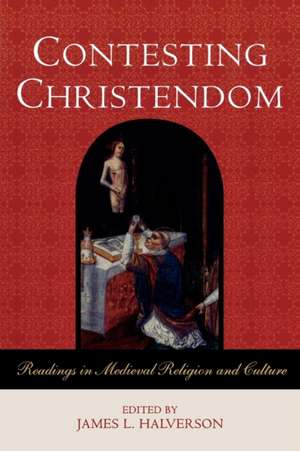
Contesting Christendom: Readings in Medieval Religion and Culture
Editat de James L. Halversonen Limba Engleză Paperback – 26 iul 2007
Introducing students to medieval Christianity, James L. Halverson presents a rich array of readings that offers a variety of ways to study the history of religion within a chronological setting. His opening chapter and introductions to each section and selection frame the essays and provide a strong conceptual framework to build upon. Making it clear that scholars have approached religion from many perspectives and used many different methodologies, this collection presents some of the best scholarship of religion as culture and practice, emphasizing the ongoing attempt to understand the social and cultural aspects of medieval Christianity.
Contributions by: Rudolf Bell, Constance Brittain Bouchard, Peter Brown, Marcus Bull, Caroline Walker Bynum, Mark R. Cohen, Georges Duby, Eamon Duffy, Joan Ferrante, Richard Fletcher, Katherine L. French, Thomas A. Fudge, Herbert Grundmann, James L. Halverson, Karen Louise Jolly, Lester Little, Rob Means, Bernd Moeller, Andrew P. Roach, Jane Tibbets Schulenburg, Keith Thomas, and Ian Wood.
Preț: 307.98 lei
Preț vechi: 389.50 lei
-21%
Puncte Express: 462
Carte tipărită la comandă
Livrare economică 23 noiembrie-07 decembrie
Livrare prin curier în România Termenul estimat este afișat lângă disponibilitate.
Transport gratuit de la 400.00 lei Plată online sau ramburs, în funcție de opțiunile comenzii.
Retur gratuit în 14 zile Comandă securizată și suport în română.
Specificații
ISBN-13: 9780742554726
ISBN-10: 0742554724
Pagini: 246
Dimensiuni: 148 x 226 x 18 mm
Greutate: 0.39 kg
Editura: Bloomsbury Publishing
Colecția Rowman & Littlefield
Locul publicării:New York, United States
ISBN-10: 0742554724
Pagini: 246
Dimensiuni: 148 x 226 x 18 mm
Greutate: 0.39 kg
Editura: Bloomsbury Publishing
Colecția Rowman & Littlefield
Locul publicării:New York, United States
V-ar putea interesa
-
 -19%Preț: 370.74 lei456.62 lei
 -
 A History of the Churches in the United States and CanadaRobert T. Handy-20%Preț: 284.05 lei356.72 lei
 -
 Catholic Identity and the Revolt of the Netherlands, 1520-1635Judith Pollmann-31%Preț: 915.43 lei1331.67 lei
 -
 Heaven in the American ImaginationGary Scott Smith-22%Preț: 341.99 lei438.42 lei
 -
 -13%Preț: 277.23 lei319.88 lei
 -
 The Philokalia and the Inner LifeChristopher C H CookPreț: 404.69 lei
 -
 Saint and NationErin Kathleen RowePreț: 313.35 lei
 -
 A New History of Early ChristianityCharles FreemanPreț: 116.75 lei
 -
 The World Missionary Conference, Edinburgh 1910Brian StanleyPreț: 286.01 lei
 -
 A Dance with DeceptionCharles W. ColsonPreț: 107.23 lei
 -
 La ConquistadoraJaima ChevalierPreț: 95.27 lei
 -
 -11%Preț: 619.17 lei695.69 lei
 -
 The New Knighthood (Canto Classics)Malcolm BarberPreț: 160.04 lei
 -
 Christian Responses to Roman Art and ArchitectureLaura Salah NasrallahPreț: 452.10 lei
 -
 Christian History - An IntroductionAlister E. McgrathPreț: 298.39 lei
 -
 Rituals of SpontaneityLori BranchPreț: 282.94 lei
 -
 Voices of GnosticismMiguel ConnerPreț: 135.06 lei
Cuprins
Introduction
Part I: The Extent of Christianization in the Early Middle Ages
Chapter 1: Some Historical Reidentification and the Christianization of Kent
Chapter 2: Background to Augustine's Mission to Anglo-Saxon England
Chapter 3: The Barbarian Conversion from Paganism to Christianity
Chapter 4: Popular Religion in Late Saxon England: Elf Charms in Context
Chapter 5: Forgetful of Their Sex: Female Sanctity and Society, ca. 500-1100
Chapter 6: The Rise of Western Christendom
Part II: The Development of Christendom
Chapter 7: The Knight, the Lady, and the Priest: The Making of Modern Marriage in Medieval France
Chapter 8: Knightly Piety and the Lay Response to the First Crusade
Chapter 9: Sword, Mitre, and Cloister: Nobility and the Church in Burgundy
Chapter 10: Under Crescent and Cross: The Jews in the Middle Ages
Chapter 11: To the Glory of Her Sex
Part III: The Apostolic Life
Chapter 12: Religious Movements in the Middle Ages
Chapter 13: Religious Poverty and the Profit Economy in Medieval Europe
Chapter 14: Holy Anorexia
Chapter 15: Women Mystics and Eucharistic Devotion in the Thirteenth Century
Chapter 16: The Devil's World: Heresy and Society, 1100-1300
Part IV: Popular Religion in the Late Middle Ages
Chapter 17: Religious Life in Germany on the Eve of the Reformation
Chapter 18: The Stripping of the Altars: Traditional Religion in England, ca. 1400-1580
Chapter 19: Religion and the Decline of Magic
Chapter 20: Women in the Late Medieval English Parish
Chapter 21: The Magnificent Ride: The First Reformation in Hussite Bohemia
Part I: The Extent of Christianization in the Early Middle Ages
Chapter 1: Some Historical Reidentification and the Christianization of Kent
Chapter 2: Background to Augustine's Mission to Anglo-Saxon England
Chapter 3: The Barbarian Conversion from Paganism to Christianity
Chapter 4: Popular Religion in Late Saxon England: Elf Charms in Context
Chapter 5: Forgetful of Their Sex: Female Sanctity and Society, ca. 500-1100
Chapter 6: The Rise of Western Christendom
Part II: The Development of Christendom
Chapter 7: The Knight, the Lady, and the Priest: The Making of Modern Marriage in Medieval France
Chapter 8: Knightly Piety and the Lay Response to the First Crusade
Chapter 9: Sword, Mitre, and Cloister: Nobility and the Church in Burgundy
Chapter 10: Under Crescent and Cross: The Jews in the Middle Ages
Chapter 11: To the Glory of Her Sex
Part III: The Apostolic Life
Chapter 12: Religious Movements in the Middle Ages
Chapter 13: Religious Poverty and the Profit Economy in Medieval Europe
Chapter 14: Holy Anorexia
Chapter 15: Women Mystics and Eucharistic Devotion in the Thirteenth Century
Chapter 16: The Devil's World: Heresy and Society, 1100-1300
Part IV: Popular Religion in the Late Middle Ages
Chapter 17: Religious Life in Germany on the Eve of the Reformation
Chapter 18: The Stripping of the Altars: Traditional Religion in England, ca. 1400-1580
Chapter 19: Religion and the Decline of Magic
Chapter 20: Women in the Late Medieval English Parish
Chapter 21: The Magnificent Ride: The First Reformation in Hussite Bohemia
Recenzii
Twenty-two well-written and informative essays.
Halverson has assembled a wonderful set of readings on the changing nature of medieval Christendom. The selections chosen here reflect old and new approaches and the ongoing work of scholars to questions about what made the Middle Ages Christian, or whether they were Christian at all. Halverson is sensitive to change over time, and also to changing methodologies and angles of approach. I imagine readers coming away with a much richer sense of the debates-still current!-surrounding Europe's religious inheritance.
Demonstrating the various ways in which Christianity shaped medieval culture, this book will be warmly embraced in many medieval European history classrooms as well as in courses on medieval Christianity. Because the readings deal with religion from social and cultural perspectives, it will be valuable even in courses that are not specifically focused on religion.
Halverson has assembled a wonderful set of readings on the changing nature of medieval Christendom. The selections chosen here reflect old and new approaches and the ongoing work of scholars to questions about what made the Middle Ages Christian, or whether they were Christian at all. Halverson is sensitive to change over time, and also to changing methodologies and angles of approach. I imagine readers coming away with a much richer sense of the debates-still current!-surrounding Europe's religious inheritance.
Demonstrating the various ways in which Christianity shaped medieval culture, this book will be warmly embraced in many medieval European history classrooms as well as in courses on medieval Christianity. Because the readings deal with religion from social and cultural perspectives, it will be valuable even in courses that are not specifically focused on religion.