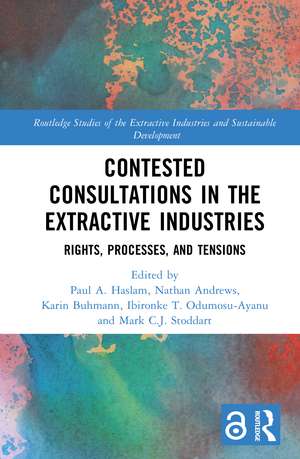
Contested Consultations in the Extractive Industries: Rights, Processes, and Tensions: Routledge Studies of the Extractive Industries and Sustainable Development
Editat de Paul A. Haslam, Nathan Andrews, Karin Buhmann, Ibironke T. Odumosu-Ayanu, Mark Stoddarten Limba Engleză Hardback – 29 sep 2025
In recent years international organisations, governments and companies around the world have dramatically reformed the regime that governs consultations with community stakeholders about proposed extractive projects. However, the characteristics of this consultation regime are often contested, with diverse stakeholders seeking to defend their interests by drawing on different authoritative interpretations of the rules, norms and decision-making procedures that govern stakeholder consultation. Contestation over the meaning, governance and practice of stakeholder consultation is the central thread that ties this book together. Within this overarching concern, the volume takes a global and comparative perspective that examines the complexity of these intersecting and overlapping consultation requirements, with a particular focus on Indigenous Peoples, using cases from the Global North and Global South, including Argentina, Australia, Brazil, Canada, The Central African Republic, The Democratic Republic of Congo, Iceland, Ghana, Greenland, Guyana, Norway, and Peru. The book highlights the tensions associated with the application of this contested regime and identifies possible solutions from best practices around the world. From a theoretical perspective the book unpacks the maze of overlapping consultation requirements and practices that highlights the normative disagreements between key stakeholders and the overlapping rules and procedures that govern the implementation of consultation. A unique contribution of this collection is the commentary from practitioners, who reflect on the same issues addressed by the academic contributors, but based on their own vast practical experience.
This book will be of great interest to students and scholars researching public participation and stakeholder consultation in the extractive industries as well as natural resource governance and sustainable development more broadly.
The Open Access version of this book, available at http://www.taylorfrancis.com, has been made available under a Creative Commons Attribution-Non Commercial-No Derivatives (CC BY-NC-ND) 4.0 license.
Din seria Routledge Studies of the Extractive Industries and Sustainable Development
-
 Preț: 224.52 lei
 -
 Preț: 410.01 lei
 -
 Preț: 409.59 lei
 -
 Preț: 364.54 lei
 -
 Preț: 404.89 lei
 -
 Preț: 397.58 lei
 -
 Preț: 405.33 lei
 -
 Preț: 469.66 lei
 - 18%
 Preț: 1112.72 lei
 -
 Preț: 443.74 lei
 - 15%
 Preț: 434.86 lei
 -
 Preț: 435.03 lei
 -
 Preț: 424.32 lei
 - 18%
 Preț: 1057.86 lei
 -
 Preț: 405.33 lei
 -
 Preț: 414.50 lei
 -
 Preț: 424.32 lei
 -
 Preț: 428.45 lei
 - 15%
 Preț: 446.65 lei
 -
 Preț: 425.04 lei
 -
 Preț: 220.52 lei
 -
 Preț: 413.32 lei
 - 18%
 Preț: 1248.18 lei
 - 18%
 Preț: 1119.70 lei
 -
 Preț: 471.34 lei
 - 18%
 Preț: 1150.69 lei
 - 18%
 Preț: 1348.52 lei
 - 15%
 Preț: 473.76 lei
 - 18%
 Preț: 1065.09 lei
Preț: 1116.20 lei
Preț vechi: 1361.23 lei
-18%
Puncte Express: 1674
Carte tipărită la comandă
Livrare economică 23 noiembrie-07 decembrie
Livrare prin curier în România Termenul estimat este afișat lângă disponibilitate.
Transport gratuit pentru acest produs Plată online sau ramburs, în funcție de opțiunile comenzii.
Retur gratuit în 14 zile Comandă securizată și suport în română.
Specificații
ISBN-13: 9781032785639
ISBN-10: 1032785632
Pagini: 290
Ilustrații: 18
Dimensiuni: 156 x 234 x 25 mm
Greutate: 0.56 kg
Ediția:1
Editura: Taylor & Francis
Colecția Routledge
Seria Routledge Studies of the Extractive Industries and Sustainable Development
Locul publicării:Oxford, United Kingdom
ISBN-10: 1032785632
Pagini: 290
Ilustrații: 18
Dimensiuni: 156 x 234 x 25 mm
Greutate: 0.56 kg
Ediția:1
Editura: Taylor & Francis
Colecția Routledge
Seria Routledge Studies of the Extractive Industries and Sustainable Development
Locul publicării:Oxford, United Kingdom
V-ar putea interesa
-
 The Third PillarRaghuram RajanPreț: 106.35 lei
 -
 -33%Preț: 577.70 lei858.19 lei
 -
 -33%Preț: 569.20 lei844.94 lei
 -
 -18%Preț: 252.06 lei306.88 lei
 -
 Preț: 133.70 lei
 -
 Preț: 298.12 lei
 -
 Unearthing Forgotten Values: Toward a Meaningful Archaeological PracticeSean P. ConnaughtonPreț: 257.89 lei
 -
 Grassroots Responses to Extractivism: Case Studies from Around the WorldSamuel Leguizamon Grant-16%Preț: 160.26 lei191.26 lei
 -
 Stakeholder WhisperingBill Shander-20%Preț: 175.65 lei219.56 lei
 -
 Sovereignty and ContestationKeith CherryPreț: 229.33 lei
 -
 CommunityJ. Toby ReinerPreț: 138.63 lei
 -
 The ServiceberryRobin Wall KimmererPreț: 108.03 lei
 -
 Unearthing JusticeJoan KuyekPreț: 110.83 lei
 -
 -20%Preț: 67.49 lei84.46 lei
 -
 Taking Back Control?Wolfgang StreeckPreț: 206.82 lei
 -
 The Participation ReaderAndrea Cornwall-14%Preț: 180.03 lei210.26 lei
 -
 The Age of ExtractionTim WuPreț: 107.56 lei
 -
 Contesting MegaprojectsGerardo del Cerro Santamaría-17%Preț: 415.51 lei500.61 lei
 -
 -18%Preț: 734.36 lei895.57 lei
 -
 -17%Preț: 364.59 lei441.01 lei
Public țintă
Academic, Postgraduate, and Undergraduate AdvancedNotă biografică
Paul A. Haslam is Professor of International Development and Global Studies at the University of Ottawa, Canada.
Nathan Andrews is Associate Professor of Political Science at McMaster University, Canada.
Karin Buhmann is Professor in Business and Human Rights at Copenhagen Business School, Denmark.
Ibironke T. Odumosu-Ayanu is Professor and Associate Dean, Research and Graduate Studies at the College of Law, University of Saskatchewan, Canada.
Mark C.J. Stoddart is Professor of Sociology at Memorial University, Canada.
Nathan Andrews is Associate Professor of Political Science at McMaster University, Canada.
Karin Buhmann is Professor in Business and Human Rights at Copenhagen Business School, Denmark.
Ibironke T. Odumosu-Ayanu is Professor and Associate Dean, Research and Graduate Studies at the College of Law, University of Saskatchewan, Canada.
Mark C.J. Stoddart is Professor of Sociology at Memorial University, Canada.
Cuprins
INTRODUCTION: 1. Contested stakeholder consultations in global comparative perspective PART 1: UNDERSTANDING CONTESTATION 2. Consultation, Indigenous peoples and the extractive industries 3. Sustainable mining for whom? Agential Constructivist perspectives on global mining sector consultation regimes in Africa 4. Civil society and extractive company-community relations in Canada and Norway PART 2: THE CONSTESTED MEANINGS OF CONSULTATION 5. From consultation to consent: A potentially complex transition in the Indigenous rights context, and analogous implications for stakeholder consultation 6. Agreements, consultation, and consent in extractive projects 7. Rights-based approach to consultation with Indigenous Peoples in natural resource extraction 8. Indigenous governance, gender, and engagement with rights-holders: Lessons from Canada through environmental human rights PART 3: CONSULT HOW? PROCESSES FOR MEANINGFUL CONSULTATION 9. Meaningful engagement of affected people and communities: Exploring tensions between formal requirements and lived experiences of public participation in impact assessments 10. Public consultation in emergency situations: Lessons from decommissioning mine tailings dams in Minas Gerais, Brazil. 11. Stakeholder engagement and company-community relations in Ghana: Consultation practices, legal pluralism, and discontents 12. Impact assessment and responsible business guidance tools in the extractive sector: implications for engagement in Canada PART 4: PRACTITIONER INSIGHTS 13. Meaningful stakeholder engagement and The Canadian Ombudsman for Responsible Enterprise (CORE): Guided by principles 14. An early example of engagement and consultation in the industry setting the stage for improved social performance today 15. An early example of engagement and consultation in the industry setting the stage for improved social performance today 16. Consultation as an exercise in democracy that produces a win-win understanding across the territory 17. Challenges to the protection of consultation in Latin America: The role of the Inter-American Court of Human Rights 18. Globally recognized sustainability standard raising the bar for the mining sector worldwide 19. Between flaws, setbacks, and timid progress: Findings after 25 years of mining-related consultations CONCLUSION 20. Beyond contested stakeholder consultation regimes: A regime in flux
Descriere
This volume explores how communities, companies, and governments contest and shape the evolution of norms, rules, and decision-making processes that govern stakeholder consultation in extractive industries. It will interest students and scholars researching public participation and stakeholder consultation in the extractive industries.