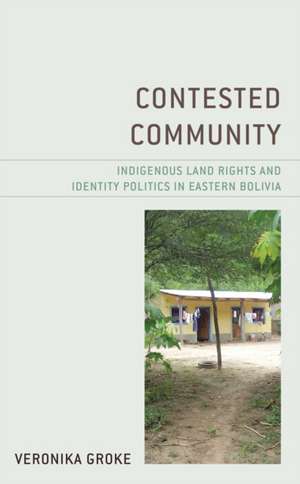
Contested Community: Indigenous Land Rights and Identity Politics in Eastern Bolivia
Autor Veronika Grokeen Limba Engleză Paperback – 15 mar 2023
Preț: 221.53 lei
Preț vechi: 307.35 lei
-28%
Puncte Express: 332
Carte tipărită la comandă
Livrare economică 24 noiembrie-08 decembrie
Livrare prin curier în România Termenul estimat este afișat lângă disponibilitate.
Transport gratuit de la 400.00 lei Plată online sau ramburs, în funcție de opțiunile comenzii.
Retur gratuit în 14 zile Comandă securizată și suport în română.
Specificații
ISBN-13: 9781793613752
ISBN-10: 1793613753
Pagini: 276
Ilustrații: 18 b/w photos; 2 maps;
Dimensiuni: 154 x 223 x 17 mm
Greutate: 0.37 kg
Editura: Bloomsbury Publishing
Colecția Lexington Books
Locul publicării:New York, United States
ISBN-10: 1793613753
Pagini: 276
Ilustrații: 18 b/w photos; 2 maps;
Dimensiuni: 154 x 223 x 17 mm
Greutate: 0.37 kg
Editura: Bloomsbury Publishing
Colecția Lexington Books
Locul publicării:New York, United States
Cuprins
Part I: The Comunidad in History - History in the Comunidad
Chapter 1. Cañón de Segura and Its Histories
Chapter 2. 'Tenemos Nuestra Historia': A Case of History Objectified
Part II: 'This Is a Free Community': Comunarios' Ideas about 'Comunidad'
Chapter 3. Tranquility Beats Reciprocity? Of Shifting Meanings and Enduring Significance
Chapter 4. The Emergent Community
Part III: Multiple Perspectives: Negotiating Different Meanings of 'Comunidad'
Chapter 5. (N)GOs and the Economy of Proyectos
Chapter 6. Beautiful Culture, 'Shitty Indians': The Comunidades in Karai and Guaraní Identity Politics
Chapter 7. Changing Alliances: The Elusive Position of Guaraní Comunidades in Local and Regional Politics
Chapter 1. Cañón de Segura and Its Histories
Chapter 2. 'Tenemos Nuestra Historia': A Case of History Objectified
Part II: 'This Is a Free Community': Comunarios' Ideas about 'Comunidad'
Chapter 3. Tranquility Beats Reciprocity? Of Shifting Meanings and Enduring Significance
Chapter 4. The Emergent Community
Part III: Multiple Perspectives: Negotiating Different Meanings of 'Comunidad'
Chapter 5. (N)GOs and the Economy of Proyectos
Chapter 6. Beautiful Culture, 'Shitty Indians': The Comunidades in Karai and Guaraní Identity Politics
Chapter 7. Changing Alliances: The Elusive Position of Guaraní Comunidades in Local and Regional Politics
Recenzii
This fine-grained ethnography follows a group of formerly captive Guaraní as they make a new indigenous community in the Bolivian Chaco. Groke traces the many constructed meanings of the term 'community,' showing how it takes form through a mix of histories, memories, myths, and discourses, as well as the lived experiences of kinship and reciprocal sociality. In a masterful examination of politics at multiple scales, Groke shows how the Guaraní negotiate development agencies' aims to develop them and regional elites' efforts to coop them, in the process maintaining Guaraní notions of freedom and mobility.
Contested Community offers the reader a richly documented ethnographic and historical account of the Guaraní struggle to recover ancestral land in Bolivia. With intimate portraits and oral testimonies of community leaders and archival and legal research, Groke illustrates the ways that violence, knowledge, the law, and ultimately, collective power and determination, led to the recovery of one corner of Guaraní territory. This book is an invaluable contribution to Guaraní Studies, to the Guaraní themselves, and to the unfinished history of decolonizing Bolivia.
A fascinating account of Guaraní life on Bolivia's lowland frontiers under the first Movimiento al Socialismo (MAS) government of Evo Morales. Frank and engagingly written, Groke gives a sensitive and astute account of the tense political pressures affecting the community of Cañón de Segura, and of Guaraní people's stubborn search for space, identity, and freedom. Faced with the landed gentry in power in Santa Cruz, as well as with the neighboring mestizos (karai), the Guaraní claim their histories, their communities, and their dead. The concept of comunidad is described in all its porous ambiguity, as a shifting vehicle for indigenous defense and innovation in the face of neocolonial violence.
A positive moral valence is broadly given to the concept of community, particularly in its common association with the recognition and rights of indigenous peoples. Contested Community counters this uncritical tendency through a well-drawn examination of a group of formerly captive Guaraní who live in Cañón de Segura, located in the Chaco region of southeastern Bolivia. Groke's study is informed by archival, legal, and other historical documents that accompany rich, ethnographically grounded accounts of how community (comunidad) is as much a "locus of conflict and negotiation" (p. 17) as a relational source of identity and belonging. Although Groke's primary focus is the role of politics-particularly during the first term of former president Evo Morales-she also illuminates the ways that food, drink, festival, work, and other deeply embodied elements of existence connect multiple historical trajectories to the creation and use of space, genealogical memory, and the incorporation of as well as resistance to concepts and practices drawn from the legacies of colonialism and slavery, Christianity, nationalism, and political resistance. Although the work focuses primarily on the Guaraní, it nonetheless provides tools to interrogate the meaning and uses of community in many other contexts. Recommended. Lower-division undergraduates through faculty; professionals.
Contested Community offers the reader a richly documented ethnographic and historical account of the Guaraní struggle to recover ancestral land in Bolivia. With intimate portraits and oral testimonies of community leaders and archival and legal research, Groke illustrates the ways that violence, knowledge, the law, and ultimately, collective power and determination, led to the recovery of one corner of Guaraní territory. This book is an invaluable contribution to Guaraní Studies, to the Guaraní themselves, and to the unfinished history of decolonizing Bolivia.
A fascinating account of Guaraní life on Bolivia's lowland frontiers under the first Movimiento al Socialismo (MAS) government of Evo Morales. Frank and engagingly written, Groke gives a sensitive and astute account of the tense political pressures affecting the community of Cañón de Segura, and of Guaraní people's stubborn search for space, identity, and freedom. Faced with the landed gentry in power in Santa Cruz, as well as with the neighboring mestizos (karai), the Guaraní claim their histories, their communities, and their dead. The concept of comunidad is described in all its porous ambiguity, as a shifting vehicle for indigenous defense and innovation in the face of neocolonial violence.
A positive moral valence is broadly given to the concept of community, particularly in its common association with the recognition and rights of indigenous peoples. Contested Community counters this uncritical tendency through a well-drawn examination of a group of formerly captive Guaraní who live in Cañón de Segura, located in the Chaco region of southeastern Bolivia. Groke's study is informed by archival, legal, and other historical documents that accompany rich, ethnographically grounded accounts of how community (comunidad) is as much a "locus of conflict and negotiation" (p. 17) as a relational source of identity and belonging. Although Groke's primary focus is the role of politics-particularly during the first term of former president Evo Morales-she also illuminates the ways that food, drink, festival, work, and other deeply embodied elements of existence connect multiple historical trajectories to the creation and use of space, genealogical memory, and the incorporation of as well as resistance to concepts and practices drawn from the legacies of colonialism and slavery, Christianity, nationalism, and political resistance. Although the work focuses primarily on the Guaraní, it nonetheless provides tools to interrogate the meaning and uses of community in many other contexts. Recommended. Lower-division undergraduates through faculty; professionals.