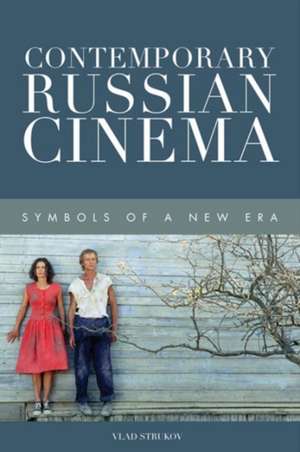
Contemporary Russian Cinema
Autor Vlad Strukoven Limba Engleză Hardback – 26 apr 2016
Preț: 598.55 lei
Preț vechi: 797.73 lei
-25%
Puncte Express: 898
Carte tipărită la comandă
Livrare economică 07-21 decembrie
Livrare prin curier în România Termenul estimat este afișat lângă disponibilitate.
Transport gratuit pentru acest produs Plată online sau ramburs, în funcție de opțiunile comenzii.
Retur gratuit în 14 zile Comandă securizată și suport în română.
Specificații
ISBN-13: 9781474407649
ISBN-10: 1474407641
Pagini: 304
Dimensiuni: 152 x 239 x 23 mm
Greutate: 0.56 kg
Editura: EDINBURGH UNIVERSITY PRESS
ISBN-10: 1474407641
Pagini: 304
Dimensiuni: 152 x 239 x 23 mm
Greutate: 0.56 kg
Editura: EDINBURGH UNIVERSITY PRESS
V-ar putea interesa
-
 Preț: 323.22 lei
 -
 The Edinburgh Companion to Irvine WelshBerthold Schoene-17%Preț: 177.33 lei214.35 lei
 -
 -15%Preț: 212.13 lei250.14 lei
 -
 George StevensNeil SinyardPreț: 278.12 lei
 -
 Storytelling for Film and TelevisionKen DancygerPreț: 391.67 lei
 -
 Preț: 391.16 lei
 -
 The Costumes of Burlesque: 1866-2018Coleen ScottPreț: 456.58 lei
 -
 Memory and Securitization in Contemporary EuropeVlad Strukov-18%Preț: 925.11 lei1128.18 lei
 -
 Female Stars of British CinemaMelanie Williams-17%Preț: 173.77 lei208.65 lei
 -
 Refocus: The Films of Delmer DavesMatthew Carter-16%Preț: 212.58 lei251.76 lei
 -
 Extreme CinemaAaron Kerner-17%Preț: 171.55 lei207.25 lei
 -
 World Cinema and the Essay FilmBrenda Hollweg-25%Preț: 598.09 lei797.42 lei
 -
 Refocus: The Films of Francis VeberKeith Corson-25%Preț: 627.71 lei831.47 lei
 -
 -6%Preț: 175.71 lei187.73 lei
 -
 Animal WorldsLaura Mcmahon-25%Preț: 597.38 lei793.88 lei
 -
 Preț: 215.87 lei
 -
 Mit den Ohren sehenViola SchmidtPreț: 140.50 lei
 -
 Kein Land in SichtMichael KleffPreț: 151.53 lei
 -
 Esclavos de la tradiciónMayuresh KumarPreț: 137.84 lei
Cuprins
Introduction
Chapter 1: Abstracted Subjectivity and Knowledge-Worlds: Aleksandr Sokurov's Taurus (2001)
Chapter 2: The Lacking Sense of Cinema: Aleksandr Proshkin's The Miracle (2009)
Chapter 3: Gatekeepers of (Non-)Knowledge: Aleksei Balabanov's Morphine (2008)
Chapter 4: Symbolic Folds and Flattened Discourse: Andrei Zviagintsev's Elena (2010)
Chapter 5: Non-Knowledge and the Symbolic Mode: Nikolai Khomeriki's A Tale About Darkness (2009)
Chapter 6: The World and the Event: Kirill Serebrennikov's St. George's Day (2008)
Chapter 7: A Plea for the Dead (Self): Renata Litvinova's Goddess: How I Fell in Love (2004)
Chapter 8: Body in Crisis and Posthumous Subjectivity: Igor' Voloshin's Nirvana (2008)
Chapter 9: The Difficulty of Being Dead: Aleksandr Veledinskii's Alive (2006)
Chapter 10: Intentionality and Modelled Subjectivities: Aleksei Fedorchenko's Silent Souls (2010)
Chapter 11: Abandoned Being: Mikhail Kalatozishvili's The Wild Field (2008)
Chapter 12: Conclusions: Amplifications of Subjectivity: Aleksandr Zel'dovich's The Target (2010)
Filmography
Bibliography
Index
Chapter 1: Abstracted Subjectivity and Knowledge-Worlds: Aleksandr Sokurov's Taurus (2001)
Chapter 2: The Lacking Sense of Cinema: Aleksandr Proshkin's The Miracle (2009)
Chapter 3: Gatekeepers of (Non-)Knowledge: Aleksei Balabanov's Morphine (2008)
Chapter 4: Symbolic Folds and Flattened Discourse: Andrei Zviagintsev's Elena (2010)
Chapter 5: Non-Knowledge and the Symbolic Mode: Nikolai Khomeriki's A Tale About Darkness (2009)
Chapter 6: The World and the Event: Kirill Serebrennikov's St. George's Day (2008)
Chapter 7: A Plea for the Dead (Self): Renata Litvinova's Goddess: How I Fell in Love (2004)
Chapter 8: Body in Crisis and Posthumous Subjectivity: Igor' Voloshin's Nirvana (2008)
Chapter 9: The Difficulty of Being Dead: Aleksandr Veledinskii's Alive (2006)
Chapter 10: Intentionality and Modelled Subjectivities: Aleksei Fedorchenko's Silent Souls (2010)
Chapter 11: Abandoned Being: Mikhail Kalatozishvili's The Wild Field (2008)
Chapter 12: Conclusions: Amplifications of Subjectivity: Aleksandr Zel'dovich's The Target (2010)
Filmography
Bibliography
Index
Notă biografică
Vlad Strukov is Associate Professor at the University of Leeds, specialising in world cinemas, digital media and cultural theory
Descriere
Descriere de la o altă ediție sau format:
One of the first books to explore Russian cinema in the new millennium, this volume captures the emergence of a new cinematic sensibility and interprets it through the framework of the symbolic mode.
One of the first books to explore Russian cinema in the new millennium, this volume captures the emergence of a new cinematic sensibility and interprets it through the framework of the symbolic mode.