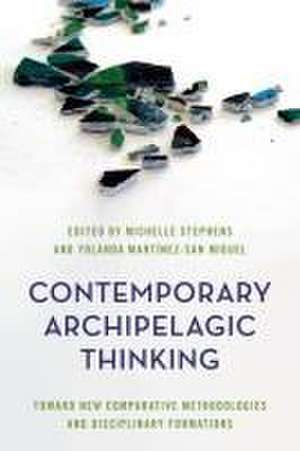
Contemporary Archipelagic Thinking: Toward New Comparative Methodologies and Disciplinary Formations: Rethinking the Island
Editat de Michelle Stephens, Yolanda Martínez-San Miguelen Limba Engleză Paperback – 26 apr 2024



Preț: 263.36 lei
Preț vechi: 354.15 lei
-26%
Puncte Express: 395
Carte tipărită la comandă
Livrare economică 30 noiembrie-14 decembrie
Livrare prin curier în România Termenul estimat este afișat lângă disponibilitate.
Transport gratuit de la 400.00 lei Plată online sau ramburs, în funcție de opțiunile comenzii.
Retur gratuit în 14 zile Comandă securizată și suport în română.
Specificații
ISBN-13: 9781538149911
ISBN-10: 1538149915
Pagini: 498
Ilustrații: 51 b/w illustrations
Dimensiuni: 148 x 228 x 28 mm
Greutate: 0.66 kg
Editura: Bloomsbury Publishing
Colecția Rowman & Littlefield
Seria Rethinking the Island
Locul publicării:New York, United States
ISBN-10: 1538149915
Pagini: 498
Ilustrații: 51 b/w illustrations
Dimensiuni: 148 x 228 x 28 mm
Greutate: 0.66 kg
Editura: Bloomsbury Publishing
Colecția Rowman & Littlefield
Seria Rethinking the Island
Locul publicării:New York, United States
Descriere
Contemporary Archipelagic Thinking takes as point of departure the insights of Antonio Benítez Rojo, Derek Walcott and Edouard Glissant on how to conceptualize the Caribbean as a space in which networks of islands are constitutive of a particular epistemology or way of thinking. This rich volumetakes questions that have explored the Caribbean and expands them to a global, Anthropocenic framework.
This anthology explores the archipelagic as both a specific and a generalizable geo-historical and cultural formation, occurring across various planetary spaces including: the Mediterranean and Aegean Seas, the Caribbean basin, the Malay archipelago, Oceania, and the creole islands of the Indian Ocean. As an alternative geo-formal unit, archipelagoes can interrogate epistemologies, ways of reading and thinking, and methodologies informed implicitly or explicitly by more continental paradigms and perspectives. Keeping in mind the structuring tension between land and water, and between island and mainland relations, the archipelagic focuses on the types of relations that emerge, island to island, when island groups are seen not so much as sites of exploration, identity, sociopolitical formation, and economic and cultural circulation, but also, and rather, as models.
The book includes 21 chapters, a series of poems and an Afterword from both senior and junior scholars in American Studies, Archaeology, Biology, Cartography, Digital Mapping, Environmental Studies, Ethnomusicology, Geography, History, Politics, Comparative Literary and Cultural Studies, and Sociology who engage with Archipelago studies. Archipelagic Studies has become a framework with a robust intellectual genealogy.. The particular strength of this handbook is the diversity of fields and theoretical approaches in the Humanities, Social Sciences and Natural Sciences that the included essays engage with. There is an editor's introduction in which they meditate about the specific contributions of the archipelagic framework in interdisciplinary analyses of multi-focal and transnational socio-political and cultural context, and in which they establish a dialogue between archipelagic thinking and network theory, assemblages, systems theory, or the study of islands, oceans and constellations.
This anthology explores the archipelagic as both a specific and a generalizable geo-historical and cultural formation, occurring across various planetary spaces including: the Mediterranean and Aegean Seas, the Caribbean basin, the Malay archipelago, Oceania, and the creole islands of the Indian Ocean. As an alternative geo-formal unit, archipelagoes can interrogate epistemologies, ways of reading and thinking, and methodologies informed implicitly or explicitly by more continental paradigms and perspectives. Keeping in mind the structuring tension between land and water, and between island and mainland relations, the archipelagic focuses on the types of relations that emerge, island to island, when island groups are seen not so much as sites of exploration, identity, sociopolitical formation, and economic and cultural circulation, but also, and rather, as models.
The book includes 21 chapters, a series of poems and an Afterword from both senior and junior scholars in American Studies, Archaeology, Biology, Cartography, Digital Mapping, Environmental Studies, Ethnomusicology, Geography, History, Politics, Comparative Literary and Cultural Studies, and Sociology who engage with Archipelago studies. Archipelagic Studies has become a framework with a robust intellectual genealogy.. The particular strength of this handbook is the diversity of fields and theoretical approaches in the Humanities, Social Sciences and Natural Sciences that the included essays engage with. There is an editor's introduction in which they meditate about the specific contributions of the archipelagic framework in interdisciplinary analyses of multi-focal and transnational socio-political and cultural context, and in which they establish a dialogue between archipelagic thinking and network theory, assemblages, systems theory, or the study of islands, oceans and constellations.
Cuprins
Acknowledgments
Archipelagic Poetics: Foreword, Craig Santos Perez
1. Introduction: "Isolated Above, but Connected Below": Toward New, Global, Archipelagic Linkages, Yolanda Martínez-San Miguel and Michelle Stephens
PART I: SPACE, SCALE, LANGUAGE, AND TIME: FOUNDATIONAL EPISTEMOLOGICAL CONTRIBUTIONS OF ARCHIPELAGIC THOUGHT
2. Disciplinary Formations, Creative Tensions, and Certain Logics in Archipelagic Studies, Elaine Stratford
3. The Affirmational Turn to Ontology in the Anthropocene: A Critique, Jonathan Pugh
4. What Is an Archipelago? On Bandung Praxis, Lingua Franca, and Archipelagic Interlapping, Brian Russell Roberts
5. The Chronotopes of Archipelagic Thinking: Glissant and the Narrative of Philosophy, Lanny Thompson
PART II: BEYOND THE SEA AS METAPHOR: COMPARATIVE MARITIME EPISTEMOLOGIES
6. An Early Medieval "Sea of Islands": Area Studies, Medieval Studies, and Traditions of Wayfinding, Jeremy DeAngelo
7. Archipelago of the Maghreb: Mapping Mediterranean Movement from Transnational Migration to Transregional Mobility, Sarah DeMott
8. Archipelagic Deformations and Decontinental Disability Studies, Mary Eyring
9. Digital Currents, Oceanic Drift, and the Evolving Ecology of the Temporary Autonomous Zone, Lisa Swanstrom
PART III: ARCHIPELAGIC ENVIRONMENTS: EVOLVING POLITICAL ECOLOGIES
10. Literary Archipelagraphies: Readings from the British-Irish Archipelago, Pippa Marland
11. Conservation Archipelago: Protecting Long-Distance Migratory Shorebirds along the Atlantic Flyway, Jenny R. Isaacs
12. The Debris of Caribbean History: Literature, Art, and Archipelagic Plastic, Lizabeth Paravisini-Gebert
PART IV: RELATIONAL ARCHIPELAGICS: REDEFINING IMPERIAL AND POSTCOLONIAL STUDIES
13. Archipelagoes as the Fractal Fringe of Coloniality: Demilitarizing Caribbean and Pacific Islands, Mimi Sheller
14. Sardinia "Lost between Europe and Africa": Archaeology and Archipelagic Theory, Thomas P. Leppard, Elizabeth A. Murphy, and Andrea Roppa
15. Sovereignty between Empire and Nation-State: The Archipelago as Postcolonial Format, Christopher J. Lee
16. Archipelagic Feeling: Counter-mapping Indigeneity and Diaspora in the Trans-Pacific, Haruki Eda
PART V: INTER-ISLAND DYNAMISMS: SMALL ISLANDS/BIG WORLDS
17. "Together, but Not Together, Together": The Politics of Identity in Island Archipelagoes, Godfrey Baldacchino
18. Small Islands, Large Radio: Archipelagic Listening in the Caribbean, Jessica Swanston Baker
19. The Insular and the Transnational Archipelagoes: The Indo-Caribbean in Samuel Selvon and Harold Sonny Ladoo, Anjali Nerlekar
20. On Archipelagic Beings, Gitanjali Pyndiah
Index
About the Contributors
Archipelagic Poetics: Foreword, Craig Santos Perez
1. Introduction: "Isolated Above, but Connected Below": Toward New, Global, Archipelagic Linkages, Yolanda Martínez-San Miguel and Michelle Stephens
PART I: SPACE, SCALE, LANGUAGE, AND TIME: FOUNDATIONAL EPISTEMOLOGICAL CONTRIBUTIONS OF ARCHIPELAGIC THOUGHT
2. Disciplinary Formations, Creative Tensions, and Certain Logics in Archipelagic Studies, Elaine Stratford
3. The Affirmational Turn to Ontology in the Anthropocene: A Critique, Jonathan Pugh
4. What Is an Archipelago? On Bandung Praxis, Lingua Franca, and Archipelagic Interlapping, Brian Russell Roberts
5. The Chronotopes of Archipelagic Thinking: Glissant and the Narrative of Philosophy, Lanny Thompson
PART II: BEYOND THE SEA AS METAPHOR: COMPARATIVE MARITIME EPISTEMOLOGIES
6. An Early Medieval "Sea of Islands": Area Studies, Medieval Studies, and Traditions of Wayfinding, Jeremy DeAngelo
7. Archipelago of the Maghreb: Mapping Mediterranean Movement from Transnational Migration to Transregional Mobility, Sarah DeMott
8. Archipelagic Deformations and Decontinental Disability Studies, Mary Eyring
9. Digital Currents, Oceanic Drift, and the Evolving Ecology of the Temporary Autonomous Zone, Lisa Swanstrom
PART III: ARCHIPELAGIC ENVIRONMENTS: EVOLVING POLITICAL ECOLOGIES
10. Literary Archipelagraphies: Readings from the British-Irish Archipelago, Pippa Marland
11. Conservation Archipelago: Protecting Long-Distance Migratory Shorebirds along the Atlantic Flyway, Jenny R. Isaacs
12. The Debris of Caribbean History: Literature, Art, and Archipelagic Plastic, Lizabeth Paravisini-Gebert
PART IV: RELATIONAL ARCHIPELAGICS: REDEFINING IMPERIAL AND POSTCOLONIAL STUDIES
13. Archipelagoes as the Fractal Fringe of Coloniality: Demilitarizing Caribbean and Pacific Islands, Mimi Sheller
14. Sardinia "Lost between Europe and Africa": Archaeology and Archipelagic Theory, Thomas P. Leppard, Elizabeth A. Murphy, and Andrea Roppa
15. Sovereignty between Empire and Nation-State: The Archipelago as Postcolonial Format, Christopher J. Lee
16. Archipelagic Feeling: Counter-mapping Indigeneity and Diaspora in the Trans-Pacific, Haruki Eda
PART V: INTER-ISLAND DYNAMISMS: SMALL ISLANDS/BIG WORLDS
17. "Together, but Not Together, Together": The Politics of Identity in Island Archipelagoes, Godfrey Baldacchino
18. Small Islands, Large Radio: Archipelagic Listening in the Caribbean, Jessica Swanston Baker
19. The Insular and the Transnational Archipelagoes: The Indo-Caribbean in Samuel Selvon and Harold Sonny Ladoo, Anjali Nerlekar
20. On Archipelagic Beings, Gitanjali Pyndiah
Index
About the Contributors
Recenzii
Through literary studies, anthropology and archaeology, poetry, philosophy, cartography, eco-environmental critique, ethnomusicology-and more-the contributors to Contemporary Archipelagic Thinking provide dazzling insights into fragments of time, space, genealogy, and political culture that shape global "interlapping" journeys. Across the Pacific, Caribbean, Mediterranean, Atlantic, and Indian Ocean, they capture elusive experiences that redefine histories and narratives lived through continents, oceans, and islands.
Archipelagic modes of thought offer just what we need to grasp the ambiguities of our contemporary world, and Contemporary Archipelagic Thinking offers an indispensable guide. Attentive to the development of new ways of theorizing, always geographically specific, never forgetful of the legacies of colonialism, this is an urgent book but also one that makes time to remember poetry.
Archipelagic thinking centers islands' geographies and their populations' histories as an onto-ecological ferment producing mobilities between and among seas, lands, continents, and peoples. This volume's prose and poetry shift the meaning of islands, moving from insular islands to spaces that are produced vis-à-vis the intertwinements of place and the inseparable autonomies of sociocultural practices. This bold and dynamic thinking--archipelagic thinking--is a provocative text that champions a methodology. It demands that we think of totality through the elements that compose place--tracing the connections, flows, and mobilities that constitute place.
Yolanda Martinez-San Miguel and Michelle Stephens have gathered in Contemporary Archipelagic Thinking a stellar line-up of scholars and artists who are on the cutting edge of redefining the epistemologies that have traditionally informed area studies. This volume models the interdisciplinarity it calls for, probing the political, ecological, geographical, and aesthetic dimensions of culture beyond the confines of the nation state. Its achievements are many, not the least of which is its capacity to open new ways of imagining the interplay of locality and globality without the tired anxieties of influence that have often plagued previous efforts.
Like a multilayered archipelago, poetry and scholarship resonate and come together in beautiful new forms in this extraordinary collection. Subaqueous and subterranean connections and entanglements forge new relational paths and unfold in revelatory ways. Inspiring world-making visions, the collection draws attention to the intellectual seismic shifts reimagining how we think through the human, the non-human, and our geographic worlds.
Contemporary Archipelagic Thinking reveals what forms of intellectual, political, material, and ecological relation become possible when archipelagoes are imagined not as peripheral or marginal geo-formations, but as models for new modes of affiliation and transformation. The essays and poems in this volume constellate fresh and often surprising perspectives on a contemporary world in which the scales of the global and the local are themselves in shifting relation.
This groundbreaking collection of essays, by seeking to establish a more flexible definition of the archipelago, draws together its historical, cultural, and diasporic dimensions to seek out new epistemologies, new modes of inquiry and new methodologies that will reframe a range of interdisciplinary approaches by viewing them through an archipelagic prism. By conceiving the analytical and re-presentational potential of islands, oceans and bodies of water as a framework that can theorize multiplicity and difference, and expanding it to a global framework, the resulting disciplinary formations will enable new perspectives and conclusions across a host of fields, from literature and poetics to environmental studies to the study of empire and postcoloniality.
Archipelagic modes of thought offer just what we need to grasp the ambiguities of our contemporary world, and Contemporary Archipelagic Thinking offers an indispensable guide. Attentive to the development of new ways of theorizing, always geographically specific, never forgetful of the legacies of colonialism, this is an urgent book but also one that makes time to remember poetry.
Archipelagic thinking centers islands' geographies and their populations' histories as an onto-ecological ferment producing mobilities between and among seas, lands, continents, and peoples. This volume's prose and poetry shift the meaning of islands, moving from insular islands to spaces that are produced vis-à-vis the intertwinements of place and the inseparable autonomies of sociocultural practices. This bold and dynamic thinking--archipelagic thinking--is a provocative text that champions a methodology. It demands that we think of totality through the elements that compose place--tracing the connections, flows, and mobilities that constitute place.
Yolanda Martinez-San Miguel and Michelle Stephens have gathered in Contemporary Archipelagic Thinking a stellar line-up of scholars and artists who are on the cutting edge of redefining the epistemologies that have traditionally informed area studies. This volume models the interdisciplinarity it calls for, probing the political, ecological, geographical, and aesthetic dimensions of culture beyond the confines of the nation state. Its achievements are many, not the least of which is its capacity to open new ways of imagining the interplay of locality and globality without the tired anxieties of influence that have often plagued previous efforts.
Like a multilayered archipelago, poetry and scholarship resonate and come together in beautiful new forms in this extraordinary collection. Subaqueous and subterranean connections and entanglements forge new relational paths and unfold in revelatory ways. Inspiring world-making visions, the collection draws attention to the intellectual seismic shifts reimagining how we think through the human, the non-human, and our geographic worlds.
Contemporary Archipelagic Thinking reveals what forms of intellectual, political, material, and ecological relation become possible when archipelagoes are imagined not as peripheral or marginal geo-formations, but as models for new modes of affiliation and transformation. The essays and poems in this volume constellate fresh and often surprising perspectives on a contemporary world in which the scales of the global and the local are themselves in shifting relation.
This groundbreaking collection of essays, by seeking to establish a more flexible definition of the archipelago, draws together its historical, cultural, and diasporic dimensions to seek out new epistemologies, new modes of inquiry and new methodologies that will reframe a range of interdisciplinary approaches by viewing them through an archipelagic prism. By conceiving the analytical and re-presentational potential of islands, oceans and bodies of water as a framework that can theorize multiplicity and difference, and expanding it to a global framework, the resulting disciplinary formations will enable new perspectives and conclusions across a host of fields, from literature and poetics to environmental studies to the study of empire and postcoloniality.