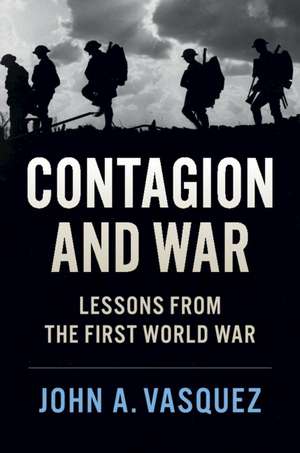
Contagion and War: Lessons from the First World War
Autor John A. Vasquezen Limba Engleză Hardback – 21 noi 2018
Această monografie academică, publicată de Cambridge University Press, reprezintă o analiză riguroasă a mecanismelor care transformă un conflict bilateral într-un război generalizat. John A. Vasquez investighează fenomenul contagiunii în relațiile internaționale, folosind Primul Război Mondial ca studiu de caz fundamental. Considerăm că forța acestei lucrări rezidă în structura sa tripartită: o fundamentare teoretică ce propune șase modele de contagiune (de la alianțe la dependență economică), urmată de o examinare empirică a deciziilor de intrare în război pentru fiecare stat implicat între 1914 și 1917, și finalizată cu o sinteză a lecțiilor istorice relevante.
Subliniem faptul că volumul Contagion and War extinde cadrul propus de Is This a Private Fight or Can Anybody Join? de Zachary C. Shirkey prin detalierea proceselor decizionale specifice fiecărui actor statal, nu doar a evenimentelor neprevăzute care schimbă așteptările neutrilor. În contextul operei sale, această lucrare completează temele recurente ale lui John A. Vasquez explorate în The War Puzzle Revisited și Territory, War, and Peace, unde autorul a stabilit deja importanța teritorialității ca sursă de conflict. Aici, el trece de la cauzele declanșării la dinamica expansiunii, oferind un aparat metodologic ce include 15 tabele și 80 de exerciții, transformând textul într-un instrument de lucru esențial pentru seminarele de studii de conflict.
Tonul este unul analitic, evitând speculațiile și ancorând fiecare concluzie în succesiuni temporale precise, fapt ce permite cititorului să înțeleagă nu doar 'de ce', ci mai ales 'cum' s-a propagat belligeranța la nivel global. Este o resursă indispensabilă pentru cercetătorii care doresc să depășească descrierile pur istoriografice în favoarea unei înțelegeri teoretice a riscului de escaladare.
Preț: 663.77 lei
Preț vechi: 745.81 lei
-11%
Carte tipărită la comandă
Livrare economică 08-22 iulie
Specificații
ISBN-10: 1108417043
Pagini: 412
Ilustrații: 27 b/w illus. 15 tables 80 exercises
Dimensiuni: 157 x 235 x 24 mm
Greutate: 0.79 kg
Editura: Cambridge University Press
Colecția Cambridge University Press
Locul publicării:Cambridge, United Kingdom
V-ar putea interesa
-
 -15%Preț: 442.75 lei520.88 lei
 -
 -18%Preț: 1195.05 lei1457.37 lei
 -
 American Foreign Policy in a Globalized WorldDavid P. ForsythePreț: 455.63 lei
 -
 Zionism and the Foundations of Israeli DiplomacySasson SoferPreț: 365.92 lei
 -
 Preț: 399.12 lei
 -
 Crisis Diplomacy: The Great Powers since the Mid-Nineteenth CenturyJames L. RichardsonPreț: 335.52 lei
 -
 The War Puzzle RevisitedJohn A. VasquezPreț: 328.57 lei
 -
 Preț: 431.38 lei
 -
 -18%Preț: 1218.68 lei1486.19 lei
 -
 The Scientific Study of Peace and War: A Text ReaderJohn A. Vasquez-26%Preț: 336.80 lei452.48 lei
 -
 International Diplomacy and United States National PoliciesBernard J. Ficarra-24%Preț: 312.09 lei412.30 lei
 -
 The Outbreak of the First World WarJack S. LevyPreț: 247.31 lei
 -
 Israel in the American MindShaul MitelpunktPreț: 334.81 lei
 -
 Preț: 213.93 lei
 -
 Preț: 196.15 lei
 -
 Conflict, War, and PeaceSara Mclaughlin Mitchell-27%Preț: 838.38 lei1148.47 lei
De ce să citești această carte
Recomandăm această carte studenților și specialiștilor în relații internaționale care caută o explicație structurală a modului în care războaiele se extind. Cititorul câștigă o înțelegere profundă a celor șase mecanisme de contagiune și a modului în care alianțele sau proximitatea geografică forțează statele neutre să intervină. Este un instrument analitic rar, care combină rigoarea științelor politice cu detaliul istoric al Marelui Război.
Despre autor
John A. Vasquez este profesor titular și Mackie Scholar în Relații Internaționale în cadrul Departamentului de Științe Politice de la Universitatea Illinois, Urbana-Champaign. Recunoscut la nivel mondial pentru abordările sale empirice și cantitative asupra cauzelor războiului, Vasquez a publicat lucrări fundamentale care au redefinit studiul conflictelor armate. În Contagion and War, el își rafinează teoriile despre pace și război, continuând tradiția cercetării sistematice începută în lucrări precum The War Puzzle Revisited. Expertiza sa acoperă diplomația, crizele internaționale și rolul teritoriului în violența inter-grupuri, fiind una dintre cele mai autoritare voci în domeniu.
Descriere scurtă
Cuprins
Recenzii
'Contagion and War is a nuanced and systematic exploration of the multiple causal processes through which war might spread, illustrated by a detailed examination of the First World War. Vasquez makes a significant contribution to both the theory of international conflict and to our historical understanding of one of the world's most catastrophic and consequential wars.' Jack S. Levy, Rutgers University, New Jersey
'Contagion and War adds to our knowledge of World War I and multiparty conflicts … by recognizing that temporal sequences are involved in both the start and spread of belligerency, and teasing out and exploring the mechanisms associated with them.' Richard Ned Lebow, War in History