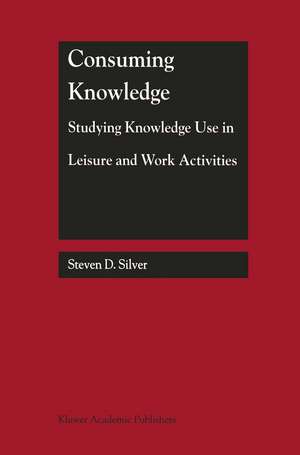
Consuming Knowledge: Studying Knowledge Use in Leisure and Work Activities
Autor Steven D. Silveren Limba Engleză Paperback – 4 oct 2012
Preț: 613.94 lei
Preț vechi: 722.28 lei
-15%
Puncte Express: 921
Carte tipărită la comandă
Livrare economică 16-30 noiembrie
Livrare prin curier în România Termenul estimat este afișat lângă disponibilitate.
Transport gratuit pentru acest produs Plată online sau ramburs, în funcție de opțiunile comenzii.
Retur gratuit în 14 zile Comandă securizată și suport în română.
Specificații
ISBN-13: 9781461370864
ISBN-10: 1461370868
Pagini: 260
Ilustrații: XII, 242 p.
Dimensiuni: 155 x 235 x 14 mm
Greutate: 0.37 kg
Ediția:Softcover reprint of the original 1st ed. 2000
Editura: Springer Us
Colecția Springer
Locul publicării:New York, NY, United States
ISBN-10: 1461370868
Pagini: 260
Ilustrații: XII, 242 p.
Dimensiuni: 155 x 235 x 14 mm
Greutate: 0.37 kg
Ediția:Softcover reprint of the original 1st ed. 2000
Editura: Springer Us
Colecția Springer
Locul publicării:New York, NY, United States
V-ar putea interesa
-
 -17%Preț: 305.07 lei369.19 lei
 -
 -12%Preț: 367.18 lei417.59 lei
 -
 -20%Preț: 298.08 lei374.13 lei
 -
 How the Economy Works: Confidence, Crashes and Self-Fulfilling PropheciesRoger E. A. Farmer-19%Preț: 87.02 lei107.69 lei
 -
 Macroeconomics and the Phillips Curve MythJames Forder-31%Preț: 790.56 lei1147.34 lei
 -
 The Death of MoneyJames Rickards-31%Preț: 63.50 lei92.05 lei
 -
 -8%Preț: 540.45 lei587.45 lei
 -
 The Escape from Balance Sheet Recession and the Qe TrapRichard C KooPreț: 232.94 lei
 -
 Zero Lower Bound Term Structure ModelingL. Krippner-8%Preț: 579.21 lei629.57 lei
 -
 Status Through ConsumptionSteven D. SilverPreț: 371.73 lei
 -
 Structural Funds: Growth, Employment and the EnvironmentNicos Christodoulakis-15%Preț: 636.47 lei748.79 lei
 -
 CryptocurrencyMichael J. Casey-19%Preț: 63.81 lei78.58 lei
 -
 The Internal Structure of U. S. Consumption ExpendituresLester D. Taylor-15%Preț: 620.36 lei729.83 lei
 -
 Preț: 364.07 lei
 -
 Comparison of Box-Jenkins and Bonn Monetary Model Predition PerformanceM. N. BhattacharyyaPreț: 365.29 lei
 -
 Grundzüge der analytischen MakroökonomieThorsten HensPreț: 247.44 lei
 -
 MakroökonomieHeinz-Peter SpahnPreț: 236.57 lei
 -
 Akquisitionsmethode und Bewertung immaterieller VermögenswerteTorsten Jaskolski-15%Preț: 460.38 lei541.62 lei
 -
 The End of BankingJonathan McMillanPreț: 133.20 lei
Public țintă
ResearchCuprins
1. Introduction.- Introduction: Consuming Knowledge.- Plan of the Exposition.- Contrasting Disciplinal Frameworks in the Study of Consumption.- Studying Non-Work Activities.- An Interactive System in Non-Work Activities.- Estimation of the Activity System.- Disturbances to the Activity System: Studying Effects of Environments.- Summary and Conclusions.- Notes.- References.- 2. Dimensioning Consumption: The Use of Knowledge in Non-Work Activities.- Factor Inputs in Non-Work Activities.- Consumer Objectives in Non-Work Activities.- Identity-Yielding Non-Work Activities.- Functional Form for a Multi-Factor Non-Work Activity System.- Dynamic Properties of the Activity System.- Examining the Sensitivities of Dynamic Activities through Simulation.- Summary and Conclusions.- Notes.- Appendix: Multi-Factor Activity System.- References.- 3. The Construct of the Valuing of Knowledge and Personal Consumption Expenditure in the U.S. National Accounts 1929-1989.- Measurement of the Value Constructs.- Constructing the Value Series.- Examining the Relationship between the Value and Experience Stock Constructs and Personal Consumption Expenditure.- Investigating Dynamic Variation in the Value Constructs: Income and Education Effects.- Summary and Conclusions.- Notes.- Appendix A: Unit Root Tests.- Appendix B: Autocorrelation-Robust Regression Estimates.- Appendix C: Value Construct Data.- References.- 4. The Interaction of Non-work and Work Activities: Cross-domain Transfers of Skill and Affect.- Introduction: The Study of Transfers between Non-Work and Work Domains.- Representing Interaction in the Non-Work and Work Domains.- Cross-Domain Productivity Effects.- Evaluating the Sensitivity of Work Activities to the Intensity of Knowledge in Non-Work Activities.- Discussion.- Summary andConclusions.- References.- 5. Integrating Non-work Activities into Frameworks of Economic Growth.- Production from Knowledge in Growth Frameworks.- Linking Consumption to Growth through Non-Work Activities.- Growth Model.- Comparative Study of Non-Work Activities in Economic Growth.- Summary and Conclusions.- Notes.- References.- 6. Directions for the Study of Knowledge Use in Non-Work Activities.- Summary of the Exposition.- Investigating the Acquisition and Use of Knowledge in Non-Work Activities: Overview of an Agenda.- Conceptualization and Measurement of Stocks of Knowledge in Non-Work Activities.- The Construct of the Valuing of Knowledge and Knowledge Use in Non-Work Activities.- Constructing Identity in Non-Work Activities: Integrating Environments and Agency.- Institutional Environments of Non-Work Activities.- Extending the Activity Framework.- Conclusions.- Notes.- References.- Appendix: Story Sample for Content Analyses of the Value Constructs.