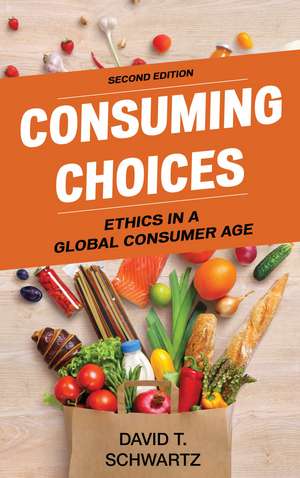
Consuming Choices: Ethics in a Global Consumer Age
Autor David T. Schwartzen Limba Engleză Hardback – 29 mar 2017
Preț: 458.64 lei
Preț vechi: 643.13 lei
-29%
Puncte Express: 688
Carte tipărită la comandă
Livrare economică 16-30 noiembrie
Livrare prin curier în România Termenul estimat este afișat lângă disponibilitate.
Transport gratuit pentru acest produs Plată online sau ramburs, în funcție de opțiunile comenzii.
Retur gratuit în 14 zile Comandă securizată și suport în română.
Specificații
ISBN-13: 9781442275454
ISBN-10: 1442275456
Pagini: 162
Dimensiuni: 150 x 232 x 18 mm
Greutate: 0.46 kg
Ediția:2
Editura: Bloomsbury Publishing
Colecția Rowman & Littlefield
Locul publicării:New York, United States
ISBN-10: 1442275456
Pagini: 162
Dimensiuni: 150 x 232 x 18 mm
Greutate: 0.46 kg
Ediția:2
Editura: Bloomsbury Publishing
Colecția Rowman & Littlefield
Locul publicării:New York, United States
V-ar putea interesa
-
 Essays on the History of EthicsMichael Slote-31%Preț: 600.41 lei871.78 lei
 -
 Deadly VicesGabriele Taylor-13%Preț: 323.24 lei370.66 lei
 -
 Reasons and the GoodRoger Crisp-12%Preț: 320.12 lei362.30 lei
 -
 A Theory of Virtue: Excellence in Being for the GoodRobert Merrihew Adams-13%Preț: 302.92 lei347.04 lei
 -
 The Constitution of Agency: Essays on Practical Reason and Moral PsychologyChristine M. Korsgaard-11%Preț: 363.03 lei407.60 lei
 -
 -21%Preț: 369.66 lei467.05 lei
 -
 Slaves of the PassionsMark Schroeder-11%Preț: 359.81 lei405.93 lei
 -
 The Limits of LoyaltySimon KellerPreț: 349.06 lei
 -
 -17%Preț: 130.86 lei157.59 lei
 -
 Sharing TimeElizabeth VerdickPreț: 58.67 lei
 -
 -25%Preț: 94.15 lei126.32 lei
Descriere
Being a consumer is now integral to the human experience, something none of us can avoid. At the same time, many of the products that we buy come to us with histories steeped in highly unethical practices, such as worker exploitation, animal suffering, and environmental damage. Consuming Choices considers the ethical dimensions of consumer life by exploring several basic questions: Exactly what sorts of unethical practices are implicated in today's consumer products? Does moral culpability for these practices fall solely on the companies that perform them, or does it also fall upon consumers who purchase the products made with such practices? And most importantly, do consumers ever have moral obligations to avoid particular products? To answer, David T. Schwartz provides the most detailed philosophical exploration to date on consumer ethics. He utilizes historical and fictional examples to illustrate the types of wrongdoing currently implicated by consumer products in this age of globalization, offers a clear description of the relevant moral theories and important ethical concepts, and provides concrete suggestions on how to be a more ethical consumer.
Cuprins
Preface
Chapter 1: Ethical Consumerism
Chapter 2: Caveat Emptor?
Chapter 3: The Consumer as Causal Agent
Chapter 4: The Consumer as Complicit Participant
Chapter 5: Toward a Practical Consumer Ethic
Notes
Bibliography
Chapter 1: Ethical Consumerism
Chapter 2: Caveat Emptor?
Chapter 3: The Consumer as Causal Agent
Chapter 4: The Consumer as Complicit Participant
Chapter 5: Toward a Practical Consumer Ethic
Notes
Bibliography
Recenzii
Professor Schwartz's book offers an instructive view on the ethics of consumption that reaches globally while paying attention to the local. He considers different kinds and cases of individual and collective ethical wrong doing, and he provides causal, consequentialist, and complicit culpability accounts thereof. His multifaceted approach to the subject matter --- using a hypothetical scenario here to illuminate a moral problem, or a historical example there to illustrate an ethical concept, etc. --- allows the reader or student alternative avenues to get at the crux of an issue. The previous edition of Schwartz's book challenged my students to think critically about the complex ethical nature of consumption while thoughtfully considering possible solutions to a variety of problems. For a course in contemporary moral issues, global ethics, or perhaps a bioethics or similarly motivated course, I would certainly recommend the second edition to the instructor who would intend a similar pedagogical effect.