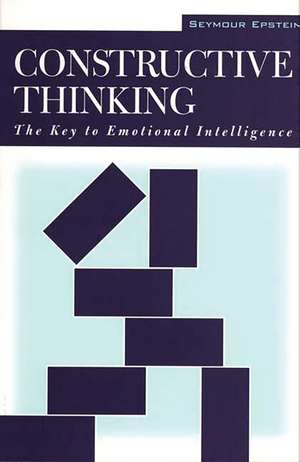
Constructive Thinking: The Key to Emotional Intelligence
Autor Seymour Epsteinen Limba Engleză Hardback – 27 aug 1998
În capitolul fundamental intitulat „O poveste despre două minți”, Seymour Epstein pune bazele unei înțelegeri riguroase a psihicului uman, demarcând clar funcționarea minții rațional-analitice de cea a minții intuitiv-experiențiale. Putem afirma că relevanța acestei lucrări rezidă în fundamentarea științifică a inteligenței emoționale, un concept adesea tratat superficial în literatura de popularizare, dar care aici primește rigoarea unei cercetări academice de zeci de ani. Autorul argumentează că, în timp ce IQ-ul măsoară inteligența analitică, succesul în viață și echilibrul interior depind de „gândirea constructivă”, o formă de inteligență a sistemului experiențial care poate fi evaluată prin inventarul CTI inclus în volum.
Structura cărții urmărește o progresie logică, de la definirea teoretică a celor două sisteme, la dovezi empirice și aplicații practice în domenii precum succesul la locul de muncă, relațiile interpersonale și sănătatea fizică. Merită menționat că textul este conceput pentru nivelul universitar, oferind nu doar teorie, ci și exerciții de evaluare a gândirii automate și tehnici de antrenare a minții experiențiale. Constructive Thinking completează perspectiva oferită de Rationality and the Reflective Mind de Keith Stanovich, adăugând o metodologie concretă de intervenție asupra proceselor intuitive, nu doar o analiză a erorilor de raționament.
În contextul operei sale, această carte reprezintă rafinarea ideilor din Cognitive-Experiential Theory, unde Seymour Epstein a propus o teorie integratoare a personalității. Dacă în lucrările anterioare accentul cădea pe arhitectura teoretică, Constructive Thinking translatează aceste concepte într-un format aplicat, păstrând însă standardele academice care l-au consacrat pe autor în revistele de specialitate.
Preț: 476.07 lei
Preț vechi: 691.15 lei
-31%
Carte tipărită la comandă
Livrare economică 07-21 decembrie
Specificații
ISBN-10: 0275958841
Pagini: 304
Dimensiuni: 156 x 235 x 28 mm
Greutate: 0.64 kg
Ediția:New.
Editura: Bloomsbury Publishing
Colecția Praeger
Locul publicării:New York, United States
V-ar putea interesa
-
 The Power of Physical IntelligenceTony BuzanPreț: 58.25 lei
 -
 Spell-Out and the Minimalist ProgramJuan Uriagereka-20%Preț: 388.51 lei483.66 lei
 -
 The Origin of ConceptsSusan Carey-27%Preț: 375.07 lei515.68 lei
 -
 Trusting PerformanceN. RokotnitzPreț: 302.60 lei
 -
 Perceptual IllusionsC. CalabiPreț: 408.25 lei
 -
 The g Factor: The Science of Mental AbilityArthur R. Jensen-33%Preț: 580.72 lei863.35 lei
 -
 Cognition and MotivationShulamith Kreitler-11%Preț: 661.73 lei743.51 lei
 -
 Cognitive PsychologyMatthew CoxonPreț: 320.69 lei
 -
 Flourish: A Visionary New Understanding of Happiness and Well-BeingMartin E P SeligmanPreț: 113.35 lei
 -
 The Confidence Workbook: Teach YourselfAdrian Tannock-23%Preț: 96.04 lei125.13 lei
 -
 The Little CBT WorkbookDr Michael Sinclair-27%Preț: 67.51 lei92.21 lei
De ce să citești această carte
Această carte este esențială pentru studenții și profesioniștii din psihologie care doresc o abordare fundamentată științific a inteligenței emoționale. Cititorul câștigă acces la instrumentul Constructive Thinking Inventory și învață tehnici validate de control al emoțiilor prin înțelegerea procesării intuitive. Este un manual riguros care transformă concepte abstracte în strategii practice pentru reducerea stresului și îmbunătățirea adaptării sociale.
Despre autor
Seymour Epstein este Profesor Emerit de Psihologie la University of Massachusetts, Amherst, fiind recunoscut la nivel internațional ca o autoritate în psihologia personalității. Cu o carieră de peste patru decenii susținută de National Institute of Mental Health, Epstein a dezvoltat Teoria Cognitiv-Experiențială, o contribuție majoră în științele cognitive. Dincolo de activitatea de cercetător și autor de tratate academice, el a explorat psihicul uman și prin literatură, așa cum demonstrează succesul romanului său „Leah”. Această dualitate între rigoarea statistică și intuiția literară îi permite să abordeze inteligența emoțională dintr-o perspectivă unică și profundă.
Descriere
According to the theory, people operate by two minds, a rational-analytical mind and an intuitive-experiential mind, the latter being intimately associated with emotions. Each mind operates by its own principles and each has its own form of intelligence. The intelligence of the rational-analytical mind is measured by IQ tests and the intelligence of the intuitive-experiential mind (which is related to emotional intelligence) by the Constructive Thinking Inventory (CTI), a test developed by Epstein that is included in the book. By understanding the principles of operation of the intuitive-experiential mind, it is possible to train it as well as to learn from it, and thereby to improve one's emotional intelligence. The book provides exercises for applying the principles in everyday life and a review of a variety of other procedures for improving emotional intelligence. It is suited for use as a primary or supplementary text in courses on improving emotional intelligence or coping with stress as well as for individual reading.
Cuprins
A Tale of Two Minds
Emotional Intelligence Revisited
What Is Emotional Intelligence, and How Can It Be Measured?
Constructive Thinking: The Intelligence of the Experiential Mind
Testing Your Constructive Thinking
Evidence for the Existence of the Experiential Mind
How Your Experiential Mind Thinks
Why We Do What We Do: A New Understanding of Human Behavior
Constructive Thinking and Success in Living
Constructive Thinking and Success in the Workplace
Constructive Love
Better Constructive Thinking Means Better Adjustment and Less Stress
How You Think Can Affect Your Health
Where Constructive Thinking Comes From and How It Changes
Once a Constructive Thinker, Always a Constructive Thinker?
Parenting Good Constructive Thinkers
How Life Experience Affects Constructive Thinking
Improving Your Constructive Thinking
Getting to Know Your Experiential Self
Evaluating Your Automatic Thinking
Training Your Experiential Mind
The Wisdom of the Experiential Mind
Epilogue: Constructive Thinking in Broader Context
Index