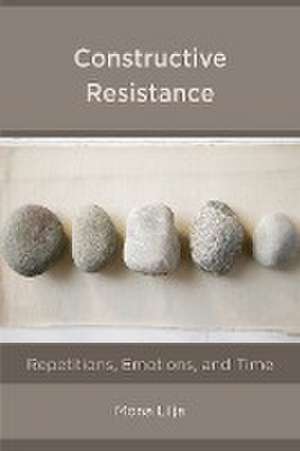
Constructive Resistance: Repetitions, Emotions, and Time
Autor Mona Liljaen Limba Engleză Paperback – 5 apr 2023
More specifically, the book discusses the discursive struggles regarding migrant bodies, where artifacts that pertain to the hardship are presented in Swedish museums; the Preah Vihear temple conflict between Cambodia and Thailand; the border conflict in West Sahara; the self-making of (self-defined) women politicians in Cambodia; and climate activism communication. Through discussions on the importance of figurations, posters, narratives, photographs, artifacts and buildings in the establishing of contemporary discussions and world views, the book inquires how and why these representations are (re)imparted with meaning and the effect that this has.
The book does not only illustrate different forms of resistance, but also contributes theoretically to our understanding of repetitions, emotions and time, which are properties that must be embarked upon in order to capture the various dimension of resistance. Given that the type of constructive resistance that is expanded upon is about processes of significations, the time aspect-how alternative truths are repeated and thereby established over time-becomes crucial. And, resistance has a temporality of its own; for example, close authorities are instantly resisted here and now, while meaning-making resistance suffers from the inescapable time-lag of processes of signification. In all forms of resistance, emotions prevail as an important engine of political struggles and, as is displayed in this book, emotions are an important means of constructive resistance.
Preț: 219.46 lei
Preț vechi: 306.23 lei
-28%
Puncte Express: 329
Carte tipărită la comandă
Livrare economică 30 noiembrie-14 decembrie
Livrare prin curier în România Termenul estimat este afișat lângă disponibilitate.
Transport gratuit de la 400.00 lei Plată online sau ramburs, în funcție de opțiunile comenzii.
Retur gratuit în 14 zile Comandă securizată și suport în română.
Specificații
ISBN-13: 9781538149942
ISBN-10: 153814994X
Pagini: 202
Ilustrații: 7 b/w photos;
Dimensiuni: 148 x 226 x 12 mm
Greutate: 0.28 kg
Editura: Bloomsbury Publishing
Colecția Rowman & Littlefield
Locul publicării:New York, United States
ISBN-10: 153814994X
Pagini: 202
Ilustrații: 7 b/w photos;
Dimensiuni: 148 x 226 x 12 mm
Greutate: 0.28 kg
Editura: Bloomsbury Publishing
Colecția Rowman & Littlefield
Locul publicării:New York, United States
V-ar putea interesa
-
 Preț: 72.21 lei
 -
 -15%Preț: 457.38 lei538.09 lei
 -
 -19%Preț: 314.00 lei388.70 lei
 -
 My Life as an ExplorerRoald AmundsenPreț: 79.45 lei
 -
 Preț: 275.41 lei
 -
 La Pequeña MuerteDaniela RendónPreț: 253.64 lei
 -
 LA CONSTRUCCIÓN Y VALIDACIÓN DE UN INSTRUMENTO EDUMÉTRICONelson Paucca GonzalesPreț: 253.64 lei
 -
 Investigación Cualitativa en Salud IIILuis Enrique Hernández GamundiPreț: 255.68 lei
 -
 ¿Migrar es Neoesclavizarse?Christ-Levy Leboba NdjokaPreț: 253.79 lei
 -
 Impactos de las Restricciones de Movilidad en los Derechos de los UsuariosAndrea Carolina Vergara PauttPreț: 253.79 lei
 -
 Essai d¿éthique politique au BurundiAloys Misago-8%Preț: 419.45 lei455.92 lei
 -
 Précarité socioéconomique et environnementale urbaineProsper Mampeta BulayaPreț: 254.52 lei
 -
 Interprétation des Mots Français: Sources de Conflit au Nord du PNVi?Josias Kambale LuhembaPreț: 254.29 lei
 -
 La problématique de la gestion des eaux usées domestiquesDjiby Abdoul SyPreț: 392.84 lei
 -
 Problématique de la recherche éthique en AfriqueSimon de Marie Safari BurhunganePreț: 255.10 lei
 -
 Afrique et le paradigme de la terreurMohamed Lamine KabaPreț: 253.64 lei
Cuprins
Foreword by Roland Bleiker
Acknowledgments
1. Constructive Resistance: Emotions, Repetitions, and Time
PART I: RESISTANCE AND REPETITION
2. Resistance and Repetition: The Emotional Construction of Preah Vihear Temple Replicas
3. Constructive Resistance: Communicating Dissent through Repetitions
4. Layer-Cake Figurations and Resistance in Cambodia
PART II: RESISTANCE AND EMOTIONS
5. Dangerous Bodies, Matter, and Emotions: Public Assemblies and Embodied Resistance
6. Constructive Resistance as Emotional Reality Effects: Strategies of Representation of the Japanese Civil Society
7. Artifacts, Affects, and Authenticity: Constructive Resistance in Museum Spaces
PART III: RESISTANCE AND TIME
8. Geographies of Time and Resistance
9. The Politics of Time and Temporality in Foucault's Theorization of Resistance: Ruptures, Time Lags, and Decelerations
10. Bodies, Non-Bodies, and the Desert: Resistance and Political Time Concepts in Photo Images
11. Conclusion
Acknowledgments
1. Constructive Resistance: Emotions, Repetitions, and Time
PART I: RESISTANCE AND REPETITION
2. Resistance and Repetition: The Emotional Construction of Preah Vihear Temple Replicas
3. Constructive Resistance: Communicating Dissent through Repetitions
4. Layer-Cake Figurations and Resistance in Cambodia
PART II: RESISTANCE AND EMOTIONS
5. Dangerous Bodies, Matter, and Emotions: Public Assemblies and Embodied Resistance
6. Constructive Resistance as Emotional Reality Effects: Strategies of Representation of the Japanese Civil Society
7. Artifacts, Affects, and Authenticity: Constructive Resistance in Museum Spaces
PART III: RESISTANCE AND TIME
8. Geographies of Time and Resistance
9. The Politics of Time and Temporality in Foucault's Theorization of Resistance: Ruptures, Time Lags, and Decelerations
10. Bodies, Non-Bodies, and the Desert: Resistance and Political Time Concepts in Photo Images
11. Conclusion
Recenzii
Through a nuanced conceptualization of constructive resistance, Mona Lilja provides a sophisticated window into the relationship between everyday resistance, power, knowledge, repetition and the social construction of subjectivities. This is a highly original and important work from one of the foremost contemporary theorists of resistance studies.
I cannot recommend this book highly enough. Constructive Resistance provides a fresh, theoretically sophisticated and empirically rich analysis of forms of resistance that often remain unseen, but which should be central to our understanding of politics, power and being human. Expertly weaving together discussions around resistance, power, temporality, bodies and emotions, it is a ground-breaking study by one of the world's leading resistance scholars at the very top of her intellectual powers. I am in no doubt that this book changes the way we understand resistance, while at the same time, it has a wider relevance and importance far beyond the field of resistance studies.
Lilja's conceptualization proposes a distinctive and innovative characterization of those aspects of resistance that exceed opposition and create alternative discourses, ways of life, desires and bodies. Her concept of constructive resistance is an original and complex combination of theoretical reflections inspired by a series of case studies analyzed and discussed both at the level of practices and in terms of discourses.. Overall, Lilja's book is a brilliant contribution to recent efforts in conceptualizing resistance beyond its oppositional stance.Constructive Resistance is a fundamental and much needed contribution to the emerging field of resistance studies, but it also promises to influence debates on power and resistance in philosophy and social sciences.
Mona Lilja's new book moves beyond the one-dimensional conceptualization of resistance in power terms, and argues that resistance produces alternatives for social and political transformation. This is a thorough and innovative exploration that demonstrates how constructive resistance is "performed, displayed, and repeated" (p. 2).. The book makes an important contribution to the growing scholarship on conceptualizing resistance beyond power terms. Lilja blends innovative theoretical concepts with empirical evidence from different societies and various forms of resistance. As a result, the book is lucidly argued and contests established truths with alternative knowledge. The author's flexible conception of resistance allows societies to think of and practice new forms of defiance. Overall, this inspiring book should be widely read.
I cannot recommend this book highly enough. Constructive Resistance provides a fresh, theoretically sophisticated and empirically rich analysis of forms of resistance that often remain unseen, but which should be central to our understanding of politics, power and being human. Expertly weaving together discussions around resistance, power, temporality, bodies and emotions, it is a ground-breaking study by one of the world's leading resistance scholars at the very top of her intellectual powers. I am in no doubt that this book changes the way we understand resistance, while at the same time, it has a wider relevance and importance far beyond the field of resistance studies.
Lilja's conceptualization proposes a distinctive and innovative characterization of those aspects of resistance that exceed opposition and create alternative discourses, ways of life, desires and bodies. Her concept of constructive resistance is an original and complex combination of theoretical reflections inspired by a series of case studies analyzed and discussed both at the level of practices and in terms of discourses.. Overall, Lilja's book is a brilliant contribution to recent efforts in conceptualizing resistance beyond its oppositional stance.Constructive Resistance is a fundamental and much needed contribution to the emerging field of resistance studies, but it also promises to influence debates on power and resistance in philosophy and social sciences.
Mona Lilja's new book moves beyond the one-dimensional conceptualization of resistance in power terms, and argues that resistance produces alternatives for social and political transformation. This is a thorough and innovative exploration that demonstrates how constructive resistance is "performed, displayed, and repeated" (p. 2).. The book makes an important contribution to the growing scholarship on conceptualizing resistance beyond power terms. Lilja blends innovative theoretical concepts with empirical evidence from different societies and various forms of resistance. As a result, the book is lucidly argued and contests established truths with alternative knowledge. The author's flexible conception of resistance allows societies to think of and practice new forms of defiance. Overall, this inspiring book should be widely read.