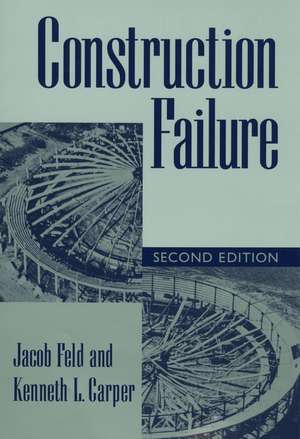
Construction Failure
Autor Jacob Feld, Kenneth L Carperen Limba Engleză Hardback – 26 dec 1996
Jacob Feld knew thirty years ago that in order to learn from our mistakes, we must first acknowledge and understand them. With this revised volume, Kenneth Carper has ensured that Feld's now-posthumous message will continue to be heard for years to come.
Jacob Feld's comprehensive work on failure analysis has now been skillfully amended to address current design and construction tools, materials, and practices. Building on the first edition's peerless examination of the causes and lessons of failure, Construction Failure, Second Edition provides you with expanded coverage of:
- Technical, procedural, structural, and nonstructural failures
- Natural hazards, earthworks, soil and foundation problems, and more
- Reinforced, precast and prestressed concrete, steel, timber, masonry, and other materials
- Responsibility and litigation concerns, dispute avoidance, and alternative dispute resolution techniques
- Construction safety issues
- Many different types of structures, including dams and bridges
Preț: 1291.20 lei
Preț vechi: 1418.90 lei
-9%
Puncte Express: 1937
Carte tipărită la comandă
Livrare economică 03-17 decembrie
Livrare prin curier în România Termenul estimat este afișat lângă disponibilitate.
Transport gratuit pentru acest produs Plată online sau ramburs, în funcție de opțiunile comenzii.
Retur gratuit în 14 zile Comandă securizată și suport în română.
Specificații
ISBN-13: 9780471574774
ISBN-10: 0471574775
Pagini: 528
Dimensiuni: 161 x 240 x 33 mm
Greutate: 0.96 kg
Ediția:2nd Revised edition
Editura: Wiley
Locul publicării:Hoboken, United States
ISBN-10: 0471574775
Pagini: 528
Dimensiuni: 161 x 240 x 33 mm
Greutate: 0.96 kg
Ediția:2nd Revised edition
Editura: Wiley
Locul publicării:Hoboken, United States
V-ar putea interesa
-
 Construction Management of Healthcare ProjectsSanjiv Gokhale-40%Preț: 559.78 lei938.92 lei
-
 -40%Preț: 816.68 lei1353.22 lei
-
 2012 International Building Code HandbookDouglas Thornburg-34%Preț: 1191.80 lei1794.27 lei
-
 -11%Preț: 658.34 lei739.72 lei
-
 Estimating Construction CostsRobert Peurifoy-29%Preț: 1368.17 lei1916.38 lei
-
 The Development of Transportation in Modern EnglandWilliam T. Jackman-18%Preț: 1717.47 lei2094.48 lei
-
 -19%Preț: 705.06 lei870.45 lei
-
 Earthquake Engineering for Concrete DamsAnil K Chopra-9%Preț: 883.67 lei971.06 lei
-
 -18%Preț: 1248.98 lei1523.15 lei
-
 -24%Preț: 642.61 lei845.54 lei
-
 Integrated Matrix Analysis of StructuresMario Paz-18%Preț: 951.61 lei1160.51 lei
-
 The Seismic Design HandbookFarzad Naeim-18%Preț: 1440.23 lei1756.38 lei
-
 -15%Preț: 599.31 lei705.07 lei
-
 Civil Engineering Topics, Volume 4Tom Proulx-18%Preț: 1200.79 lei1464.37 lei
-
 Preț: 365.86 lei
-
 The Surveying HandbookRussell C. Brinker-24%Preț: 1319.02 lei1735.55 lei
-
 Building Economics: Theory and PracticeHarold Marshall-18%Preț: 958.81 lei1169.27 lei
-
 Dictionary of Civil Engineering: English-FrenchJean-Paul Kurtz-24%Preț: 955.99 lei1257.87 lei
-
 Heisswasser- und HochdruckdampfanlagenGünter Scholz-18%Preț: 1111.95 lei1356.04 lei
-
 Der maschinelle ErdbauGünter Kühn-15%Preț: 482.13 lei567.21 lei
-
 Preț: 281.97 lei
-
 Entwurf eines KrisenmanagementhandbuchesHolger KönneckePreț: 318.91 lei
Public țintă
Design Engineers in the Civil, Structural, and Geotechnical fields, Architects, Constructors, Construction Managers, Forensic Engineers working in the Construction Industry, Students studying Architecture, Engineering, Construction and Law.Notă biografică
JACOB FELD (1899-1975) was a prominent structural engineer in NewYork for many years with design responsibility for a number ofimportant buildings, including the New York Coliseum, GuggenheimMuseum, Yonkers Raceway, and Lincoln Center. From 1966 until hisdeath in 1975, he was a partner in the firm of Feld, Kaminetzky& Cohen. Feld was a graduate of City College, receiving anhonorary doctor of laws degree from that institution in 1972, aswell as a PhD from the University of Cincinnati in 1922. He servedas president of the New York Academy of Sciences and was a Fellowof the American Society of Civil Engineers (ASCE), which cited himas "Metropolitan Engineer of the Year" in 1969. Feld also receivedthe Townsend Harris Award of the City College Alumni Association,the Alumni Award of the University of Cincinnati, and the FrenchOrder of Merit. He taught as a visiting professor at PurdueUniversity, Northwestern University, and North Carolina StateUniversity.
KENNETH L. CARPER, a registered architect with degrees in botharchitecture and civil engineering, is a professor in the School ofArchitecture at Washington State University. He has received manyteaching awards, including the 1994 all-university President'sFaculty Excellence Award at WSU. A past chair of the ASCE TechnicalCouncil on Forensic Engineering, Carper is the current and foundingEditor in Chief of the ASCE Journal of Performance of ConstructedFacilities. His professional awards include the national ASCEDaniel W. Mead and Richard Torrens Awards. In 1994, he was named"Engineer of the Year" by the Inland Empire Section of ASCE(Washington and Idaho). Carper has lectured extensively aboutstructural failure to students, faculty, and professional groups ofarchitects, engineers, and building officials in the United States,Canada, Europe, India, and Japan. Prior publications include thebooks Forensic Engineering and Forensic Engineering: Learning fromFailures.
KENNETH L. CARPER, a registered architect with degrees in botharchitecture and civil engineering, is a professor in the School ofArchitecture at Washington State University. He has received manyteaching awards, including the 1994 all-university President'sFaculty Excellence Award at WSU. A past chair of the ASCE TechnicalCouncil on Forensic Engineering, Carper is the current and foundingEditor in Chief of the ASCE Journal of Performance of ConstructedFacilities. His professional awards include the national ASCEDaniel W. Mead and Richard Torrens Awards. In 1994, he was named"Engineer of the Year" by the Inland Empire Section of ASCE(Washington and Idaho). Carper has lectured extensively aboutstructural failure to students, faculty, and professional groups ofarchitects, engineers, and building officials in the United States,Canada, Europe, India, and Japan. Prior publications include thebooks Forensic Engineering and Forensic Engineering: Learning fromFailures.
Cuprins
Failures: Causes, Costs, and Benefits.
Natural Hazards and Unusual Loads: Effect on the BuiltEnvironment.
Earthworks, Soil, and Foundations Problems.
Dams and Bridges.
Timber Structures.
Steel Structures.
Reinforced Concrete Structures (Cast-in-Place).
Precast and Prestressed Concrete Structures.
Masonry Structures.
Nonstructural Failures.
Construction Safety and Failures during Construction.
Responsibility for Failures: Litigation and ADR Techniques.
Learning from Failures.
Index.
Descriere
The text reviews the history of failure analysis as it relates to the evolution of engineering design. The concepts behind failure analysis are reviewed and its root causes discussed. It includes information updated since the first edition.