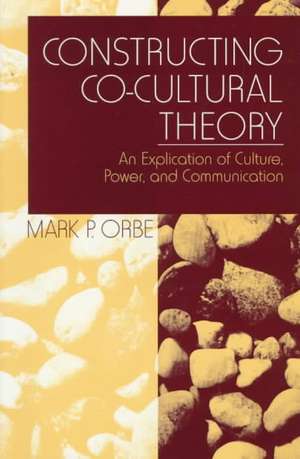
Constructing Co-Cultural Theory
Autor Mark P. Orbeen Limba Engleză Paperback – 25 sep 1997
Preț: 811.59 lei
Preț vechi: 989.74 lei
-18%
Puncte Express: 1217
Carte tipărită la comandă
Livrare economică 30 noiembrie-14 decembrie
Livrare prin curier în România Termenul estimat este afișat lângă disponibilitate.
Transport gratuit pentru acest produs Plată online sau ramburs, în funcție de opțiunile comenzii.
Retur gratuit în 14 zile Comandă securizată și suport în română.
Specificații
ISBN-13: 9780761910688
ISBN-10: 0761910689
Pagini: 168
Ilustrații: 1
Dimensiuni: 152 x 229 x 9 mm
Greutate: 0.25 kg
Ediția:New.
Editura: SAGE Publications
Locul publicării:Thousand Oaks, United States
ISBN-10: 0761910689
Pagini: 168
Ilustrații: 1
Dimensiuni: 152 x 229 x 9 mm
Greutate: 0.25 kg
Ediția:New.
Editura: SAGE Publications
Locul publicării:Thousand Oaks, United States
V-ar putea interesa
-
 The Devil That Danced on the WaterAminatta FornaPreț: 92.49 lei
 -
 Country Of My SkullAntjie Krog-19%Preț: 76.61 lei94.05 lei
 -
 -21%Preț: 282.06 lei355.70 lei
 -
 -28%Preț: 346.93 lei482.89 lei
 -
 -31%Preț: 710.53 lei1030.88 lei
 -
 Understanding Social ExclusionJohn Hills-28%Preț: 392.55 lei547.65 lei
 -
 Language Rights and Political TheoryWill Kymlicka-28%Preț: 415.04 lei577.10 lei
 -
 -15%Preț: 648.96 lei763.48 lei
 -
 The Other Side of the RiverAlex KotlowitzPreț: 118.45 lei
 -
 Preț: 101.55 lei
 -
 Polite LiesKyoko MoriPreț: 111.85 lei
 -
 Ethnicity and GlobalizationStephen Castles-15%Preț: 480.60 lei565.41 lei
 -
 Transcultural Counselling in Action (Second Edition)Patricia D'Ardenne-15%Preț: 583.38 lei686.34 lei
 -
 The SAGE Handbook of Intercultural CompetenceDarla K. Deardorff-27%Preț: 1095.68 lei1500.93 lei
 -
 -43%Preț: 263.89 lei465.59 lei
Cuprins
An Introduction into Co-Cultural Communication
Foundations of Muted Group and Standpoint Theory
Explicating Phenomenological Inquiry
Co-Cultural Communicative Practices
Clarifying a Co-Cultural Communication Process
Limitations, Extensions and Future Directions
Foundations of Muted Group and Standpoint Theory
Explicating Phenomenological Inquiry
Co-Cultural Communicative Practices
Clarifying a Co-Cultural Communication Process
Limitations, Extensions and Future Directions
Notă biografică
Mark P. Orbe (PhD, Ohio University) is professor of communication and diversity in the School of Communication at Western Michigan University, where he also holds a joint appointment in the gender and women¿s studies program. He conducts research in interpersonal-intercultural communication, co-cultural communication, intergroup relations, mass media representations of underrepresented group members, and negotiation/intersection of multiple cultural identities. Over his career, has published ten books and hundreds of journal articles and book chapters. He is also founder and president of Dumela Communications, a full-service consulting company that specializes in providing services for clients committed to enhancing their communication cultural competencies.
Descriere
This book presents a phenomenological framework for understanding the intricate relationship between culture, power and communication. Grounded in muted group and standpoint theory, this volume presents a theoretical framework which fosters a critically insightful vantage point into the complexities of culture, power and communication. Key coverage includes: a review and critique of the literature on co-cultural communication; a description of how the perspective of co-cultural group members were involved in each stage of theory development; and an explication of 25 co-cultural communication strategies and a model of six factors that influence strategy selection. The final chapter examines how co-cultural theory correlates with other work i