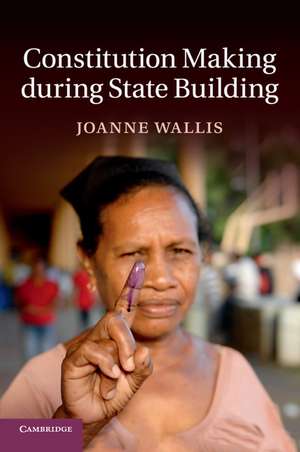
Constitution Making during State Building
Autor Joanne Wallisen Limba Engleză Paperback – 25 feb 2016
Preț: 320.25 lei
Puncte Express: 480
Carte tipărită la comandă
Livrare economică 07-21 decembrie
Livrare prin curier în România Termenul estimat este afișat lângă disponibilitate.
Transport gratuit de la 400.00 lei Plată online sau ramburs, în funcție de opțiunile comenzii.
Retur gratuit în 14 zile Comandă securizată și suport în română.
Specificații
ISBN-13: 9781107666658
ISBN-10: 1107666651
Pagini: 420
Ilustrații: 3 maps 2 tables
Dimensiuni: 152 x 229 x 23 mm
Greutate: 0.61 kg
Editura: Cambridge University Press
Locul publicării:New York, United States
ISBN-10: 1107666651
Pagini: 420
Ilustrații: 3 maps 2 tables
Dimensiuni: 152 x 229 x 23 mm
Greutate: 0.61 kg
Editura: Cambridge University Press
Locul publicării:New York, United States
V-ar putea interesa
-
 Constitutional TheoryGeoffrey Marshall-23%Preț: 340.08 lei439.32 lei
 -
 Judicial Review: Principles and ProcedureJonathan Auburn-23%Preț: 2517.87 lei3269.96 lei
 -
 The New York State Constitution, Second EditionPeter J. Galie-30%Preț: 1064.66 lei1522.53 lei
 -
 Everyday Law on the Street: City Governance in an Age of DiversityMariana ValverdePreț: 255.99 lei
 -
 Australian Constitutional LandmarksH. P. LeePreț: 322.51 lei
 -
 Legislative DeferralsGeorge I. LovellPreț: 304.12 lei
 -
 Judicial Reasoning Under the UK Human Rights ACTHelen FenwickPreț: 469.26 lei
 -
 Prosecuting Heads of StateEllen L. LutzPreț: 330.25 lei
 -
 -14%Preț: 812.28 lei944.51 lei
 -
 The Cambridge Companion to Human Rights LawConor GeartyPreț: 302.43 lei
 -
 Proportionality and Constitutional CultureMoshe Cohen-EliyaPreț: 300.43 lei
 -
 Presidents and Civil Liberties from Wilson to ObamaSamuel WalkerPreț: 375.21 lei
 -
 Money Laundering: An Analysis of Federal LawCarlyle M Bennett-26%Preț: 395.62 lei531.92 lei
 -
 Affirmative Action & Preferential Treatment: Laws & DevelopmentsPamela L Medina-27%Preț: 999.54 lei1362.45 lei
 -
 Amending the Constitution by an Article V ConventionScott J Hill-26%Preț: 394.65 lei531.30 lei
Cuprins
Part I. Normative Justification for Participatory Constitution Making: 1. The normative justification; 2. A constituent process; Part II. Minimal Participation in Timor-Leste: 3. State building and constitution making in Timor-Leste; 4. Constituent power in Timor-Leste; 5. Constituted power in Timor-Leste; Part III. Extensive Participation in Bougainville: 6. State building and constitution making in Bougainville; 7. Constituent power in Bougainville; 8. Constituted power in Bougainville; Part IV. Evidence for and against Participatory Constitution Making: 9. Comparing the constitution-making processes; 10. Role in state building.
Recenzii
'Joanne Wallis has made an extraordinary contribution to our understanding of the constituent process in twenty-first-century state-building. Based on empirically grounded studies of constitution-making processes in Timor-Leste and Bougainville, Wallis uses a comparative historical method to explore how public participation in constitution-making processes may assist state-building in deeply divided societies. Wallis persuasively argues that the effectiveness of new state institutions is linked to the success in achieving a liberal-local hybridity through popular participation. Her contextually rich analysis is a must-read for lawyers, political scientists, and policy makers around the world who are confronted with the failure of state institutions that were imposed or inherited in the postcolonial and World War II era.' Heinz Klug, Evjue-Bascom Professor of Law and Director of the Global Legal Studies Center, University of Wisconsin Law School
'One of the signal successes of [Wallis's] book is her thorough and wide-ranging survey of the literature on the topic. Moreover, she draws from the survey an extensive and detailed menu for constitutional planning committees on how best to go about creating a process that includes broad representation and that shows due respect for all segments of the new state.' Jean G. Zorn, Pacific Affairs
'One of the signal successes of [Wallis's] book is her thorough and wide-ranging survey of the literature on the topic. Moreover, she draws from the survey an extensive and detailed menu for constitutional planning committees on how best to go about creating a process that includes broad representation and that shows due respect for all segments of the new state.' Jean G. Zorn, Pacific Affairs
Descriere
This book argues that fragmented, divided societies that aren't immediately compatible with centralised statehood can best adjust by emphasising the role of constitution making.