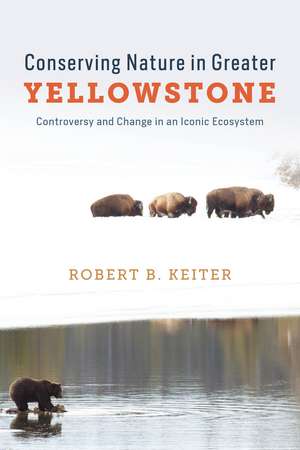
Conserving Nature in Greater Yellowstone: Controversy and Change in an Iconic Ecosystem
Autor Robert B. Keiteren Limba Engleză Paperback – 9 iul 2025
For more than 150 years, the Yellowstone region—now widely known as the twenty-three million acre Greater Yellowstone Ecosystem—has played a prominent role in the United States’ nature conservation agenda. In this book, Robert B. Keiter, an award-winning public land law and policy expert, traces the evolution and application of fundamental ecological conservation concepts tied to Yellowstone.
Keiter’s book highlights both the conservation successes and controversies connected with this storied region, which has been enmeshed in change. During the 1980s, leaders in Yellowstone embraced ecosystem management concepts to recover a dwindling grizzly bear population and to support wolf reintroduction. Since then, management policies in the region’s two national parks and adjacent national forests have largely followed suit, prioritizing ecosystem-level conservation over industrial activity. Groundbreaking efforts are currently afoot to protect elk, deer, and pronghorn migration corridors and to maintain the park’s bison population, effectively expanding the scope of regional conservation initiatives. But in the face of explosive human population growth and related development pressures, new efforts must also account for the region’s privately owned lands along with accelerating recreational activities that present quite different problems.
Indeed, the Greater Yellowstone Ecosystem—extending across three states and twenty counties and embracing more than sixteen million acres of federal land as well as private and tribal lands —can only be characterized as a complex, jurisdictionally fragmented landscape. As Keiter makes clear, the quest for common ground among federal land managers, state officials, local communities, conservationists, ranchers, Indigenous tribes, and others is a vital, enduring task.
Exploring both notable conservation accomplishments and the ongoing challenges confronting this special place, Keiter’s book explains the many forces—scientific, political, economic, legal, cultural, climatic, and more—at work driving controversy and change across the region. But more than this, Conserving Nature in Greater Yellowstone shows us that the lessons gleaned from Yellowstone’s expansive nature conservation efforts are profoundly important for both the country and the world.
Preț: 200.64 lei
Nou
Puncte Express: 301
Preț estimativ în valută:
35.50€ • 41.36$ • 30.100£
35.50€ • 41.36$ • 30.100£
Carte disponibilă
Livrare economică 29 decembrie 25 - 12 ianuarie 26
Livrare express 12-18 decembrie pentru 27.72 lei
Preluare comenzi: 021 569.72.76
Specificații
ISBN-13: 9780226841267
ISBN-10: 022684126X
Pagini: 384
Ilustrații: 15 halftones
Dimensiuni: 152 x 229 x 25 mm
Greutate: 0.43 kg
Ediția:First Edition
Editura: University of Chicago Press
Colecția University of Chicago Press
ISBN-10: 022684126X
Pagini: 384
Ilustrații: 15 halftones
Dimensiuni: 152 x 229 x 25 mm
Greutate: 0.43 kg
Ediția:First Edition
Editura: University of Chicago Press
Colecția University of Chicago Press
Notă biografică
Robert B. Keiter is the Wallace Stegner Professor of Law, University Distinguished Professor, and founding director of the Wallace Stegner Center for Land, Resources, and the Environment at the University of Utah's S. J. Quinney College of Law. His books include To Conserve Unimpaired, Keeping Faith with Nature, and The Greater Yellowstone Ecosystem. He currently serves on the National Park System Advisory Board and as a trustee for the National Parks Conservation Association.
Cuprins
Preface
Introduction
1. Greater Yellowstone and Ecosystem Conservation
2. Nature Conservation in the GYE National Parks
3. Restoring Endangered Species: Grizzly Bears and Wolves
4. Maintaining Migratory Wildlife: Bison, Elk, and Pronghorn
5. The Multiple-Use Lands: From Clearcuts to Playgrounds
6. A Fragmenting Landscape: The Private Land Conservation Challenge
7. Ecosystem Conservation Revisited
Conclusion
Acknowledgments
Notes
Index
Introduction
1. Greater Yellowstone and Ecosystem Conservation
2. Nature Conservation in the GYE National Parks
3. Restoring Endangered Species: Grizzly Bears and Wolves
4. Maintaining Migratory Wildlife: Bison, Elk, and Pronghorn
5. The Multiple-Use Lands: From Clearcuts to Playgrounds
6. A Fragmenting Landscape: The Private Land Conservation Challenge
7. Ecosystem Conservation Revisited
Conclusion
Acknowledgments
Notes
Index
Recenzii
"While Yellowstone National Park is the core of the Greater Yellowstone Ecosystem (GYE), the GYE is actually much bigger than the park, encompassing Grand Teton National Park and a variety of other public lands, for a total of 23 million acres. Keiter, a public land law and policy expert, explores the GYE in this book, which comes out in July. He looks at how the Yellowstone ecosystem came to be tied to conservation, and the controversies, challenges, and changes the region has dealt with in the past, as well as what it’s currently facing. But it’s not just a book about Yellowstone; Keiter examines the lessons in nature conservation learned from Yellowstone and how they can be applied elsewhere, helping to pave the way for the future."
"Voluminous, and eminently timely. . . . Conserving Nature in Greater Yellowstone . . . provides a sobering assessment of how Greater Yellowstone as a concept came into being and the existential challenges it faces, [and] I’m hoping it gets into wide circulation. There’s none other like it and is an important new contribution to the established written canon of conservation."
“The Greater Yellowstone Ecosystem was once an interwoven fabric of biodiversity, migrating wildlife, and the livelihood of Indigenous people. But in our insatiable appetite for economic growth, we sliced it up into pieces for states, timber harvest, mining, energy development, ranches, homesteads, and fortunately, two big parks in the middle. Keiter artfully explains this history and how, with science, law, litigation, policy, and politics, we are trying to stitch it back together into a quilt that may, we hope, resemble its former function and beauty.”
“Keiter did it again!—an insightful, well written, accessible book on Yellowstone’s seminal contribution to America’s and the world’s human-nature interrelations. He captures Yellowstone’s evolving environmental and policy dynamic over history, up to and including present challenges. The Greater Yellowstone Ecosystem of today needs farsighted leadership and enduring public support to sustain this global treasure. Keiter’s book will help all of us in this vital endeavor.”
“No book on the subject comes close to this one in scope or readability, which means it is suitable for both specialists in environmental and natural resource management and casual readers interested in knowing more about this celebrated landscape.”