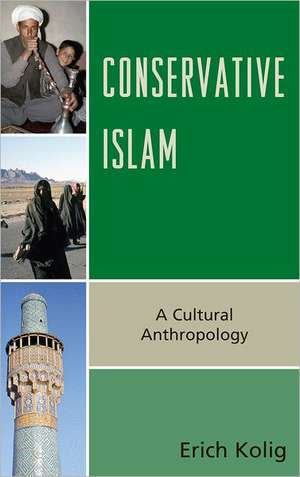
Conservative Islam: A Cultural Anthropology
Autor Erich Koligen Limba Engleză Hardback – 5 apr 2012
Preț: 770.12 lei
Preț vechi: 1206.80 lei
-36%
Puncte Express: 1155
Carte tipărită la comandă
Livrare economică 10-24 noiembrie
Livrare prin curier în România Termenul estimat este afișat lângă disponibilitate.
Transport gratuit pentru acest produs Plată online sau ramburs, în funcție de opțiunile comenzii.
Retur gratuit în 14 zile Comandă securizată și suport în română.
Specificații
ISBN-13: 9780739174241
ISBN-10: 073917424X
Pagini: 410
Dimensiuni: 163 x 236 x 30 mm
Greutate: 0.73 kg
Ediția:New.
Editura: Bloomsbury Publishing
Colecția Lexington Books
Locul publicării:New York, United States
ISBN-10: 073917424X
Pagini: 410
Dimensiuni: 163 x 236 x 30 mm
Greutate: 0.73 kg
Ediția:New.
Editura: Bloomsbury Publishing
Colecția Lexington Books
Locul publicării:New York, United States
Cuprins
Acknowledgments
Introduction
Chapter 1: Unity in Plurality
Chapter 2: Islamic Law
Chapter 3: Islamic Commensality
Chapter 4: Vexing Questions About Gender Relations and Women
Chapter 5: Sartorial Conundrums
Chapter 6: The Intellectual Ingredient of Freedom and Levity
Chapter 7: Islamic Politics and Leadership
Chapter 8: Sacred Violence, Martyrs, and Secret Societies
Epilogue
About the Author
Index
Introduction
Chapter 1: Unity in Plurality
Chapter 2: Islamic Law
Chapter 3: Islamic Commensality
Chapter 4: Vexing Questions About Gender Relations and Women
Chapter 5: Sartorial Conundrums
Chapter 6: The Intellectual Ingredient of Freedom and Levity
Chapter 7: Islamic Politics and Leadership
Chapter 8: Sacred Violence, Martyrs, and Secret Societies
Epilogue
About the Author
Index
Recenzii
Kolig's anthropological approach brings valuable nuance to understanding competing notions of the 'essence of Islam' and 'Muslim diversity.' The book deals with Islam in an accessible and stimulating way through the treatment of a series of topical and fascinating subjects. The end result is a work that provides broad coverage combined with perceptive insights from other cultural settings.
In this thought-provoking study, Erich Kolig provides an analysis of contemporary Islam with its starting point in precisely those aspects which most upset outsiders, including violence, the position of women, dress, freedom of expression, dietary rules, and assertive politics. Kolig provides a contextual and conceptual introduction which invites the reader to follow him in his enterprise. He sets up a dialogue among the founding Islamic texts, the subsequent interpretations, history, and contemporary society which emphasizes the enormous diversity of the Islamic space both historically and in the present. This book demands that the reader rethink many of today's simplifications and generalizations about Islam.
This densely written book by a cultural anthropologist attempts to trace the characteristics of present-day Islam back to "ancient cultural and social peculiarities and symbols extant at the time of Islam's emergence." Kolig (Univ. of Otago, New Zealand) has set himself a difficult task: reconstruct the formative ideas and values of Islam from its origin in the Arabian Peninsula in the seventh century of the Christian era and evaluate their influence on current Islamic dogma and culture. Though his book is primarily a study of the history of ideas, the author's goal is to link these formative ideas to their expression today in the context of a globalized Islam whose 1.5 billion adherents are increasingly coming face-to-face with the secular and liberal ideology of the politically and economically dominant West. Kolig examines such topics as Islam and democracy, gender relations in Islam, and the urgent question of violence in Islam. This is a serious effort by a Western anthropologist to understand the conceptual underpinnings of Muslim society and the ways the religion of Islam shapes the cultural expression of its diverse believers the world over. Summing Up: Recommended.
In this thought-provoking study, Erich Kolig provides an analysis of contemporary Islam with its starting point in precisely those aspects which most upset outsiders, including violence, the position of women, dress, freedom of expression, dietary rules, and assertive politics. Kolig provides a contextual and conceptual introduction which invites the reader to follow him in his enterprise. He sets up a dialogue among the founding Islamic texts, the subsequent interpretations, history, and contemporary society which emphasizes the enormous diversity of the Islamic space both historically and in the present. This book demands that the reader rethink many of today's simplifications and generalizations about Islam.
This densely written book by a cultural anthropologist attempts to trace the characteristics of present-day Islam back to "ancient cultural and social peculiarities and symbols extant at the time of Islam's emergence." Kolig (Univ. of Otago, New Zealand) has set himself a difficult task: reconstruct the formative ideas and values of Islam from its origin in the Arabian Peninsula in the seventh century of the Christian era and evaluate their influence on current Islamic dogma and culture. Though his book is primarily a study of the history of ideas, the author's goal is to link these formative ideas to their expression today in the context of a globalized Islam whose 1.5 billion adherents are increasingly coming face-to-face with the secular and liberal ideology of the politically and economically dominant West. Kolig examines such topics as Islam and democracy, gender relations in Islam, and the urgent question of violence in Islam. This is a serious effort by a Western anthropologist to understand the conceptual underpinnings of Muslim society and the ways the religion of Islam shapes the cultural expression of its diverse believers the world over. Summing Up: Recommended.