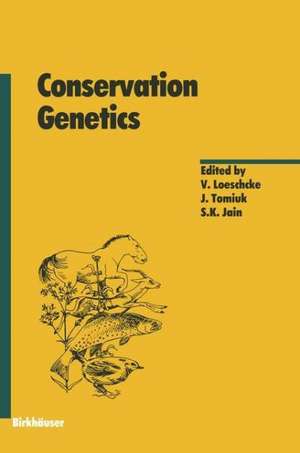
Conservation Genetics: Experientia Supplementum, cartea 68
Editat de V. Loeschcke, J. Tomiuk, S. K. Jainen Limba Engleză Hardback – 25 mai 1994
Din seria Experientia Supplementum
- 5%
 Preț: 1525.70 lei
 - 5%
 Preț: 952.28 lei
 -
 Preț: 376.92 lei
 - 5%
 Preț: 371.78 lei
 - 18%
 Preț: 948.56 lei
 - 18%
 Preț: 911.84 lei
 - 5%
 Preț: 742.01 lei
 - 15%
 Preț: 670.25 lei
 - 15%
 Preț: 669.81 lei
 - 18%
 Preț: 1279.95 lei
 - 5%
 Preț: 1147.85 lei
 - 5%
 Preț: 1087.09 lei
 - 5%
 Preț: 867.84 lei
 - 5%
 Preț: 1250.16 lei
 - 5%
 Preț: 1242.70 lei
 - 18%
 Preț: 955.31 lei
 -
 Preț: 330.60 lei
 -
 Preț: 389.71 lei
 - 15%
 Preț: 640.51 lei
 -
 Preț: 332.93 lei
 -
 Preț: 370.95 lei
 -
 Preț: 488.72 lei
 -
 Preț: 376.39 lei
 - 15%
 Preț: 456.14 lei
 -
 Preț: 422.54 lei
 - 15%
 Preț: 467.32 lei
 -
 Preț: 388.90 lei
 -
 Preț: 364.69 lei
 -
 Preț: 465.61 lei
 -
 Preț: 335.90 lei
 - 18%
 Preț: 916.85 lei
 - 15%
 Preț: 489.85 lei
 -
 Preț: 369.02 lei
 -
 Preț: 378.02 lei
 -
 Preț: 445.72 lei
 -
 Preț: 276.99 lei
 -
 Preț: 411.09 lei
 -
 Preț: 458.61 lei
 -
 Preț: 368.78 lei
Preț: 573.54 lei
Preț vechi: 674.75 lei
-15%
Puncte Express: 860
Carte tipărită la comandă
Livrare economică 30 noiembrie-14 decembrie
Livrare prin curier în România Termenul estimat este afișat lângă disponibilitate.
Transport gratuit pentru acest produs Plată online sau ramburs, în funcție de opțiunile comenzii.
Retur gratuit în 14 zile Comandă securizată și suport în română.
Specificații
ISBN-13: 9783764329396
ISBN-10: 3764329394
Pagini: 440
Greutate: 0.92 kg
Editura: Birkhauser
Colecția Birkhauser
Seriile Experientia Supplementum, Operator Theory, Advances and Applications
Locul publicării:Basel, Switzerland
ISBN-10: 3764329394
Pagini: 440
Greutate: 0.92 kg
Editura: Birkhauser
Colecția Birkhauser
Seriile Experientia Supplementum, Operator Theory, Advances and Applications
Locul publicării:Basel, Switzerland
V-ar putea interesa
-
 King Solomon's RingKonrad LorenzPreț: 172.13 lei
 -
 Perspectives on Animal BehaviorJudith Goodenough-23%Preț: 1508.85 lei1959.54 lei
 -
 Ecology and Evolution of Cooperative Breeding in BirdsWalter D. Koenig-11%Preț: 598.30 lei672.25 lei
 -
 Primate CommunitiesJ. G. FleaglePreț: 371.85 lei
 -
 Island ColonizationIan ThorntonPreț: 427.87 lei
 -
 An Introduction to the InvertebratesJanet Moore-19%Preț: 445.03 lei549.42 lei
 -
 Urban Insects and ArachnidsWilliam. H Robinson-23%Preț: 1514.44 lei1966.80 lei
 -
 Monkeys of the Taï ForestW Scott Mcgraw-14%Preț: 859.21 lei999.08 lei
 -
 Animal Communications NetworksP. K McGregor-14%Preț: 1140.24 lei1325.86 lei
 -
 Primate and Human EvolutionSusan Cachel-23%Preț: 1206.67 lei1567.10 lei
 -
 The Thalamus 2 Volume Hardback SetEdward G Jones-23%Preț: 5483.31 lei7121.18 lei
 -
 Preț: 72.71 lei
Public țintă
ResearchCuprins
I: Genetics and conservation biology.- Introductory remarks: Genetics and conservation biology.- Global issues of genetic diversity.- II: Genetic variation and fitness.- Introductory remarks.- Genetic variation and fitness: Conservation lessons from pines.- Genetic diversity and fitness in small populations.- Mutation load depending on variance in reproductive success and mating system.- Extinction risk by mutational meltdown: Synergistic effects between population regulation and genetic drift.- III: Inbreeding, population and social structure.- Introductory remarks.- Inbreeding: One word, several meanings, much confusion.- The genetic structure of metapopulations and conservation biology.- Effects of inbreeding in small plant populations: Expectations and implications for conservation.- The interaction of inbreeding depression and environmental stochasticity in the risk of extinction of small populations.- Genetic structure of a population with social structure and migration.- Guidelines in conservation genetics and the use of the population cage experiments with butterflies to investigate the effects of genetic drift and inbreeding.- IV: Molecular approaches to conservation.- Introductory remarks.- Rare alleles, MHC and captive breeding.- Andean tapaculos of the genus Scytalopus (Aves, Rhinocryptidae): A study of speciation using DNA sequence data.- Genetic distances and the setting of conservation priorities.- Multi-species risk analysis, species evaluation and biodiversity conservation.- V: Case studies.- Introductory remarks.- On genetic erosion and population extinction in plants: A case study in Scabiosa columbaria and Salvia pratensis.- Effects of releasing hatchery-reared brown trout to wild trout populations.- Genetics and demography of rare plants and patchily distributed colonizing species.- Response to environmental change: Genetic variation and fitness in Drosophila buzzatii following temperature stress.- Alternative life histories and genetic conservation.- The principles of population monitoring for conservation genetics.- VI: Genetic resource conservation.- Introductory remarks.- Optimal sampling strategies for core collections of plant genetic resources.- Conservation genetics and the role of botanical gardens.- Animal breeding and conservation genetics.- Scenarios.- Introductory remarks.- A: The genetic monitoring of primate populations for their conservation.- B: Heavy metal tolerance, plant evolution and restoration ecology.- C: Genetic conservation and plant agriculture.- D: Fragmented plant populations and their lost interactions.- E: Host-pathogen coevolution under in situ conservation.- Concluding remarks.