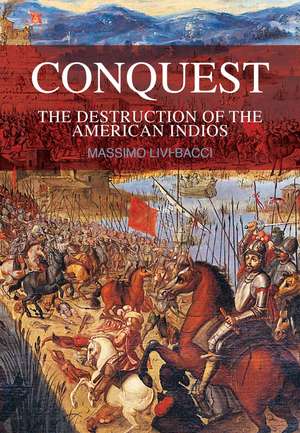
Conquest
Autor Massimo Livi-Baccien Limba Engleză Hardback – 8 ian 2008
The surviving documentation is extraordinarily rich: conquistadors, religious figures, administrators, officials, and merchants kept records, carried out inquiries, and issued edicts. The native world, for its part, has also left eloquent traces of events as well as direct testimony of its harsh subjugation at the hands of the Europeans.
Drawing on these sources, Livi Bacci shows how not only the 'imported' diseases but also a series of economic and social factors played a role in the disastrous decline of the native populations. He argues that the catastrophe was not the inevitable outcome of contact with Europeans but was a function of both the methods of the conquest and the characteristics of the subjugated societies.
This gripping narrative recounts one of the greatest tragedies of human history, one whose protagonists include figures like Columbus, Montezuma, Atahuallpa, Pizarro, Corts and Tupac Amaru.
Preț: 498.87 lei
Preț vechi: 615.88 lei
-19%
Puncte Express: 748
Carte tipărită la comandă
Livrare economică 19 decembrie 26 - 02 ianuarie 27
Livrare prin curier în România Termenul estimat este afișat lângă disponibilitate.
Transport gratuit pentru acest produs Plată online sau ramburs, în funcție de opțiunile comenzii.
Retur gratuit în 14 zile Comandă securizată și suport în română.
Specificații
ISBN-13: 9780745640006
ISBN-10: 0745640001
Pagini: 368
Dimensiuni: 144 x 214 x 28 mm
Greutate: 0.58 kg
Editura: Polity Press
Locul publicării:Chichester, United Kingdom
ISBN-10: 0745640001
Pagini: 368
Dimensiuni: 144 x 214 x 28 mm
Greutate: 0.58 kg
Editura: Polity Press
Locul publicării:Chichester, United Kingdom
V-ar putea interesa
-
 Land Rights: Oxford Amnesty LecturesTimothy Chesters-23%Preț: 421.43 lei547.43 lei
-
 -18%Preț: 390.38 lei473.26 lei
-
 Haa Leelk'w Has Aani Saax'u / Our Grandparents' Names on the LandThomas F. ThorntonPreț: 361.69 lei
-
 The Comanche EmpirePekka HamalainenPreț: 162.96 lei
-
 Preț: 237.98 lei
-
 Indigenous Peoples and ColonialismColin SamsonPreț: 215.37 lei
-
 Seminole Voices: Reflections on Their Changing Society, 1970-2000Julian M. PleasantsPreț: 442.26 lei
-
 Preț: 286.80 lei
-
 Preț: 329.86 lei
-
 The Wolf at TwilightKent NerburnPreț: 110.98 lei
Public țintă
students and scholars in history; interested general readersNotă biografică
Massimo Livi-Bacci is Professor of Demography at the University of Florence.
Cuprins
Preface
I In which are described three voyages that changed the face of a continent, the American population at the time of contact, the demographic catastrophe of the Indios, the sorrowful increase of the Africans, and the expansion of the Europeans
II A humble Franciscan, two combative Dominicans, an Italian humanist at the Court of Spain, a remorseful viceroy, a naturalist 'alcade', a Europeanized Inca and an Inca fallen on hard times, a conquistador observer... different witnesses and a common analysis of the catastrophe
III A tireless traveler disrupts a continent, but a quarter century too late. From the Caribbean to Perú: a brief history of a long voyage and of the suspected assassin of Huayna Capac, father of Atahuallpa. The true and presumed sins of smallpox and other crowd diseases
IV A golden nose ring and the tragic destiny of the Taíno. An Indio follows a deer and discovers a mountain of silver. A people in constant movement, over 1000 miles and at an elevation of 4000 meters, and the wealth of Potosí. Deeds and misdeeds of gold and silver
V Hispaniola, the territorial paradise of Columbus and the imagination of modern scholars. One hundred thousand or ten million Taíno? The catastrophe of the Antilles as seen from close up and a credible leyenda negra. People die while animals flourish
VI A great and rich city, dreamed of by Columbus and destroyed by Cortés. The modern dispute over the population of Mesoamerica. Tributaries, tributes, and population. Thirteen brigantines hauled overland and a tunnel in the rock. Men and beasts
VII The Incas and many millions of subjects. A quarter century of wars: Indios versus Indios, Spaniards versus Indios, Spaniards versus Spaniards. 'Quipu' pen and ink. A viceroy who counts, measures and acts. Epidemics: the moderns debate them, the ancients ignore them
VIII Colonists and 'Paulists' hunting down Guaraní between the Paraná and the Uruguay. One hundred Jesuits for 100,000 Indios. Steel axes and security in exchange for Christian habits. Monogamy and reproduction stronger than crowd diseases
Epilog
Appendices
Tables
Figures
Notes
Chronology
Glossary
Note on Illustrations
Index
Descriere
The arrival of Europeans in the Americas brought with it a demographic catastrophe of vast proportions for the native populations. In this book Livi Bacci argues that the catastrophe was not the inevitable outcome of contact with Europeans but was a function of both the methods of the conquest and the characteristics of the subjugated societies.