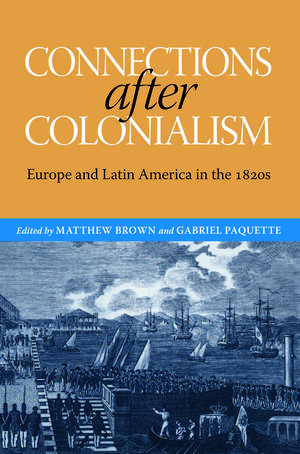
Connections after Colonialism: Europe and Latin America in the 1820s: Atlantic Crossings
Editat de Matthew Brown, Gabriel Paquette Contribuţii de Will Fowler, Josep M. Fradera, Carrie Gibson, Brian Roger Hamnett, Maurizio Isabella, Iona Macintyre, Scarlett O'Phelan Godoy, David Rock, Christopher Schmidt-Nowara, Jay Sexton, Reuben Zahleren Limba Engleză Paperback – 16 dec 2024 – vârsta ani
In the Atlantic World, the 1820s was a decade marked by the rupture of colonial relations, the independence of Latin America, and the ever-widening chasm between the Old World and the New. Connections after Colonialism, edited by Matthew Brown and Gabriel Paquette, builds upon recent advances in the history of colonialism and imperialism by studying former colonies and metropoles through the same analytical lens, as part of an attempt to understand the complex connections—political, economic, intellectual, and cultural—between Europe and Latin America that survived the demise of empire.
Historians are increasingly aware of the persistence of robust links between Europe and the new Latin American nations. This book focuses on connections both during the events culminating with independence and in subsequent years, a period strangely neglected in European and Latin American scholarship. Bringing together distinguished historians of both Europe and America, the volume reveals a new cast of characters and relationships including unrepentant American monarchists; compromise-seeking liberals in Lisbon and Madrid who envisioned transatlantic federations; British merchants in the River Plate who saw opportunity where others saw risk; public moralists whose audiences spanned from Paris to Santiago de Chile; and plantation owners in eastern Cuba who feared that slave rebellions elsewhere in the Caribbean would spread to their island.
Contributors
Matthew Brown / Will Fowler / Josep M. Fradera / Carrie Gibson / Brian Hamnett / Maurizio Isabella / Iona Macintyre / Scarlett O’Phelan Godoy / Gabriel Paquette / David Rock / Christopher Schmidt-Nowara / Jay Sexton / Reuben Zahler



Preț: 282.14 lei
Puncte Express: 423
Carte disponibilă
Livrare economică 05-19 noiembrie
Livrare prin curier în România Termenul estimat este afișat lângă disponibilitate.
Transport gratuit de la 400.00 lei Plată online sau ramburs, în funcție de opțiunile comenzii.
Retur gratuit în 14 zile Comandă securizată și suport în română.
Specificații
ISBN-13: 9780817361976
ISBN-10: 0817361979
Pagini: 344
Ilustrații: 1 illustration
Dimensiuni: 152 x 229 x 28 mm
Greutate: 1.16 kg
Ediția:First Edition
Editura: University Of Alabama Press
Colecția University Alabama Press
Seria Atlantic Crossings
ISBN-10: 0817361979
Pagini: 344
Ilustrații: 1 illustration
Dimensiuni: 152 x 229 x 28 mm
Greutate: 1.16 kg
Ediția:First Edition
Editura: University Of Alabama Press
Colecția University Alabama Press
Seria Atlantic Crossings
Notă biografică
Matthew Brown is a reader in Latin American studies at the University of Bristol.
Gabriel Paquette is an assistant professor in history at the Johns Hopkins University. He is author of Enlightenment, Governance, and Reform in Spain and Its Empire, 1759–1808.
Gabriel Paquette is an assistant professor in history at the Johns Hopkins University. He is author of Enlightenment, Governance, and Reform in Spain and Its Empire, 1759–1808.
Cuprins
Acknowledgments
Introduction: Between the Age of Atlantic Revolutions and the Age of Empire
By Matthew Brown and Gabriel Paquette
Chapter 1. Themes and Tensions in a Contradictory Decade: Ibero-America as a Multiplicity of States
By Brian Hamnett
Chapter 2. Rafael del Riego and the Spanish Origins of the Nineteenth-Century Mexican Pronunciamiento
By Will Fowler
Chapter 3. Include and Rule: The Limits of Liberal Colonial Policy, 1810–1837
By Josep M. Fradera
Chapter 4. Entangled Patriotisms: Italian Liberals and Spanish America in the 1820s
By Maurizio Isabella
Chapter 5. The Brazilian Origins of the 1826 Portuguese Constitution
By Gabriel Paquette
Chapter 6. An American System: The North American Union and Latin America in the 1820s
By Jay Sexton
Chapter 7. The Chilean Irishman Bernardo O'Higgins and the Independence of Peru
By Scarlett O'Phelan Godoy
Chapter 8. Corinne in the Andes: European Advice for Women in 1820s Argentina and Chile
By Iona Macintyre
Chapter 9. Heretics, Cadavers, and Capitalists: European Foreigners in Venezuela during the 1820s
By Reuben Zahler
Chapter 10. Porteño Liberals and Imperialist Emissaries in the Rio de la Plata: Rivadavia and the British
By David Rock
Chapter 11. "There Is No Doubt That We Are under Threat from the Negroes of Santo Domingo": The Specter of Haiti in the Spanish Caribbean in the 1820s
By Carrie Gibson
Chapter 12. Bartolomé de las Casas and the Slave Trade to Cuba circa 1820
By Christopher Schmidt-Nowara
Chapter 13. The 1820s in Perspective: The Bolivarian Decade
By Matthew Brown
Bibliography
Contributors
Index
Introduction: Between the Age of Atlantic Revolutions and the Age of Empire
By Matthew Brown and Gabriel Paquette
Chapter 1. Themes and Tensions in a Contradictory Decade: Ibero-America as a Multiplicity of States
By Brian Hamnett
Chapter 2. Rafael del Riego and the Spanish Origins of the Nineteenth-Century Mexican Pronunciamiento
By Will Fowler
Chapter 3. Include and Rule: The Limits of Liberal Colonial Policy, 1810–1837
By Josep M. Fradera
Chapter 4. Entangled Patriotisms: Italian Liberals and Spanish America in the 1820s
By Maurizio Isabella
Chapter 5. The Brazilian Origins of the 1826 Portuguese Constitution
By Gabriel Paquette
Chapter 6. An American System: The North American Union and Latin America in the 1820s
By Jay Sexton
Chapter 7. The Chilean Irishman Bernardo O'Higgins and the Independence of Peru
By Scarlett O'Phelan Godoy
Chapter 8. Corinne in the Andes: European Advice for Women in 1820s Argentina and Chile
By Iona Macintyre
Chapter 9. Heretics, Cadavers, and Capitalists: European Foreigners in Venezuela during the 1820s
By Reuben Zahler
Chapter 10. Porteño Liberals and Imperialist Emissaries in the Rio de la Plata: Rivadavia and the British
By David Rock
Chapter 11. "There Is No Doubt That We Are under Threat from the Negroes of Santo Domingo": The Specter of Haiti in the Spanish Caribbean in the 1820s
By Carrie Gibson
Chapter 12. Bartolomé de las Casas and the Slave Trade to Cuba circa 1820
By Christopher Schmidt-Nowara
Chapter 13. The 1820s in Perspective: The Bolivarian Decade
By Matthew Brown
Bibliography
Contributors
Index
Recenzii
“Paquette and Brown have brought together an eminent group of scholars to reexamine the critical decade of the 1820s, long ignored, or misinterpreted, by historians of the Atlantic world. Traditionally these years are seen as marking the collapse of European rule and the emergence of new nations, a period of separation and disintegration of old patterns of social, economic, institutional, and international relations. They argue persuasively that the period needs serious reevaluation in this highly original and important work that is sure to begin the process.” —Kenneth Maxwell, author of Conflicts and Conspiracies: Brazil and Portugal, 1750–1808
“This volume represents an important contribution to the expanding understanding of Atlantic history.” —Hispanic American Historical Review
“Connections after Colonialism constitutes a significant contribution to a growing body of historical research that emphasises the persistence of links between Europe and Latin America in the wake of Latin American independence. It should inspire researchers to move beyond the boundaries of a nation-based or area studies-based analysis of the processes of change in the early nineteenth-century and to reassess the 1820s as a key decade in the cultural, political and intellectual evolution of Europe and Latin America in the Age of Revolutions.” —Reviews in History
“This volume represents an important contribution to the expanding understanding of Atlantic history.” —Hispanic American Historical Review
“Connections after Colonialism constitutes a significant contribution to a growing body of historical research that emphasises the persistence of links between Europe and Latin America in the wake of Latin American independence. It should inspire researchers to move beyond the boundaries of a nation-based or area studies-based analysis of the processes of change in the early nineteenth-century and to reassess the 1820s as a key decade in the cultural, political and intellectual evolution of Europe and Latin America in the Age of Revolutions.” —Reviews in History
Descriere
Contributing to the historiography of transnational and global transmission of ideas, Connections after Colonialism examines relations between Europe and Latin America during the tumultuous 1820s.