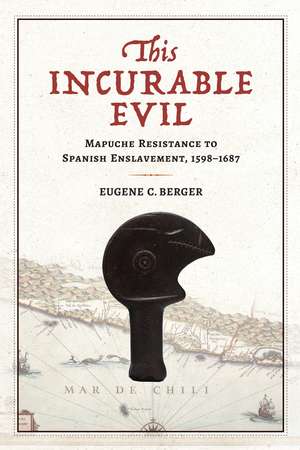
This Incurable Evil: Mapuche Resistance to Spanish Enslavement, 1598–1687: Atlantic Crossings
Autor Eugene C. Bergeren Limba Engleză Paperback – 23 mai 2023
The history of Spanish presence in the Americas is usually viewed as a one-sided conquest. In This Incurable Evil: Mapuche Resistance to Spanish Enslavement, 1598–1687, Eugene C. Berger provides a major corrective in the case of Chile. For example, in the south, indigenous populations were persistent in their resistance against Spanish settlement. By the end of the sixteenth century, Spanish aspirations to conquer the entire Pacific Coast were dashed at least twice by armed resistance from the Mapuche peoples. By 1600, the Mapuche had killed two Spanish governors and occupied more than a dozen Spanish towns. Chile’s colonial future was quite uncertain.
As Berger documents, for much of the seventeenth century it seemed that there could be peace along the Spanish-Mapuche frontier. Through trade, intermarriage, and even mutual distrust of Dutch and English pirates, the Mapuche and the Spanish began to construct a colonial entente. However, this growing alliance was obliterated by the “incurable evil,” an ever-expanding enslavement of Mapuches, and one which prompted a new generation of Mapuche resistance. This trade saw Mapuche rivals, neutrals, and even friends placed in irons and forced to board ships in Valdivia and Concepción or to march northward along the Andes. The Mapuche labored in the gold mines of La Serena, in urban workshops in Lima, in the silver mines of Potosí, or on the thousands of haciendas in between and would never return to their homes. With this tragic betrayal, Chile was left a more corrupt, violent, and polarized place, which would cause deep wounds for centuries.

Preț: 264.99 lei
Puncte Express: 397
Carte disponibilă
Livrare economică 02-16 noiembrie
Livrare express 16-22 octombrie pentru 23.67 lei
Livrare prin curier în România Termenul estimat este afișat lângă disponibilitate.
Transport gratuit de la 400.00 lei Plată online sau ramburs, în funcție de opțiunile comenzii.
Retur gratuit în 14 zile Comandă securizată și suport în română.
Specificații
ISBN-13: 9780817361105
ISBN-10: 0817361103
Pagini: 216
Ilustrații: 16 B&W figures - 5 maps
Dimensiuni: 152 x 229 x 23 mm
Greutate: 0.32 kg
Editura: University Of Alabama Press
Colecția University Alabama Press
Seria Atlantic Crossings
ISBN-10: 0817361103
Pagini: 216
Ilustrații: 16 B&W figures - 5 maps
Dimensiuni: 152 x 229 x 23 mm
Greutate: 0.32 kg
Editura: University Of Alabama Press
Colecția University Alabama Press
Seria Atlantic Crossings
Notă biografică
Eugene C. Berger is associate professor of history at Georgia Gwinnett College. He is coauthor of World History: Cultures, States and Societies to 1500.
Cuprins
Acknowledgments
Introduction: Indigenous Slavery and Slave Societies
Chapter 1. Winka: The Sixteenth Century and Origins of Mapuche Resistance
Chapter 2. A Pacific Coast Diaspora: The Incurable Evil and an Evolving Need for Resistance
Chapter 3. The Era of “Great Tokis”
Chapter 4. Indios Amigos and the 1655 Mapuche Uprising
Chapter 5. Toward a Ban of Mapuche Enslavement: Midcentury Resistance and Outrageously Corrupt Governors
Conclusion: An Act of God and an End to the Trade?
Glossary
Notes
Bibliography
Index
Introduction: Indigenous Slavery and Slave Societies
Chapter 1. Winka: The Sixteenth Century and Origins of Mapuche Resistance
Chapter 2. A Pacific Coast Diaspora: The Incurable Evil and an Evolving Need for Resistance
Chapter 3. The Era of “Great Tokis”
Chapter 4. Indios Amigos and the 1655 Mapuche Uprising
Chapter 5. Toward a Ban of Mapuche Enslavement: Midcentury Resistance and Outrageously Corrupt Governors
Conclusion: An Act of God and an End to the Trade?
Glossary
Notes
Bibliography
Index
Recenzii
“This book makes a valuable contribution to the long-overlooked reality of the enslavement of Indigenous peoples within the Spanish empire. It also powerfully explores the agency of the Mapuche in different capacities as they were forced to engage with the Spanish, from the enslaved and exploited individuals within the empire to the indios amigos negotiating special privileges on its fringes to the military and diplomatic victories of the people outside it.”—The Americas
“This Incurable Evil examines a topic of great importance, yet one barely treated by scholars: the enslavement of Indigenous Chileans across a considerable stretch of the colonial period but centered on the seventeenth century. This rich and important book recovers and chronicles the ‘lost worlds’ of the Mapuche and their neighbors. The material is compelling, and the story is compellingly told.”—Kris Lane, author of Potosí: The Silver City That Changed the World
“Through extensive archival research, Berger weaves together colonial letters, diary extracts, speeches, testimonials, legal records, and laws to great effect to argue how the Mapuche successfully resisted against continued efforts of Spanish colonial enslavement.”—H-Net
“This Incurable Evil examines a topic of great importance, yet one barely treated by scholars: the enslavement of Indigenous Chileans across a considerable stretch of the colonial period but centered on the seventeenth century. This rich and important book recovers and chronicles the ‘lost worlds’ of the Mapuche and their neighbors. The material is compelling, and the story is compellingly told.”—Kris Lane, author of Potosí: The Silver City That Changed the World
“Through extensive archival research, Berger weaves together colonial letters, diary extracts, speeches, testimonials, legal records, and laws to great effect to argue how the Mapuche successfully resisted against continued efforts of Spanish colonial enslavement.”—H-Net
Descriere
In This Incurable Evil, Eugene C. Berger offers a powerful reinterpretation of Spanish colonialism in Chile by centering the sustained resistance of the Mapuche against enslavement between 1598 and 1687. Challenging narratives of inevitable conquest, Berger shows how early cooperation between Spaniards and Mapuche communities gave way to a brutal system of Indigenous enslavement that reshaped the region’s political, social, and economic life. This book reveals how Mapuche leaders adapted militarily and diplomatically to preserve autonomy in the face of colonial violence and exploitation. By foregrounding Indigenous agency and resistance, This Incurable Evil makes a significant contribution to the histories of empire, slavery, and the Atlantic world.