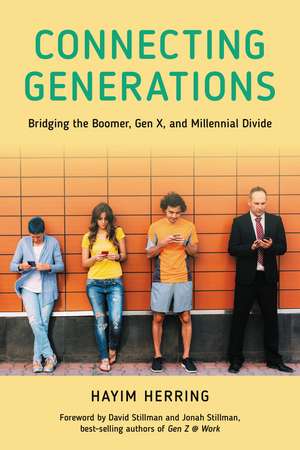
Connecting Generations: Bridging the Boomer, Gen X, and Millennial Divide
Autor Hayim Herring Cuvânt înainte de David Stillman, Jonah Stillmanen Limba Engleză Hardback – 8 mai 2019
Even in those rare communities where young and old live near each other, they lack organic settings that encourage intergenerational relationships. In addition, it isn't technology, but generational diversity that is our best tool for navigating the changes that affect so many aspects of our lives - whether it's work, entertainment, education, or family dynamics. We can't restore yesterday's model of community, where only those who were older transmitted wisdom downward to the generation below. But we can relearn how much members of different generations have to offer each other and recreate intergenerational communities for the 21st century where young, old, and everyone in between is equally valued for their perspectives, and where each generation views itself as having a stake in the other's success. Here, Hayim Herring focuses more deeply on how Baby Boomers, Gen Xers, and Millennials perceive one another and looks underneath the generational labels that compound isolation. He offers ways we can prepare current and future generations for a world in which ongoing interactions with people from multiple generations become the norm, and re-experience how enriching intergenerational relationships are personally and communally.
Preț: 259.19 lei
Preț vechi: 336.53 lei
-23%
Puncte Express: 389
Carte tipărită la comandă
Livrare economică 30 noiembrie-14 decembrie
Livrare prin curier în România Termenul estimat este afișat lângă disponibilitate.
Transport gratuit de la 400.00 lei Plată online sau ramburs, în funcție de opțiunile comenzii.
Retur gratuit în 14 zile Comandă securizată și suport în română.
Specificații
ISBN-13: 9781538112168
ISBN-10: 1538112167
Pagini: 200
Ilustrații: 1 table
Dimensiuni: 160 x 231 x 21 mm
Greutate: 0.47 kg
Editura: Bloomsbury Publishing
Colecția Rowman & Littlefield
Locul publicării:New York, United States
ISBN-10: 1538112167
Pagini: 200
Ilustrații: 1 table
Dimensiuni: 160 x 231 x 21 mm
Greutate: 0.47 kg
Editura: Bloomsbury Publishing
Colecția Rowman & Littlefield
Locul publicării:New York, United States
V-ar putea interesa
-
 Overwhelmed: Coping With Life's Ups and DownsNancy K. Schlossberg-27%Preț: 254.91 lei349.61 lei
 -
 -33%Preț: 369.30 lei553.12 lei
 -
 -25%Preț: 345.70 lei460.49 lei
 -
 The Power of Language in the Clinical Process: Assessing and Treating the Bilingual PersonRoseMarie Perez Foster-31%Preț: 571.67 lei825.04 lei
 -
 Rethinking Clinical TechniqueFred Busch-31%Preț: 570.88 lei824.45 lei
 -
 A Primer for Child PsychotherapistsDiana Siskind-31%Preț: 597.55 lei870.57 lei
 -
 -32%Preț: 990.76 lei1466.79 lei
 -
 -26%Preț: 353.00 lei480.22 lei
 -
 I Am AspiengirlTania MarshallPreț: 149.56 lei
 -
 You Can FlyCandis MorganPreț: 130.52 lei
 -
 -26%Preț: 174.67 lei237.31 lei
 -
 Treatment of the Severely Disturbed AdolescentDonald B. Rinsley-29%Preț: 455.91 lei644.59 lei
 -
 -27%Preț: 1637.76 lei2230.25 lei
 -
 Planned Behavior: Theory, Applications & PerspectivesVincent L Rush-27%Preț: 613.52 lei836.21 lei
 -
 Emdr for the Next Generation-Healing Children and Families 2nd EdJoanne Morris-SmithPreț: 354.89 lei
 -
 Mal himmelhoch, mal abgrundtiefThomas D. MeyerPreț: 184.73 lei
 -
 Preț: 220.48 lei
 -
 -19%Preț: 375.42 lei463.48 lei
 -
 Perception de la voixBruckert-L-23%Preț: 687.33 lei892.64 lei
 -
 Les étudiants de première annéeEmilie Boujut-19%Preț: 617.44 lei762.27 lei
 -
 -19%Preț: 554.03 lei683.99 lei
 -
 Passage A L'Acte Auto- Et Hetero-Agressif: Metallurgie de La Periode ThuleNicolas COMBALBERT-23%Preț: 650.29 lei844.54 lei
 -
 -15%Preț: 398.48 lei468.80 lei
Cuprins
Chapter 1: An Epidemic of Loneliness?
Chapter 2: Generational Stereotypes
Chapter 3: Meet the Family
Chapter 4: Understanding Community
Chapter 5: Education
Chapter 6: Are You Your Work?
Chapter 7: We're All Perennials, So Let's Act Together!
Appendix A: Family Technology Action Plan
Appendix B: Healthcare Transition Discussion Guide
Appendix C: Individual Experts and Organizational Resources
Chapter 2: Generational Stereotypes
Chapter 3: Meet the Family
Chapter 4: Understanding Community
Chapter 5: Education
Chapter 6: Are You Your Work?
Chapter 7: We're All Perennials, So Let's Act Together!
Appendix A: Family Technology Action Plan
Appendix B: Healthcare Transition Discussion Guide
Appendix C: Individual Experts and Organizational Resources
Recenzii
Addressing the issue of loneliness, former rabbi and nonprofit executive ¬Herring (Leading Congregations and Nonprofit Organizations in a Connected World) maintains that it is only by relearning how much one generation has to offer another generation that people can end social isolation and embrace richer lives. Chapters cover issues such as understanding stereotypes, exploring careers and identity, and family caretaking, with "What You Can Do" suggestions mostly revolving around getting out of one's comfort zone and spending time with a member of a different generation, rounding out each section. In conclusion, Herring introduces the concept of "perennial" to reclaim organic intergenerational relationships. VERDICT Herring's words add a lot to our understanding of generational perspectives. Appendixes featuring a family technology action plan, a health-care transition guide, and a bibliography of experts and organizational resources serve as catalysts for further intergenerational discussion.
Time was, three or four generations lived under one roof, but today, Americans live in lonely silos. Without harking back to "the good old days," Herring understands the human need for connection. He defines and describes five different age groups living today and contends that even though technology promises connection, more often it makes strangers of us all. Each group longs for a community to feel at home in, but finding it solely with one's peers is to miss out on a banquet of relationships, posits Herring. He interviewed 30 people to better understand how circumstances shape us and how differing ages can better relate. For instance, Baby Boomers will work at a hateful job for money, but a Millennial will not. If one doesn't understand why, misconceptions persist. Each chapter concludes with concrete suggestions for how to bridge gaps between age groups. This book is written in an engaging style and is completed by appendices, lengthy notes, and bibliography complete the book. This could be welcome on a sociology syllabus or in a faith-group study.
Most people only have friends their own age. Hayim Herring is passionate about changing that. He shows the value of connections between people of all ages, shares examples of how he has established those connections in his own life, and gives solid advice on creating your own intergenerational community.
Anticipating the Hard Trends that are transforming the future and empowering individuals, organizations, and communities to make wise choices is a strategic imperative. Herring focuses our attention on one Hard Trend that is driving transformational change -the unprecedented reality of having six generations of people alive at one time - and challenges us to replace unhealthy generational conflicts with enriching intergenerational connections. Read this book today!
Rabbi Herring's book is a work of imaginative empathy and a hand of friendship extended across the generations.
At a time in history rife with rapid technological, demographic, and political change, Connecting Generations provides the reader a timely and valuable set of principles and strategies to help individuals, families, and communities connect in meaningful ways. As a Gen X mother with Millennial and Gen Z kids, and parents of the Silent Generation, I can attest firsthand to the challenges of bridging generational divides. Is 'friend' a noun or a verb? Don't only birds tweet? Isn't swiping mainly done in anger?! This book helped me not only to contemplate the importance of meaningful connections, but provided my family a roadmap for strengthening them.
Connecting Generations not only identifies and analyzes the current phenomenon of loneliness, social isolation and polarization, but it encourages the reader to become more empathetic and to pursue a variety of measures that can help shape a more vibrant reality for the individual, community and society at large. Hayim Herring presents us with a compelling argument for transformation and social change.
Time was, three or four generations lived under one roof, but today, Americans live in lonely silos. Without harking back to "the good old days," Herring understands the human need for connection. He defines and describes five different age groups living today and contends that even though technology promises connection, more often it makes strangers of us all. Each group longs for a community to feel at home in, but finding it solely with one's peers is to miss out on a banquet of relationships, posits Herring. He interviewed 30 people to better understand how circumstances shape us and how differing ages can better relate. For instance, Baby Boomers will work at a hateful job for money, but a Millennial will not. If one doesn't understand why, misconceptions persist. Each chapter concludes with concrete suggestions for how to bridge gaps between age groups. This book is written in an engaging style and is completed by appendices, lengthy notes, and bibliography complete the book. This could be welcome on a sociology syllabus or in a faith-group study.
Most people only have friends their own age. Hayim Herring is passionate about changing that. He shows the value of connections between people of all ages, shares examples of how he has established those connections in his own life, and gives solid advice on creating your own intergenerational community.
Anticipating the Hard Trends that are transforming the future and empowering individuals, organizations, and communities to make wise choices is a strategic imperative. Herring focuses our attention on one Hard Trend that is driving transformational change -the unprecedented reality of having six generations of people alive at one time - and challenges us to replace unhealthy generational conflicts with enriching intergenerational connections. Read this book today!
Rabbi Herring's book is a work of imaginative empathy and a hand of friendship extended across the generations.
At a time in history rife with rapid technological, demographic, and political change, Connecting Generations provides the reader a timely and valuable set of principles and strategies to help individuals, families, and communities connect in meaningful ways. As a Gen X mother with Millennial and Gen Z kids, and parents of the Silent Generation, I can attest firsthand to the challenges of bridging generational divides. Is 'friend' a noun or a verb? Don't only birds tweet? Isn't swiping mainly done in anger?! This book helped me not only to contemplate the importance of meaningful connections, but provided my family a roadmap for strengthening them.
Connecting Generations not only identifies and analyzes the current phenomenon of loneliness, social isolation and polarization, but it encourages the reader to become more empathetic and to pursue a variety of measures that can help shape a more vibrant reality for the individual, community and society at large. Hayim Herring presents us with a compelling argument for transformation and social change.