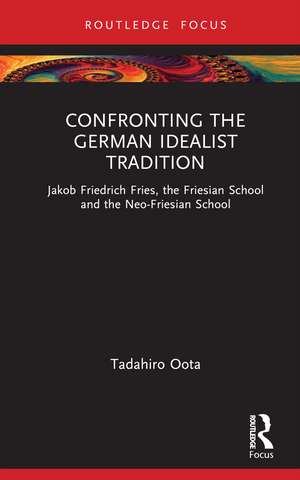
Confronting the German Idealist Tradition: Jakob Friedrich Fries, the Friesian School and the Neo-Friesian School
Autor Tadahiro Ootaen Limba Engleză Hardback – 24 mai 2023
From this perspective, this book examines the philosophy of Jakob Friedrich Fries, a philosopher contemporaneous and in confrontation with Hegel. By examining Fries’ standpoint, the book attempts to reconstruct the picture of 19th-century German philosophy. In the 19th and 20th centuries, philosophers other than Kant, Fichte, Schelling, and Hegel – especially Fries – had a significant influence on the history of philosophy, constituting an alternative genealogy to Hegel’s. One might say that the conventional history of philosophy conceals Fries’ influence. Accordingly, this book will examine Fries’ philosophy, the Friesian school established by E.F. Apelt, and the Neo-Friesian school formed by Leonard Nelson.
This approach reveals the factiousness of the history of philosophy that starts from Kant, passes through German idealism and flows into the Neo-Kantian movement. It will provide a new viewpoint from which to reconsider the history of German philosophy.
Preț: 437.26 lei
Preț vechi: 514.43 lei
-15%
Carte tipărită la comandă
Livrare economică 05-19 septembrie
Livrare express 01-07 august pentru 129.63 lei
Specificații
ISBN-10: 1032522984
Pagini: 120
Dimensiuni: 138 x 216 x 13 mm
Greutate: 0.38 kg
Ediția:1
Editura: Taylor & Francis
Colecția Routledge
Locul publicării:Oxford, United Kingdom
Public țintă
Academic, Postgraduate, and Undergraduate AdvancedNotă biografică
Cuprins
Preface
1 Introduction
1.1 Why should 19th-century German philosophy be addressed today?
1.2 Why should we begin with the reconstruction of Fries¿ philosophy?
2 Jakob Friedrich Fries¿ philosophy
2.1 Fries¿ conception of a critique of reason
2.2 On the construction of a metaphysical system: From the viewpoint of the method of philosophy
3 The Friesian and Neo-Friesian schools
3.1 The Friesian school
3.2 The Neo-Friesian school
4 Conclusion
Bibliography
Descriere
The philosophical activity of modern Germany represents a peak in the history of philosophy beginning from Thales in ancient Greece. This book attempts to reconsider the conventional image of 19th-century German philosophy. To this end, it illuminates a forgotten philosophical stream contemporaneous with so-called "German idealism."
From this perspective, this book examines the philosophy of Jakob Friedrich Fries, a philosopher contemporaneous and in confrontation with Hegel. By examining Fries’ standpoint, the book attempts to reconstruct the picture of 19th-century German philosophy. In the 19th and 20th centuries, philosophers other than Kant, Fichte, Schelling and Hegel – especially Fries – had a significant influence on the history of philosophy, constituting an alternative genealogy to Hegel’s. One might say that the conventional history of philosophy conceals Fries’ influence. Accordingly, this book will examine Fries’ philosophy, the Friesian school established by E. F. Apelt, and the Neo-Friesian school formed by Leonard Nelson.
This approach reveals the factiousness of the history of philosophy that starts from Kant, passes through German idealism and flows into the Neo-Kantian movement. It will provide a new viewpoint from which to reconsider the history of German philosophy.