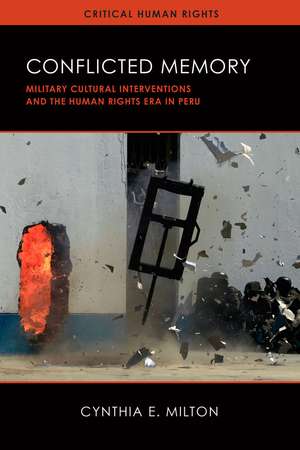
Conflicted Memory: Military Cultural Interventions and the Human Rights Era in Peru: Critical Human Rights
Autor Cynthia E. Miltonen Limba Engleză Paperback – 14 ian 2020
| Toate formatele și edițiile | Preț | Express |
|---|---|---|
| Paperback (1) | 171.87 lei 43-57 zile | |
| University of Wisconsin Press – 14 ian 2020 | 171.87 lei 43-57 zile | |
| Hardback (1) | 455.06 lei 43-57 zile | |
| University of Wisconsin Press – 23 ian 2018 | 455.06 lei 43-57 zile |
Din seria Critical Human Rights
-
 Preț: 191.62 lei
 - 19%
 Preț: 421.28 lei
 -
 Preț: 153.16 lei
 -
 Preț: 193.92 lei
 -
 Preț: 298.18 lei
 -
 Preț: 216.56 lei
 -
 Preț: 172.96 lei
 -
 Preț: 169.46 lei
 -
 Preț: 169.46 lei
 -
 Preț: 226.15 lei
 - 23%
 Preț: 435.46 lei
 -
 Preț: 213.10 lei
 -
 Preț: 204.91 lei
 -
 Preț: 221.51 lei
 - 23%
 Preț: 454.79 lei
 -
 Preț: 171.87 lei
 -
 Preț: 176.52 lei
 - 23%
 Preț: 456.35 lei
 - 23%
 Preț: 454.06 lei
 - 23%
 Preț: 565.98 lei
 - 23%
 Preț: 459.33 lei
 -
 Preț: 485.39 lei
 - 23%
 Preț: 454.94 lei
 -
 Preț: 168.13 lei
 -
 Preț: 166.22 lei
Preț: 171.87 lei
Puncte Express: 258
Preț estimativ în valută:
30.43€ • 35.43$ • 26.43£
30.43€ • 35.43$ • 26.43£
Carte tipărită la comandă
Livrare economică 23 februarie-09 martie
Preluare comenzi: 021 569.72.76
Specificații
ISBN-13: 9780299315047
ISBN-10: 0299315045
Pagini: 296
Ilustrații: 26 b-w illus., 1 map
Dimensiuni: 152 x 229 x 20 mm
Greutate: 0.4 kg
Ediția:1
Editura: University of Wisconsin Press
Colecția University of Wisconsin Press
Seria Critical Human Rights
ISBN-10: 0299315045
Pagini: 296
Ilustrații: 26 b-w illus., 1 map
Dimensiuni: 152 x 229 x 20 mm
Greutate: 0.4 kg
Ediția:1
Editura: University of Wisconsin Press
Colecția University of Wisconsin Press
Seria Critical Human Rights
Recenzii
"Brings to light how military 'entrepreneurs of memory' strategically place memory products in a memory marketplace. A major intervention in debates about Peru's internal armed conflict of the 1980s and '90s and its aftermath, which will interest scholars in many disciplines and regions."—Paulo Drinot, coeditor of Comics and Memory in Latin America
"Impressively documents the military's diverse interventions in Peru's culture—memoirs, 'truth' reports, films, novels, and memorials—and its numerous attempts to censor cultural productions that challenge its preferred narrative."—Jo-Marie Burt, George Mason University
"This incisive analysis of Peruvian countermemories explores the military's seemingly failed cultural memory production, its lack of artistry and inability to suppress evidence. Though the military is unable to fully reclaim heroic and self-sacrificing patriotism, Milton nonetheless recognizes its success in shaping memory politics and current political debates."—Leigh Payne, author of Unsettling Accounts
"Milton calls attention to fabrications of our post-truth era but goes further to deeply explore the ways members of the Peruvian military see their past, how they actively commemorate and curate it in the present, and why they do so. Her nuanced approach upends frameworks of memory studies that reduce military and ex-military to a predictable role of outright denial."—Rélam
"Impressively documents the military's diverse interventions in Peru's culture—memoirs, 'truth' reports, films, novels, and memorials—and its numerous attempts to censor cultural productions that challenge its preferred narrative."—Jo-Marie Burt, George Mason University
"This incisive analysis of Peruvian countermemories explores the military's seemingly failed cultural memory production, its lack of artistry and inability to suppress evidence. Though the military is unable to fully reclaim heroic and self-sacrificing patriotism, Milton nonetheless recognizes its success in shaping memory politics and current political debates."—Leigh Payne, author of Unsettling Accounts
"Milton calls attention to fabrications of our post-truth era but goes further to deeply explore the ways members of the Peruvian military see their past, how they actively commemorate and curate it in the present, and why they do so. Her nuanced approach upends frameworks of memory studies that reduce military and ex-military to a predictable role of outright denial."—Rélam
Notă biografică
Cynthia E. Milton is the Canada Research Chair in Latin American History at the Université de Montréal. She is the editor of Art from a Fractured Past: Memory and Truth-Telling in Post–Shining Path Peru.
Descriere
Reveals how Peru's military has engaged in a tactical cultural campaign—via books, films, museums—to shift public opinion, debate, and memories about the nation's violent recent past and its part in it. Cynthia Milton's nuanced approach upends frameworks of memory studies that reduce military and ex-military to a predictable role of outright denial.
Cuprins
List of Illustrations
Acknowledgments
Introduction: Curating and Remembering “los Buenos Militares”
1 Military Memory Books: Picking up Pens to Recount Their Truths
2 The Permanent Historical Commission of the Peruvian Army and Their Truth Report
3 Guerra fratricida: The Parallel Lives and Writings of Carlos Freyre and Lurgio Gavilán
4 Military Curations in the Turn to Human Rights Museology
5 The Captive: Military Memories and Censorship in Public Spaces
Conclusion: Tied to History: The Army’s Dirge and Counter Memories in the Era of Human Rights
Notes
Bibliography
Index
Acknowledgments
Introduction: Curating and Remembering “los Buenos Militares”
1 Military Memory Books: Picking up Pens to Recount Their Truths
2 The Permanent Historical Commission of the Peruvian Army and Their Truth Report
3 Guerra fratricida: The Parallel Lives and Writings of Carlos Freyre and Lurgio Gavilán
4 Military Curations in the Turn to Human Rights Museology
5 The Captive: Military Memories and Censorship in Public Spaces
Conclusion: Tied to History: The Army’s Dirge and Counter Memories in the Era of Human Rights
Notes
Bibliography
Index