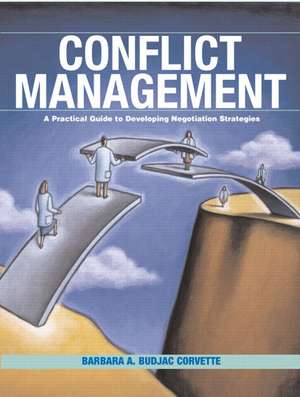
Conflict Management
Autor Barbara Budjac Corvetteen Limba Engleză Paperback – 7 feb 2006
Preț: 422.64 lei
Preț vechi: 521.78 lei
-19%
Puncte Express: 634
Preț estimativ în valută:
74.80€ • 87.42$ • 64.94£
74.80€ • 87.42$ • 64.94£
Carte disponibilă
Livrare economică 30 ianuarie-13 februarie
Preluare comenzi: 021 569.72.76
Specificații
ISBN-13: 9780131193239
ISBN-10: 0131193236
Pagini: 336
Dimensiuni: 177 x 233 x 15 mm
Greutate: 0.43 kg
Ediția:1
Editura: Pearson Education
Locul publicării:Upper Saddle River, United States
ISBN-10: 0131193236
Pagini: 336
Dimensiuni: 177 x 233 x 15 mm
Greutate: 0.43 kg
Ediția:1
Editura: Pearson Education
Locul publicării:Upper Saddle River, United States
V-ar putea interesa
-
 How to Win Friends and Influence PeopleDale CarnegiePreț: 61.36 lei
 -
 -15%Preț: 298.59 lei351.06 lei
 -
 The Values of BureaucracyPaul du Gay-14%Preț: 355.37 lei414.78 lei
 -
 Negotiating For Dummies 2eMC DonaldsonPreț: 101.20 lei
 -
 Preț: 217.98 lei
 -
 You Can Negotiate AnythingHerb CohenPreț: 51.07 lei
 -
 -18%Preț: 315.55 lei382.87 lei
 -
 Start with NoJim CampPreț: 164.85 lei
 -
 Preț: 148.40 lei
 -
 The Promise of MediationRobert A Baruch BushPreț: 383.34 lei
 -
 Preț: 132.16 lei
 -
 The Power of NiceRonald M ShapiroPreț: 143.05 lei
 -
 Social Identity Processes in Organizational ContextsMichael A. Hogg-16%Preț: 351.48 lei420.47 lei
 -
 -18%Preț: 84.10 lei102.50 lei
Descriere
Appropriate Courses: Conflict Management and Negotiation.
Becoming an effective negotiator is a universal skill that can benefit all. Unlike other books, Conflict Management explores how to develop this universal skill, using a very individual, personalized approach. Grounded in theory and research, it examines the psychological and sociological factors inherent in the negotiation process. It explores the complexities of negotiations, by looking at how conflict is related and how temperaments and personality traits impact the process. Filled with exercises, self-assessment tools, examples, and cases, the book links theory to practice and gives readers an opportunity to develop, practice, and perfect their own unique set of negotiation skills.
Becoming an effective negotiator is a universal skill that can benefit all. Unlike other books, Conflict Management explores how to develop this universal skill, using a very individual, personalized approach. Grounded in theory and research, it examines the psychological and sociological factors inherent in the negotiation process. It explores the complexities of negotiations, by looking at how conflict is related and how temperaments and personality traits impact the process. Filled with exercises, self-assessment tools, examples, and cases, the book links theory to practice and gives readers an opportunity to develop, practice, and perfect their own unique set of negotiation skills.
Cuprins
1. Defining Negotiation and Its Components
2. Personality
3. Conflict
4. Negotiation Style
5. Key Negotiating Temperaments
6. Communicating in Negotiation
7. A Note on Cultural and Gender Differences
8. Interests and Goals in Negotiation
9. Understanding the Importance of Perception in Negotiation
10. Effects of Power in Negotiation
11. Asserting Yourself
12. Principles of Persuasion
13. Rules of Negotiation & Common Mistakes
14. The Negotiation Process and Preparation
15. Alternative Styles, Strategies, & Techniques of Negotiation
16. Team Negotiation
17. Negotiation in Leadership and Public Relations
18. Third-Party Intervention
19. Using Your Personal Negotiating Power
20. Post-Negotiation Evaluation
APPENDIX A: Personality and Behavior Assessment Resources
APPENDIX B: Cases for Negotiation
2. Personality
3. Conflict
4. Negotiation Style
5. Key Negotiating Temperaments
6. Communicating in Negotiation
7. A Note on Cultural and Gender Differences
8. Interests and Goals in Negotiation
9. Understanding the Importance of Perception in Negotiation
10. Effects of Power in Negotiation
11. Asserting Yourself
12. Principles of Persuasion
13. Rules of Negotiation & Common Mistakes
14. The Negotiation Process and Preparation
15. Alternative Styles, Strategies, & Techniques of Negotiation
16. Team Negotiation
17. Negotiation in Leadership and Public Relations
18. Third-Party Intervention
19. Using Your Personal Negotiating Power
20. Post-Negotiation Evaluation
APPENDIX A: Personality and Behavior Assessment Resources
APPENDIX B: Cases for Negotiation
Caracteristici
Becoming an effective negotiator is a universal skill that can benefit all. Unlike other books, Conflict Management explores how to develop this universal skill, using a very individual, personalized approach. Grounded in theory and research, it examines the psychological and sociological factors inherent in the negotiation process. It explores the complexities of negotiations, by looking at how conflict is related and how temperaments and personality traits impact the process. Filled with exercises, self-assessment tools, examples, and cases, the book links theory to practice and gives readers an opportunity to develop, practice, and perfect their own unique set of negotiation skills.
Explores how personality and temperaments influence negotiation styles and techniques—see ch 2, ch. 5, ch. 19 and throughout the text.
- Recognizes the link between personality and conflict management styles.
- Provides effective strategies for different personality types and does not rely on just a few prescribed models.
- Offers important research and theoretical background to support practical guidelines and suggestions.
- Shows readers the complexity of both conflict management and negotiation.
- Helps readers become more skilled in negotiations by understanding how conflict often begins the negotiation process.
- Helps readers identify their own negotiation and conflict management style.
- Encourages evaluation and development of one’s own negotiation strategies.
- Provides an opportunity to develop skills and apply theory to practice.
- Gives instructors flexibility in terms of assignment material and case length.
- Uses exercises, cases and activities to help readers build their own negotiation skill set.