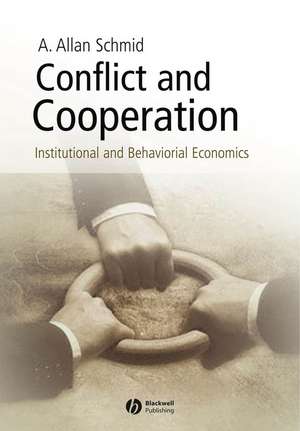
Conflict and Cooperation
Autor A Allan Schmiden Limba Engleză Paperback – 25 iun 2004
With its broad applications and numerous practice and discussion questions, this text will appeal not only to students of economics, but also to those studying sociology, law, and political science.
Preț: 487.36 lei
Preț vechi: 529.74 lei
-8%
Puncte Express: 731
Carte tipărită la comandă
Livrare economică 08-22 decembrie
Livrare prin curier în România Termenul estimat este afișat lângă disponibilitate.
Transport gratuit pentru acest produs Plată online sau ramburs, în funcție de opțiunile comenzii.
Retur gratuit în 14 zile Comandă securizată și suport în română.
Specificații
ISBN-13: 9781405113564
ISBN-10: 1405113561
Pagini: 364
Dimensiuni: 170 x 245 x 27 mm
Greutate: 0.65 kg
Ediția:New.
Editura: Wiley
Locul publicării:Chichester, United Kingdom
ISBN-10: 1405113561
Pagini: 364
Dimensiuni: 170 x 245 x 27 mm
Greutate: 0.65 kg
Ediția:New.
Editura: Wiley
Locul publicării:Chichester, United Kingdom
V-ar putea interesa
-
 Capital and Time: A Neo-Austrian TheoryJ. R. Hicks-27%Preț: 355.72 lei489.75 lei
 -
 Mathematics for Economics and Finance: Methods and ModellingMartin Anthony-8%Preț: 349.41 lei379.04 lei
 -
 Welfare EconomicsRobin BoadwayPreț: 497.46 lei
 -
 -23%Preț: 504.99 lei655.83 lei
 -
 Learning and Expectations in MacroeconomicsGeorge W. Evans-19%Preț: 625.49 lei772.20 lei
 -
 Agent-Based Modelling in EconomicsLynne Hamill-8%Preț: 428.72 lei466.00 lei
 -
 Environmental Economics and SustainabilityBrian Chi-Ang LinPreț: 246.81 lei
 -
 Issues in FinanceSayerPreț: 239.34 lei
 -
 PareconMichael AlbertPreț: 123.08 lei
 -
 The Reformation in EconomicsPhilip PilkingtonPreț: 371.71 lei
Public țintă
upper–level undergraduate students in courses on behavioral and institutional economics; law & economics; experimental economics; economic theory; and political economyNotă biografică
A. Allan Schmid is University Distinguished Professor in the Department of Agricultural Economics at Michigan State University. He is the author of eight books, including Property, Power, and Public Choice (second edition, 1987), and Benefit-Cost Analysis: A Political Economy Approach (1989).
Descriere
* Addresses formal and informal institutions, the impact of alternative institutions, and institutional change and evolution. * Presents a framework open to changing preferences, bounded rationality, and evolution. * Explains how to form empirically testable hypotheses using experiments, case studies, and econometrics.