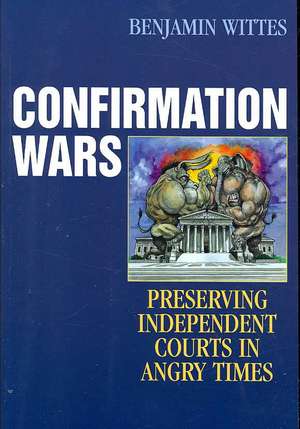
Confirmation Wars: Preserving Independent Courts in Angry Times: Hoover Studies in Politics, Economics, and Society
Autor Benjamin Wittesen Limba Engleză Paperback – 15 oct 2007
Published in cooperation with the Hoover Institution.


Preț: 109.06 lei
Preț vechi: 130.26 lei
-16%
Puncte Express: 164
Carte tipărită la comandă
Livrare economică 23 noiembrie-07 decembrie
Livrare prin curier în România Termenul estimat este afișat lângă disponibilitate.
Transport gratuit de la 400.00 lei Plată online sau ramburs, în funcție de opțiunile comenzii.
Retur gratuit în 14 zile Comandă securizată și suport în română.
Specificații
ISBN-13: 9780742551459
ISBN-10: 0742551458
Pagini: 168
Dimensiuni: 138 x 226 x 12 mm
Greutate: 0.28 kg
Editura: Bloomsbury Publishing
Colecția Rowman & Littlefield
Seria Hoover Studies in Politics, Economics, and Society
Locul publicării:New York, United States
ISBN-10: 0742551458
Pagini: 168
Dimensiuni: 138 x 226 x 12 mm
Greutate: 0.28 kg
Editura: Bloomsbury Publishing
Colecția Rowman & Littlefield
Seria Hoover Studies in Politics, Economics, and Society
Locul publicării:New York, United States
Cuprins
Chapter 1 1. Introduction
Chapter 2 2. An Unsatisfying Debate
Chapter 3 3. The Transformation of Judicial Confirmations
Chapter 4 4. The Threat to Independent Courts
Chapter 5 5. Conclusion: A Confirmation Process for Angry Times
Chapter 2 2. An Unsatisfying Debate
Chapter 3 3. The Transformation of Judicial Confirmations
Chapter 4 4. The Threat to Independent Courts
Chapter 5 5. Conclusion: A Confirmation Process for Angry Times
Recenzii
Drawing upon his deep knowledge of Washington politics, Wittes proposes several structural solutions to confirmation partisanship, including abandoning nominee testimony and focusing Senators' attention on the nominee's record. Though some may find these suggestions radical, Wittes's practical, readable text represents a serious effort to cure a process that troubles many Americans.
This beautifully written and thought-provoking book is everything that the current confirmation process is not: temperate, thoughtful, nuanced, and fair. It is a 'must read' for anyone interested in the confirmation of federal judges.
This is the most interesting and fair-minded book ever written about the politics of judicial confirmation. The partisan participants in the judicial confirmation process should take Wittes's proposals for fixing the system very seriously, but for reasons he discouragingly explains, they probably won't.
Benjamin Wittes, one of America's most insightful legal commentators, has achieved something remarkable: a book that casts genuinely fresh light on the question of judicial appointments. At a time when the debate about nominating and confirming judges tends to be shrill and partisan, this book is the opposite: scholarly, provocative, full of surprising history, and ultimately convincing. Both Wittes's analysis of the confirmation process and his proposed solutions will confound ideologues and delight open-minded readers of all political persuasions.
[Wittes is] a highly cogent legal commentator.
Wittes is not pounding madly on the table-he is too thoughtful and careful with evidence for that-but he is alarmed that in these 'angry times,' the judicial confirmation process, disfigured by harsh partisanship, poses a short and longer term threat to judicial independence. ... [Confirmation Wars] is a fine treatment of judicial confirmation politics, at all points judicious in its treatment of the issues and informative in its coverage of the relevant history and scholarly debate.
Wittes, a Washington Post editorial writer, thoughtfully and dispassionately looks at how the federal judicial confirmation process has deteriorated over time (and he persuasively argues that it has indeed deteriorated), and what can be done about it.
...A terrific history of Supreme Court nominations.
Witte's arguments and analyses are refreshing, especially his institutional perspective that sees the current confirmation process as the concomitant reaction to the overall institutional growth of the Judiciary over the last fifty years....Wittes's contribution to the study of the judicial selection process is an important one.
This beautifully written and thought-provoking book is everything that the current confirmation process is not: temperate, thoughtful, nuanced, and fair. It is a 'must read' for anyone interested in the confirmation of federal judges.
This is the most interesting and fair-minded book ever written about the politics of judicial confirmation. The partisan participants in the judicial confirmation process should take Wittes's proposals for fixing the system very seriously, but for reasons he discouragingly explains, they probably won't.
Benjamin Wittes, one of America's most insightful legal commentators, has achieved something remarkable: a book that casts genuinely fresh light on the question of judicial appointments. At a time when the debate about nominating and confirming judges tends to be shrill and partisan, this book is the opposite: scholarly, provocative, full of surprising history, and ultimately convincing. Both Wittes's analysis of the confirmation process and his proposed solutions will confound ideologues and delight open-minded readers of all political persuasions.
[Wittes is] a highly cogent legal commentator.
Wittes is not pounding madly on the table-he is too thoughtful and careful with evidence for that-but he is alarmed that in these 'angry times,' the judicial confirmation process, disfigured by harsh partisanship, poses a short and longer term threat to judicial independence. ... [Confirmation Wars] is a fine treatment of judicial confirmation politics, at all points judicious in its treatment of the issues and informative in its coverage of the relevant history and scholarly debate.
Wittes, a Washington Post editorial writer, thoughtfully and dispassionately looks at how the federal judicial confirmation process has deteriorated over time (and he persuasively argues that it has indeed deteriorated), and what can be done about it.
...A terrific history of Supreme Court nominations.
Witte's arguments and analyses are refreshing, especially his institutional perspective that sees the current confirmation process as the concomitant reaction to the overall institutional growth of the Judiciary over the last fifty years....Wittes's contribution to the study of the judicial selection process is an important one.
Notă biografică
Benjamin Wittes is the editor in chief of Lawfare. He is senior fellow at the Brookings Institution and author of Law and the Long War and The Future of Violence, among other books.