Confessions: The Philosophy of Transparency: The WISH List
Autor Prof. Thomas Dochertyen Limba Engleză Hardback – 24 mai 2012
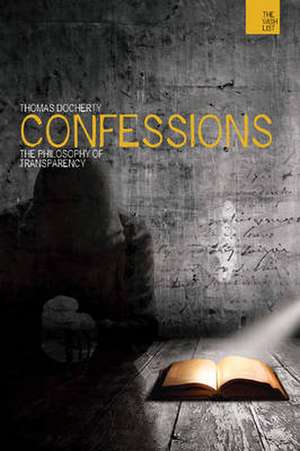
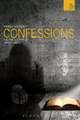
This book explores what is at stake in our confessional culture. Thomas Docherty examines confessional writings from Augustine to Montaigne and from Sylvia Plath to Derrida, arguing that through all this work runs a philosophical substratum - the conditions under which it is possible to assert a confessional mode - that needs exploration and explication.
Docherty outlines a philosophy of confession that has pertinence for a contemporary political culture based on the notion of 'transparency'. In a postmodern 'transparent society', the self coincides with its self-representations. Such a position is central to the idea of authenticity and truth-telling in confessional writing: it is the basis of saying, truthfully, 'here I take my stand'.
The question is: what other consequences might there be of an assumption of the primacy of transparency? Two areas are examined in detail: the religious and the judicial. Docherty shows that despite the tendency to regard transparency as a general social and ethical good, our contemporary culture of transparency has engendered a society in which autonomy (or the very authority of the subject that proclaims 'I confess') is grounded in guilt, reparation and victimhood.


Preț: 645.84 lei
Preț vechi: 853.17 lei
-24%
Puncte Express: 969
Carte tipărită la comandă
Livrare economică 03-17 decembrie
Livrare prin curier în România Termenul estimat este afișat lângă disponibilitate.
Transport gratuit pentru acest produs Plată online sau ramburs, în funcție de opțiunile comenzii.
Retur gratuit în 14 zile Comandă securizată și suport în română.
Specificații
ISBN-13: 9781849666596
ISBN-10: 1849666598
Pagini: 224
Dimensiuni: 156 x 234 x 23 mm
Greutate: 0.43 kg
Ediția:New.
Editura: Bloomsbury Publishing
Colecția Bloomsbury Academic
Seria The WISH List
Locul publicării:London, United Kingdom
ISBN-10: 1849666598
Pagini: 224
Dimensiuni: 156 x 234 x 23 mm
Greutate: 0.43 kg
Ediția:New.
Editura: Bloomsbury Publishing
Colecția Bloomsbury Academic
Seria The WISH List
Locul publicării:London, United Kingdom
V-ar putea interesa
-
 The Structure of Resurrection BeliefPeter Carnley-27%Preț: 356.69 lei486.31 lei
 -
 -14%Preț: 298.25 lei347.26 lei
 -
 Good God: The Theistic Foundations of MoralityDavid Baggett-13%Preț: 307.81 lei352.56 lei
 -
 No Longer the SameD. BrockmanPreț: 374.63 lei
 -
 Rolling Away the StoneStephen GottschalkPreț: 205.21 lei
 -
 Speaking ChristianMarcus J. BorgPreț: 147.62 lei
 -
 A User's Guide to Franz Rosenzweig's Star of RedemptionNorbert Samuelson-15%Preț: 462.45 lei544.06 lei
 -
 Shaping the Church: The Promise of Implicit TheologyMartyn PercyPreț: 464.26 lei
 -
 God of Salvation: Soteriology in Theological PerspectiveMurray A. RaePreț: 461.15 lei
 -
 Preț: 230.45 lei
 -
 The Prodigal SpiritGraham TomlinPreț: 74.53 lei
 -
 Café TheologyMichael LloydPreț: 118.28 lei
 -
 The Holy Spirit in the World TodayJane Ed WilliamsPreț: 69.08 lei
Cuprins
Part One: Now
'This Thing of Darkness I Acknowledge Mine'
Official Identity and Clandestine Experience
Part Two: Dilatory Time
The Ecology of Anguish
Down to Zero
Part Three: The Political Condition of Confession | My Language
'This Thing of Darkness I Acknowledge Mine'
Official Identity and Clandestine Experience
Part Two: Dilatory Time
The Ecology of Anguish
Down to Zero
Part Three: The Political Condition of Confession | My Language
Recenzii
Thomas Docherty has long been not only one of our most significant, provocative and original cultural critics, but one of the most consistent. In this, his latest foray into his chosen intellectual terrain, he deploys some of his key concepts ? the event, radical historicity, becoming as heterogeneous flux ? as a basis for a sustained interrogation of the history and supposed virtue of the idea of confession. The result is a learned, sophisticated and powerful counterblast to a culture whose demand for immediate transparency is inseparable from a range of disabling fetishes, from management and security to space and speed, `truth and reconciliation' and, above all, identity and identity-politics. Everyone should read it.
We live in an age where 'transparency' is everything, or its illusion at least, from the mea maxima culpa of the disgraced politician, to the pseudodoxia of institutional accountability. Tele-technologies, kiss-n-tell biographies and massmediatic intrusiveness have rendered confession meaningless to such a great degree, that to read so finely attuned a 'confessional' as Thomas Docherty's stunning critical and philosophical inquiry is to be reminded of an ethical imperative that is as inescapable as it is misunderstood in so wilfully stupid a secular culture as the one we presently inhabit. In a study that begins with disarmingly straightforward questions concerning what it might mean 'to confess', and what the role of the subject is in this practise, Docherty opens out his exquisitely crafted meditation, with a breadth of scope that belies the filigree-work of its arguments, its explorations, and its always-political interrogations.
I have to confess to liking this book a lot. It is a literary, theoretical and autobiographical tour de force. Docherty's acute critical sense ranges across the philosophical and cultural landscape to read Paul de Man, Giorgio Agamben, Hannah Arendt and the Lisbon Lions. A few more books like this and the humanities might be worth fighting for after all.
We live in an age where 'transparency' is everything, or its illusion at least, from the mea maxima culpa of the disgraced politician, to the pseudodoxia of institutional accountability. Tele-technologies, kiss-n-tell biographies and massmediatic intrusiveness have rendered confession meaningless to such a great degree, that to read so finely attuned a 'confessional' as Thomas Docherty's stunning critical and philosophical inquiry is to be reminded of an ethical imperative that is as inescapable as it is misunderstood in so wilfully stupid a secular culture as the one we presently inhabit. In a study that begins with disarmingly straightforward questions concerning what it might mean 'to confess', and what the role of the subject is in this practise, Docherty opens out his exquisitely crafted meditation, with a breadth of scope that belies the filigree-work of its arguments, its explorations, and its always-political interrogations.
I have to confess to liking this book a lot. It is a literary, theoretical and autobiographical tour de force. Docherty's acute critical sense ranges across the philosophical and cultural landscape to read Paul de Man, Giorgio Agamben, Hannah Arendt and the Lisbon Lions. A few more books like this and the humanities might be worth fighting for after all.