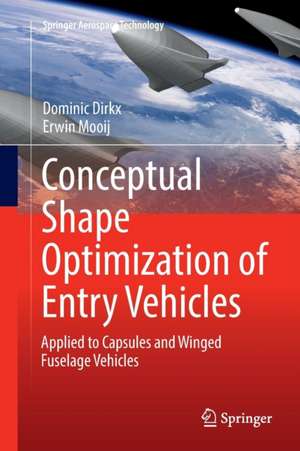
Conceptual Shape Optimization of Entry Vehicles
Autor Dominic Dirkx, Erwin Mooijen Limba Engleză Paperback – 4 iul 2018
The method detailed in Conceptual Shape Optimization of Entry Vehicles is straightforward, and the output gives the engineer insight in the effect of shape variations on trajectory performance. All applied models and algorithms used are explained in detail, allowing for reconstructing the design tool to the researcher’s requirements.
Conceptual Shape Optimization of Entry Vehicles will be of interest to both researchers and graduate students in the field of aerospace engineering, and to practitioners within the aerospace industry.
Preț: 863.50 lei
Preț vechi: 1053.06 lei
-18%
Puncte Express: 1295
Carte tipărită la comandă
Livrare economică 13-27 noiembrie
Livrare prin curier în România Termenul estimat este afișat lângă disponibilitate.
Transport gratuit pentru acest produs Plată online sau ramburs, în funcție de opțiunile comenzii.
Retur gratuit în 14 zile Comandă securizată și suport în română.
Specificații
ISBN-13: 9783319834306
ISBN-10: 3319834304
Pagini: 296
Ilustrații: XVI, 280 p. 178 illus., 130 illus. in color.
Dimensiuni: 155 x 235 x 17 mm
Greutate: 0.45 kg
Ediția:Softcover reprint of the original 1st edition 2017
Editura: Springer
Locul publicării:Cham, Switzerland
ISBN-10: 3319834304
Pagini: 296
Ilustrații: XVI, 280 p. 178 illus., 130 illus. in color.
Dimensiuni: 155 x 235 x 17 mm
Greutate: 0.45 kg
Ediția:Softcover reprint of the original 1st edition 2017
Editura: Springer
Locul publicării:Cham, Switzerland
Cuprins
Introduction.- Mission Heritage.- Flight Mechanics.- Aerothermodynamics.- Numerical Interpolation.- Vehicle Geometry.- Optimization.- Simulator Development.- Results - Capsule.- Results - Winged Vehicle.- Concluding Remarks.
Notă biografică
Dominic Dirkx works as a research associate in the field of analysis and simulation of planetary mission tracking. He has extensive experience on the design and implementation of simulation software for aerospace mission dynamics and design. His research interests include re-entry dynamics, trajectory optimization, interplanetary tracking, relativistic geodesy and modular simulation software design. He has worked on the shape optimization of entry vehicles, the conceptual design of planetary missions and the analysis of interplanetary laser ranging as a novel method of orbit determination for planetary missions.
Erwin Mooij works as an assistant professor in the field of launch and re-entry systems, amongst others teaching such course to first-year MSc students. His research interests include re-entry systems, trajectory optimization, guidance and control system design, and design methods and data-analysis techniques. Over the years he has worked on several re-entry-system projects, aimed at finding the best shape for doing hypersonic flight experiments. Before coming to work for Delft University of Technology, he worked for Dutch Space (currently: Airbus Defence and Space Netherlands). His tasks included, amongst others, system engineering for the thermal-protection system of the EXPERT entry vehicle (ESA project), as well as the shape-optimization of an earlier configuration of EXPERT.
Erwin Mooij works as an assistant professor in the field of launch and re-entry systems, amongst others teaching such course to first-year MSc students. His research interests include re-entry systems, trajectory optimization, guidance and control system design, and design methods and data-analysis techniques. Over the years he has worked on several re-entry-system projects, aimed at finding the best shape for doing hypersonic flight experiments. Before coming to work for Delft University of Technology, he worked for Dutch Space (currently: Airbus Defence and Space Netherlands). His tasks included, amongst others, system engineering for the thermal-protection system of the EXPERT entry vehicle (ESA project), as well as the shape-optimization of an earlier configuration of EXPERT.
Textul de pe ultima copertă
This book covers the parameterization of entry capsules, including Apollo capsules and planetary probes, and winged entry vehicles such as the Space Shuttle and lifting bodies. The aerodynamic modelling is based on a variety of panel methods that take shadowing into account, and it has been validated with flight and wind tunnel data of Apollo and the Space Shuttle. The shape optimization is combined with constrained trajectory analysis, and the multi-objective approach provides the engineer with a Pareto front of optimal shapes.
The method detailed in Conceptual Shape Optimization of Entry Vehicles is straightforward, and the output gives the engineer insight in the effect of shape variations on trajectory performance. All applied models and algorithms used are explained in detail, allowing for reconstructing the design tool to the researcher’s requirements.
Conceptual Shape Optimization of Entry Vehicles will be of interest to both researchers and graduate students in the field of aerospace engineering, and to practitioners within the aerospace industry.
The method detailed in Conceptual Shape Optimization of Entry Vehicles is straightforward, and the output gives the engineer insight in the effect of shape variations on trajectory performance. All applied models and algorithms used are explained in detail, allowing for reconstructing the design tool to the researcher’s requirements.
Conceptual Shape Optimization of Entry Vehicles will be of interest to both researchers and graduate students in the field of aerospace engineering, and to practitioners within the aerospace industry.
Caracteristici
The joint discussion of the relevant aspects of flight dynamics, aerothermodynamics, shape modelling and optimization in a single comprehensive text provides a crucially valuable reference for conceptual design of entry vehicles The book follows a general and modular approach that allows the contents to be easily extrapolated to related fields A detailed worked-out example of the shape generation provides excellent information to quickly implement the described algorithms Includes supplementary material: sn.pub/extras