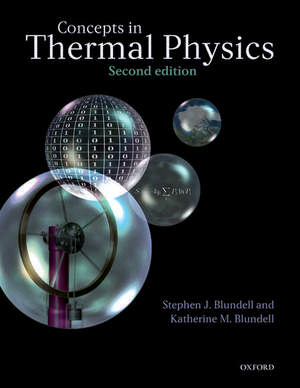
Concepts in Thermal Physics
Autor Stephen J. Blundell, Katherine M. Blundellen Limba Engleză Paperback – oct 2009
Preț: 346.65 lei
Preț vechi: 378.39 lei
-8%
Carte disponibilă
Livrare economică 06-11 noiembrie
Livrare express 22-28 octombrie pentru 94.86 lei
Specificații
ISBN-10: 0199562105
Pagini: 512
Ilustrații: 250 b/w line illustrations, 35 b/w halftones
Dimensiuni: 188 x 246 x 24 mm
Greutate: 1.09 kg
Ediția:2 Rev ed.
Editura: Oxford University Press
Colecția OUP Oxford
Locul publicării:Oxford, United Kingdom
V-ar putea interesa
-
 Statistical MechanicsR.K. Pathria-32%Preț: 568.15 lei833.67 lei
 -
 An Introduction to Thermal PhysicsDaniel V. Schroeder-9%Preț: 341.21 lei375.56 lei
 -
 Introductory Statistical MechanicsRoger Bowley-21%Preț: 403.00 lei509.21 lei
 -
 -10%Preț: 345.51 lei382.54 lei
 -
 Statistical ThermodynamicsAndrew Maczek-14%Preț: 258.40 lei302.13 lei
 -
 Entropy: A Very Short IntroductionJames Binney-20%Preț: 56.63 lei70.80 lei
 -
 An Introduction to Statistical Mechanics and ThermodynamicsRobert H. Swendsen-9%Preț: 341.11 lei375.50 lei
 -
 Quantum Stochastic Thermodynamics: Foundations and Selected ApplicationsPhilipp Strasberg-11%Preț: 293.12 lei330.25 lei
 -
 Why Chemical Reactions HappenJames Keeler-10%Preț: 347.52 lei388.17 lei
 -
 Applied Thermodynamics for Engineering TechnologistsT. D. Eastop-15%Preț: 664.50 lei781.76 lei
 -
 A Critical Study of the Law of Increasing EntropyJos Cruz Iguez RomeroPreț: 75.07 lei
 -
 Modern Condensed Matter PhysicsSteven M. Girvin-8%Preț: 575.38 lei625.41 lei
 -
 Introduction to Quantum MechanicsDavid J. Griffiths-8%Preț: 451.83 lei491.12 lei
 -
 Introduction to Thermal and Fluids EngineeringDeborah A Kaminski-23%Preț: 2010.00 lei2610.39 lei
 -
 -13%Preț: 634.94 lei729.81 lei
 -
 -23%Preț: 850.93 lei1105.10 lei
 -
 Thermodynamics For DummiesMichael PaukenPreț: 166.32 lei
 -
 Thermal SciencesMerle C. Potter-18%Preț: 809.96 lei987.74 lei
 -
 -14%Preț: 861.46 lei1001.70 lei
Descriere
An understanding of thermal physics is crucial to much of modern physics, chemistry and engineering. This book provides a modern introduction to the main principles that are foundational to thermal physics, thermodynamics and statistical mechanics. The key concepts are carefully presented in a clear way, and new ideas are illustrated with copious worked examples as well as a description of the historical background to their discovery. Applications are presented to subjects as diverse as stellar astrophysics, information and communication theory, condensed matter physics and climate change. Each chapter concludes with detailed exercises.
The second edition of this popular textbook maintains the structure and lively style of the first edition but extends its coverage of thermodynamics and statistical mechanics to include several new topics, including osmosis, diffusion problems, Bayes theorem, radiative transfer, the Ising model and Monte Carlo methods. New examples and exercises have been added throughout.
To request a copy of the Solutions Manual, visit: http: //global.oup.com/uk/academic/physics/admin/solutions
Recenzii
Notă biografică
Stephen Blundell did his undergraduate degree in Physics and Theoretical Physics at Peterhouse, Cambridge and his Ph. D. in the Cavendish Laboratory at Cambridge. He moved to the Clarendon Laboratory at Oxford to take up an SERC research fellowship, followed by a Junior Research Fellowship at Merton College, where he began research in organic magnets and superconductors using muon-spin rotation. In 1997 he was appointed to a University Lectureship in the PhysicsDepartment and a Tutorial Fellowship at Mansfield College, Oxford, and was subsequently promoted to Reader and then Professor. He was a joint winner of the Daiwa-Adrian Prize in 1999 for his work on organic magnets.Katherine Blundell did her undergraduate degree in Physics and Theoretical Physics at New Hall College, Cambridge and her Ph. D. in the Cavendish Laboratory at Cambridge. She moved to Oxford University Astrophysics department, holding a Junior Research Fellowship at Balliol College, an 1851 Research Fellowship, before taking up a Royal Society University Research Fellowship. Her research concentrates on radio galaxies and quasars. In 2005 she won a Leverhulme prize for her research, andbecame a Professor of Astrophysics in 2008.
Cuprins
- I: PRELIMINARIES
- 1: Introduction
- 2: Heat
- 3: Probability
- 4: Temperature and the Boltzmann factor
- II: KINETIC THEORY OF GASES
- 5: The Maxwell-Boltzmann distribution
- 6: Pressure
- 7: Molecular effusion
- 8: The mean free path and collisions
- III: TRANSPORT AND THERMAL DIFFUSION
- 9: Transport properties in gases
- 10: The thermal diffusion equation
- IV: THE FIRST LAW
- 11: Energy
- 12: Isothermal and adiobatic processes
- V: THE SECOND LAW
- 13: Heat engines and the second law
- 14: Entropy
- 15: Information theory
- VI: THERMODYNAMICS IN ACTION
- 16: Thermodynamic potentials
- 17: Rods, bubbles and magnets
- 18: The third law
- VII: STATISTICAL MECHANICS
- 19: Equipartition of energy
- 20: The partition function
- 21: Statistical mechanics of an ideal gas
- 22: The chemical potential
- 23: Photons
- 24: Phonons
- VIII: BEYOND THE IDEAL GAS
- 25: Relativistic gases
- 26: Real gases
- 27: Cooling real gases
- 28: Phase transitions
- 29: Bose-Einstein and Fermi-Dirac distributions
- 30: Quantum gases and condensates
- IX: SPECIAL TOPICS
- 31: Sound waves
- 32: Shock waves
- 33: Brownian motion and fluctuations
- 34: Non-equilibrium thermodynamics
- 35: Stars
- 36: Compact objects
- 37: Earth's atmosphere