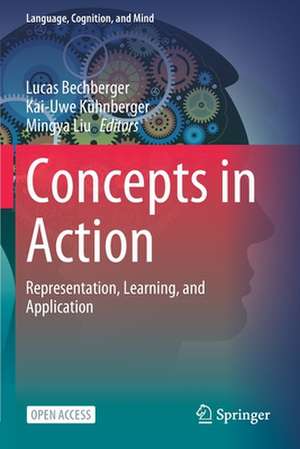
Concepts in Action: Language, Cognition, and Mind, cartea 9
Editat de Lucas Bechberger, Kai-Uwe Kühnberger, Mingya Liuen Limba Engleză Paperback – 3 aug 2021



Preț: 351.98 lei
Puncte Express: 528
Carte tipărită la comandă
Livrare economică 23 noiembrie-07 decembrie
Livrare prin curier în România Termenul estimat este afișat lângă disponibilitate.
Transport gratuit de la 400.00 lei Plată online sau ramburs, în funcție de opțiunile comenzii.
Retur gratuit în 14 zile Comandă securizată și suport în română.
Specificații
ISBN-13: 9783030698256
ISBN-10: 3030698254
Pagini: 204
Ilustrații: X, 194 p. 46 illus., 18 illus. in color.
Dimensiuni: 155 x 235 x 12 mm
Greutate: 0.3 kg
Ediția:1st edition 2021
Editura: Springer
Colecția Language, Cognition, and Mind
Seria Language, Cognition, and Mind
Locul publicării:Cham, Switzerland
ISBN-10: 3030698254
Pagini: 204
Ilustrații: X, 194 p. 46 illus., 18 illus. in color.
Dimensiuni: 155 x 235 x 12 mm
Greutate: 0.3 kg
Ediția:1st edition 2021
Editura: Springer
Colecția Language, Cognition, and Mind
Seria Language, Cognition, and Mind
Locul publicării:Cham, Switzerland
Cuprins
Chapter 1. Introduction (Lucas Bechberger).- Chapter 2. The Geometric Structure of Word (Peter Gärdenfors).- Chapter 3. Aligning between Conceptual Systems Using Internal and External Information (Robert Goldstone).- Chapter 4. Lexical and Structural Divergences between WordNets of Different Languages (Christiane D. Fellbaum).- Chapter 5. Emergence of Grounded Communication and Concepts using Deep Reinforcement Learning (Michael Spranger).- Chapter 6. Prototypes, Theory, Trust: A Multi-Dimensional Model of Concepts And a Computational Approximation (David Schlangen).- Chapter 7. Machine Learning in Conceptual Spaces: Two Learning Processes (Lucas Bechberger).- Chapter 8. On the Evaluation of Conceptual Spaces: Qualitative and Quantitative Approaches (Hadi Banaee).- Chapter 9. Kind formation by Similarity (Helmar Gust).- Chapter 10. Theories about World Representations for the Internet of Things (Michael Färber).- Chapter 11. Effects of semantic specificity in action verb processing (Margit Scheibel).- Chapter 12. Evaluating Semantic CoCreation in Cognitive Representation Models (Stefan Schneider).- Chapter 13. Grounding Abstract Concepts in Action (Paola Vernillo).- Chapter 14. (José V. Hernández-Conde).- Chapter 15. Does the Activation of Motor Information Affect Semantic Processing? (Elisa Scerrati).
Textul de pe ultima copertă
This open access book is a timely contribution in presenting recent issues, approaches, and results that are not only central to the highly interdisciplinary field of concept research but also particularly important to newly emergent paradigms and challenges. The contributors present a unique, holistic picture for the understanding and use of concepts from a wide range of fields including cognitive science, linguistics, philosophy, psychology, artificial intelligence, and computer science. The chapters focus on three distinct points of view that lie at the core of concept research: representation, learning, and application. The contributions present a combination of theoretical, experimental, computational, and applied methods that appeal to students and researchers working in these fields.
Caracteristici
Offers a synergistic focus on the representation, learning and application of concepts Provides a more holistic perspective on concept research from leading researchers in the field Combines theoretical, experimental, computational, and applied approaches