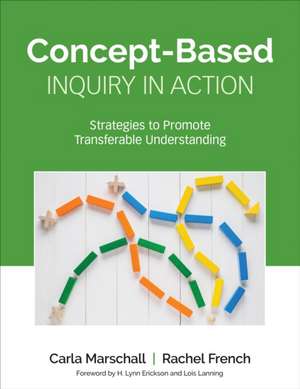
Concept-Based Inquiry in Action: Corwin Teaching Essentials
Autor Carla Marschall, Rachel Frenchen Limba Engleză Paperback – 5 iul 2018
Ceea ce aduce nou Concept-Based Inquiry in Action este transpunerea riguroasă a teoriei pedagogice într-un model operațional de investigație, menit să transforme sălile de clasă în spații de gândire activă. Subliniem faptul că Carla Marschall și Rachel French nu se limitează la a explica beneficiile învățării bazate pe concepte, ci oferă o structură pas cu pas pentru implementarea strategiilor care susțin transferul de înțelegere în orice context educațional K–12. Reținem integrarea armonioasă a abordării inductive, care permite elevilor să exploreze relațiile dintre concepte prin întrebări de ghidare bine calibrate. Cititorii familiarizați cu Concept-Based Curriculum and Instruction for the Thinking Classroom de H. Lynn Erickson vor aprecia modul în care acest volum extinde cadrul teoretic clasic către o aplicabilitate imediată la catedră. În timp ce lucrarea lui Erickson pune bazele curriculare, Marschall și French se concentrează pe acțiunea pedagogică propriu-zisă, oferind instrumentele necesare pentru organizarea învățării în jurul structurilor de cunoaștere. De asemenea, față de Worldwise Learning, unde Carla Marschall aborda cetățenia globală, volumul de față se concentrează pe mecanismele cognitive universale ale învățării. Structura cărții este organizată logic pentru a sprijini progresia cadrului didactic: primele capitole clarifică fundamentele și fuzionează învățarea prin investigație cu cea conceptuală, urmate de prezentarea detaliată a fazelor modelului de lucru. Un punct forte îl reprezintă capitolul dedicat planificării, care explică modul în care profesorii își pot aprofunda propria înțelegere asupra unei unități de curs înainte de a o preda. Tonul este unul profesional și aplicat, specific seriei Corwin Teaching Essentials, făcând din această lucrare o resursă esențială pentru educatorii care doresc să depășească nivelul factual al instruirii.
Din seria Corwin Teaching Essentials
-
 Preț: 289.81 lei
 -
 Preț: 289.79 lei
 -
 Preț: 280.42 lei
 -
 Preț: 260.28 lei
 -
 Preț: 288.34 lei
 -
 Preț: 290.48 lei
 -
 Preț: 208.84 lei
 -
 Preț: 284.94 lei
 -
 Preț: 309.36 lei
 -
 Preț: 253.54 lei
 -
 Preț: 286.71 lei
 -
 Preț: 303.33 lei
 -
 Preț: 206.08 lei
 -
 Preț: 289.02 lei
 -
 Preț: 257.61 lei
 -
 Preț: 289.75 lei
 -
 Preț: 197.35 lei
 -
 Preț: 209.56 lei
 -
 Preț: 187.01 lei
 -
 Preț: 252.96 lei
 -
 Preț: 210.94 lei
 -
 Preț: 295.80 lei
 -
 Preț: 276.51 lei
 -
 Preț: 187.01 lei
 -
 Preț: 144.96 lei
 -
 Preț: 191.12 lei
 -
 Preț: 144.96 lei
 -
 Preț: 191.12 lei
 -
 Preț: 198.80 lei
 -
 Preț: 191.12 lei
 -
 Preț: 168.04 lei
 -
 Preț: 183.41 lei
 -
 Preț: 191.12 lei
 -
 Preț: 152.65 lei
 -
 Preț: 144.96 lei
 -
 Preț: 198.80 lei
 -
 Preț: 191.12 lei
 -
 Preț: 198.80 lei
 -
 Preț: 191.12 lei
 -
 Preț: 191.12 lei
 -
 Preț: 198.80 lei
Preț: 225.09 lei
Carte disponibilă
Livrare economică 12-26 noiembrie
Livrare express 29 octombrie-04 noiembrie pentru 138.17 lei
Specificații
ISBN-10: 150639129X
Pagini: 370
Dimensiuni: 216 x 279 x 21 mm
Greutate: 1 kg
Ediția:1. Auflage
Editura: Corwin
Colecția Corwin Teaching Essentials
Seria Corwin Teaching Essentials
Locul publicării:Thousand Oaks, United States
V-ar putea interesa
-
 At the Intersection of Art and ResearchAnne SullivanPreț: 423.62 lei
 -
 Gender Differences on College Admission Test ItemsThomas LangenfeldPreț: 421.16 lei
 -
 Preț: 414.56 lei
 -
 Preț: 412.70 lei
 -
 Preț: 423.45 lei
 -
 The Parallel Curriculum in the Classroom, Book 1Carol Ann TomlinsonPreț: 313.03 lei
 -
 Navigating the National Board Certification ProcessMartha H. HopkinsPreț: 250.94 lei
 -
 When a Crisis HitsRobert H. DeckerPreț: 286.41 lei
 -
 Supporting the Spirit of LearningArthur L. CostaPreț: 319.79 lei
 -
 The Process-Centered SchoolArthur L. CostaPreț: 320.63 lei
 -
 Teaching With Heart: Making Healthy Connections With StudentsJudith A. DeiroPreț: 257.31 lei
 -
 Practical School SecurityKenneth S. TrumpPreț: 174.83 lei
 -
 LEARNING FOR LIFERonald J. AregladoPreț: 225.59 lei
 -
 The Power of StorytellingHarriet MasonPreț: 193.34 lei
 -
 Preț: 78.70 lei
 -
 Playful Learning: Events and Activities to Engage AdultsNicola WhittonPreț: 296.08 lei
 -
 Preț: 376.18 lei
 -
 Personalized Professional LearningAllison RodmanPreț: 199.62 lei
 -
 Concept-Based Curriculum and Instruction for the Thinking ClassroomH. Lynn EricksonPreț: 203.13 lei
 -
 Problems in Higher Education: Closures, Sexual Violence and Rising CostsAngela J. Santiago-27%Preț: 1082.55 lei1474.15 lei
 -
 Preț: 157.60 lei
 -
 Preț: 311.95 lei
 -
 ACE Personal Trainer Study Guide 2019-2020Trivium Personal Trainer Prep TeamPreț: 201.12 lei
 -
 Best Business Schools 2020U. S. News and World ReportPreț: 92.12 lei
 -
 TeachinglandAmanda FoxPreț: 158.69 lei
De ce să citești această carte
Această resursă este esențială pentru profesorii care doresc să cultive gândirea critică și capacitatea de transfer a elevilor. Cititorul câștigă un set concret de strategii pentru a trece de la predarea bazată pe memorare la o metodologie centrată pe investigație și concepte. Este un ghid practic, ideal pentru dezvoltarea profesională, care transformă teoria complexă în pași executabili la clasă, indiferent de disciplina predată.
Recenzii
"I feel that this is a book that is timely and needed for a clearer picture of Concept-based Inquiry in action. This is a manuscript that educators would be able to pick up, understand, and apply into the classroom."
"Filled with strategies, illustrations, diagrams, and pictures, this book really gives you the insight you need to help students better understand what they are learning. So many great ideas that can be used in any classroom. A must read for all educators."
"It’s not every day that you read educational literature that you know will immediately have an impact on developing and improving your teaching practice. This book is like a guide that will lead you through the steps to becoming a better Concept-Based teacher. It is a book that teachers will take to planning meetings, have open, and refer to everyday. Just as a travel guide leads you too new discoveries this book will lead you to new discoveries with Concept-Based Inquiry. With this book you will see change and success in not only your teaching practice but also the understanding that the students will have in their learning."
Cuprins
Acknowledgments
About the Authors
About the Illustrator
Introduction
Chapter 1: The Foundations of Concept-Based Inquiry
Bringing Together Inquiry-Based and Concept-Based Learning
Part 1: Exploring Inquiry-Based Learning
Inquiry Approaches in Concept-Based Inquiry
Part 2: Exploring Concept-Based Learning
Concepts as Organizers
The Structures of Knowledge and Process
Disciplines Draw From Knowledge and Process
Pause and Reflect
Chapter 2: Concept-Based Inquiry
A Model of Concept-Based Inquiry
The Phases of Concept-Based Inquiry
The Complexity of Inquiry
Concept-Based Inquiry and the Inductive Approach
Creating a Culture of Concept-Based Inquiry
Pause and Reflect
Chapter 3: Planning for Concept-Based Inquiry
What Planning Steps Support Concept-Based Inquiry?
How Can Teachers Enhance Their Understanding of a Unit?
What Role Do Guiding Questions Play in Concept-Based Inquiry?
What Do the Phases of Concept-Based Inquiry Look Like in a Unit?
Pacing in Concept-Based Inquiry
How Do the Phases of Inquiry Support Teacher Planning for Concept-Based Inquiry?
What Are Approaches for Making Interdisciplinary Links?
Connecting to the Phases of Inquiry
Pause and Reflect
Chapter 4: Engage
Activating Prior Knowledge Using Engagement Strategies
Using Strategies to Motivate Students
Initial Questions, Initial Thinking
Rethinking Our Use of Engagement Strategies
Opinion-Based Strategies
Experiential Strategies
Discussion-Based Strategies
Assessment in the Engage Phase
Connecting Phases of Inquiry
Pause and Reflect
Chapter 5: Focus
Using Concept Formation Strategies to Focus an Inquiry
Concepts Provide Breadth and Depth
Levels of Conceptual Thinking
Effective Concept Formation Practices
Concept Formation Strategies: Deductive and Inductive Approaches
Choosing Concept Formation Strategies
Assessment in the Focus Phase
Connecting Phases of Inquiry
Pause and Reflect
Chapter 6: Investigate
The Power of Factual Examples
Case Study Approaches
Focus on Skill Development
A Preface to Strategies
Assessment in the Investigate Phase
Connecting Phases of Inquiry
Pause and Reflect
Chapter 7: Organize
Making Meaning Using Organizers
Cognitive Load Theory and the Importance of Organizing
Representation and Conceptual Understanding
Sharing Findings as a Community of Inquirers
A Preface to Strategies
Assessment in the Organize Phase
Connecting Phases of Inquiry
Pause and Reflect
Chapter 8: Generalize
An Inductive Approach to Generalizing
Developing Strong Generalizations
Scaffolding Thinking
The Value of Recording Generalizations
The Importance of Discussion
A Preface to Strategies
Assessment in the Generalize Phase
Connecting Phases of Inquiry
Pause and Reflect
Chapter 9: Transfer
Transfer That Deepens Understanding
Testing and Justifying Generalizations
Understanding New Events and Situations
Predicting and Hypothesizing
Applying Learning
Taking Action
Assessment in the Transfer Phase
Connecting Phases of Inquiry
Pause and Reflect
Chapter 10: Reflect
The Power of Reflection
The Reflective Cycle
Building Agency
Reflection Throughout the Inquiry
Assessing Reflection Throughout the Inquiry
Connecting Phases of Inquiry
Pause and Reflect
Chapter 11: Concluding Thoughts
A Vision for Thinking Classrooms
Understand and Adapt
Resources
Resource A. Concept-Based Inquiry Glossary of Terms
Resource B. Concept-Based Inquiry Planner
Resource C. Sample Concept-Based Inquiry Planner: Industrialization Unit
References
Index
Notă biografică
Carla Marschallis an experienced educator, curriculum developer, and pedagogical leader, who has worked in a variety of leadership roles in international schools in Switzerland, Germany, Hong Kong, and Singapore over the past ten years. She currently works as the Director of Teaching & Learning at UWC South East Asia, with the mission to make "education a force to unite people, nations and cultures for peace and a sustainable future." A certified Lynn Erickson Concept-Based Curriculum and Instruction Consultant, Carla is the co-author of Concept-Based Inquiry in Action (Corwin, 2018). Carla holds a Masters in Elementary Education from Teachers College, Columbia University and a Masters in Applied Educational Leadership and Management from the Institute of Education, University of London.
Website: http://www.connectthedotsinternational.com/
Descriere
Concept-Based Inquiry is a framework for inquiry that promotes deep understanding. The key is using guiding questions to help students inquire into concepts and the relationships between them. Concept-Based Inquiry in Action provides teachers with the tools and resources necessary to organize and focus student learning around concepts and conceptual relationships that support the transfer of understanding. Step by step, the authors lead both new and experienced educators to implement teaching strategies that support the realization of inquiry-based learning for understanding in any K–12 classroom.