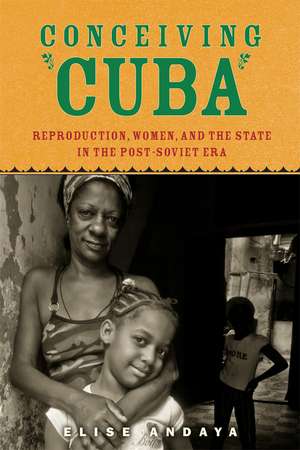
Conceiving Cuba: Reproduction, Women, and the State in the Post-Soviet Era
Autor Elise Andayaen Limba Engleză Hardback – 30 mai 2014
Received an Honorable Mention for the 2015 First Michelle Rosaldo Prize for a First Book in Feminist Anthropology from the Association for Feminist Anthropology
Winner of the Adele E. Clarke Book Award from ReproNetwork
After Cuba’s 1959 revolution, the Castro government sought to instill a new social order. Hoping to achieve a new and egalitarian society, the state invested in policies designed to promote the well-being of women and children. Yet once the Soviet Union fell and Cuba’s economic troubles worsened, these programs began to collapse, with serious results for Cuban families.
Conceiving Cuba offers an intimate look at how, with the island’s political and economic future in question, reproduction has become the subject of heated public debates and agonizing private decisions. Drawing from several years of first-hand observations and interviews, anthropologist Elise Andaya takes us inside Cuba’s households and medical systems. Along the way, she introduces us to the women who wrestle with the difficult question of whether they can afford a child, as well as the doctors who, with only meager resources at their disposal, struggle to balance the needs of their patients with the mandates of the state.
Andaya’s groundbreaking research considers not only how socialist policies have profoundly affected the ways Cuban families imagine the future, but also how the current crisis in reproduction has deeply influenced ordinary Cubans’ views on socialism and the future of the revolution. Casting a sympathetic eye upon a troubled state, Conceiving Cuba gives new life to the notion that the personal is always political.
Winner of the Adele E. Clarke Book Award from ReproNetwork
After Cuba’s 1959 revolution, the Castro government sought to instill a new social order. Hoping to achieve a new and egalitarian society, the state invested in policies designed to promote the well-being of women and children. Yet once the Soviet Union fell and Cuba’s economic troubles worsened, these programs began to collapse, with serious results for Cuban families.
Conceiving Cuba offers an intimate look at how, with the island’s political and economic future in question, reproduction has become the subject of heated public debates and agonizing private decisions. Drawing from several years of first-hand observations and interviews, anthropologist Elise Andaya takes us inside Cuba’s households and medical systems. Along the way, she introduces us to the women who wrestle with the difficult question of whether they can afford a child, as well as the doctors who, with only meager resources at their disposal, struggle to balance the needs of their patients with the mandates of the state.
Andaya’s groundbreaking research considers not only how socialist policies have profoundly affected the ways Cuban families imagine the future, but also how the current crisis in reproduction has deeply influenced ordinary Cubans’ views on socialism and the future of the revolution. Casting a sympathetic eye upon a troubled state, Conceiving Cuba gives new life to the notion that the personal is always political.
Preț: 826.65 lei
Preț vechi: 1132.40 lei
-27%
Puncte Express: 1240
Carte tipărită la comandă
Livrare economică 30 noiembrie-14 decembrie
Livrare prin curier în România Termenul estimat este afișat lângă disponibilitate.
Transport gratuit pentru acest produs Plată online sau ramburs, în funcție de opțiunile comenzii.
Retur gratuit în 14 zile Comandă securizată și suport în română.
Specificații
ISBN-13: 9780813565200
ISBN-10: 0813565200
Pagini: 192
Dimensiuni: 152 x 229 x 18 mm
Greutate: 0.4 kg
Ediția:None
Editura: Rutgers University Press
Colecția Rutgers University Press
ISBN-10: 0813565200
Pagini: 192
Dimensiuni: 152 x 229 x 18 mm
Greutate: 0.4 kg
Ediția:None
Editura: Rutgers University Press
Colecția Rutgers University Press
V-ar putea interesa
-
 The PankhurstsMartin PughPreț: 110.84 lei
 -
 Why Women Have SexCindy Meston-19%Preț: 75.58 lei93.24 lei
 -
 -21%Preț: 423.05 lei535.05 lei
 -
 There's No Crying in BusinessR. RiveraPreț: 329.84 lei
 -
 Uncollected Early Prose of Katherine Anne PorterKatherine Anne PorterPreț: 249.58 lei
 -
 Daughters of ShameJasvinder Sanghera-27%Preț: 67.67 lei92.81 lei
 -
 Multiculturalism without CultureAnne PhillipsPreț: 262.02 lei
 -
 A Jewish Feminine Mystique?: Jewish Women in Postwar AmericaProfessor Hasia R. DinerPreț: 330.54 lei
 -
 Women and the Animal Rights MovementEmily GaarderPreț: 303.44 lei
 -
 Child of the Sit-DownsJacksonPreț: 224.12 lei
 -
 -27%Preț: 76.96 lei105.94 lei
 -
 Living Dolls: The Return of SexismNatasha Walter-25%Preț: 66.98 lei89.78 lei
 -
 -39%Preț: 735.12 lei1203.75 lei
 -
 A Very Great ProfessionNicola BeaumanPreț: 150.29 lei
Notă biografică
ELISE ANDAYA is an assistant professor of anthropology at the University at Albany, State University of New York. Her work has been published in numerous essay collections and journals, including Medical Anthropology Quarterly and Feminist Studies.
Cuprins
Introduction : reproduction, women, and the state
(Re)producing the new woman : the early revolutionary years
Reproducing citizens and socialism in prenatal care
Abortion and calculated risks
Engendered economies and the dilemmas of reproduction
Having faith and making family overseas
Conclusion : reproducing the revolution
(Re)producing the new woman : the early revolutionary years
Reproducing citizens and socialism in prenatal care
Abortion and calculated risks
Engendered economies and the dilemmas of reproduction
Having faith and making family overseas
Conclusion : reproducing the revolution
Recenzii
"Andaya reveals the complex entanglement of women’s reproductive choices, healthcare practices, and the state’s agenda to reshape gender ideologies. This rich ethnography will appeal to regional specialists, and to scholars of gender, reproduction, post-socialism, and social change."
Descriere
Conceiving Cuba offers an intimate look at how the institutions promoting the well-being of mothers and children, once a cornerstone of the socialist system, collapsed with the fall of the Soviet Union, throwing both individual families and the nation itself into profound crisis. Drawing from years of first-hand observations and interviews, anthropologist Elise Andaya takes us inside the island’s households and medical facilities, as they struggle to make do with limited resources and grapple with difficult questions concerning family planning, reproductive health, and the future of the socialist revolution itself.