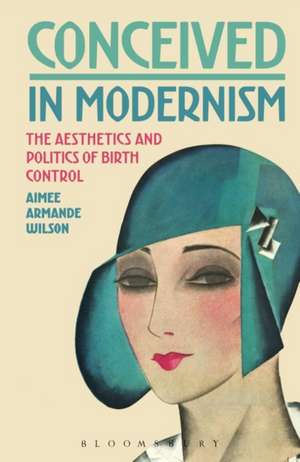
Conceived in Modernism: The Aesthetics and Politics of Birth Control
Autor Dr. Aimee Armande Wilsonen Limba Engleză Paperback – 29 iun 2017
Preț: 283.16 lei
Preț vechi: 366.34 lei
-23%
Puncte Express: 425
Carte tipărită la comandă
Livrare economică 07-21 decembrie
Livrare prin curier în România Termenul estimat este afișat lângă disponibilitate.
Transport gratuit de la 400.00 lei Plată online sau ramburs, în funcție de opțiunile comenzii.
Retur gratuit în 14 zile Comandă securizată și suport în română.
Specificații
ISBN-13: 9781501333958
ISBN-10: 150133395X
Pagini: 176
Ilustrații: 1 b/w illustration
Dimensiuni: 142 x 218 x 18 mm
Greutate: 0.21 kg
Ediția:NIPPOD
Editura: Bloomsbury Publishing
Colecția Bloomsbury Academic
Locul publicării:New York, United States
ISBN-10: 150133395X
Pagini: 176
Ilustrații: 1 b/w illustration
Dimensiuni: 142 x 218 x 18 mm
Greutate: 0.21 kg
Ediția:NIPPOD
Editura: Bloomsbury Publishing
Colecția Bloomsbury Academic
Locul publicării:New York, United States
V-ar putea interesa
-
 LORD OF RINGS READERS COMPA HBWayne G. HammondPreț: 281.26 lei
 -
 The Science of Discworld IVTerry Pratchett-19%Preț: 97.48 lei121.09 lei
 -
 The FroodJem RobertsPreț: 125.31 lei
 -
 OrlandoVirginia Woolf-17%Preț: 48.26 lei58.10 lei
 -
 Cave In The SnowVicki Mackenzie-27%Preț: 67.78 lei92.76 lei
 -
 The Women’s InstituteSusan Cohen-31%Preț: 47.85 lei69.12 lei
 -
 -25%Preț: 92.57 lei123.10 lei
 -
 The Wheel of Time CompanionRobert JordanPreț: 263.61 lei
 -
 What We See When We ReadPeter Mendelsund-28%Preț: 106.96 lei148.13 lei
 -
 Alien Woman: The Making of Lt. Ellen RipleyProfessor C. Jason Smith-40%Preț: 98.86 lei164.54 lei
 -
 Women of the World: The Rise of the Female DiplomatHelen McCarthy-49%Preț: 59.36 lei116.93 lei
 -
 -35%Preț: 37.44 lei57.64 lei
 -
 Jonathan Franzen: The Comedy of RageProfessor Philip Weinstein-45%Preț: 90.07 lei163.16 lei
 -
 Introducing Literary CriticismOwen HollandPreț: 63.43 lei
 -
 -26%Preț: 68.73 lei93.33 lei
 -
 Preț: 89.99 lei
 -
 Short Stories of George Mackay BrownLinden BicketPreț: 59.80 lei
 -
 Art & WarLavie TidharPreț: 96.68 lei
Cuprins
Introduction
Chapter 1: Modernism, Monsters, and Margaret Sanger
Chapter 2: "God spoke with me to-day": Prophecy, Birth Control, and The Waste Land
Chapter 3: "Sentences swelled, adjectives multiplied": Reproduction and the Modernist Aesthetic
Chapter 4: Southern Mother, Lethal Fetus; Or How Birth Control Makes a Modernist Out of Flannery O'Connor
Chapter 5: Where Alien Abduction Meets Family Planning: Personhood, Race and Reproduction in Octavia Butler's Dawn
Coda
Bibliography
Index
Chapter 1: Modernism, Monsters, and Margaret Sanger
Chapter 2: "God spoke with me to-day": Prophecy, Birth Control, and The Waste Land
Chapter 3: "Sentences swelled, adjectives multiplied": Reproduction and the Modernist Aesthetic
Chapter 4: Southern Mother, Lethal Fetus; Or How Birth Control Makes a Modernist Out of Flannery O'Connor
Chapter 5: Where Alien Abduction Meets Family Planning: Personhood, Race and Reproduction in Octavia Butler's Dawn
Coda
Bibliography
Index
Recenzii
Fiction is a rich ground for considering the questions of birth control and abortion ... [Wilson] make[s] intriguing connections across countries and periods.
[D]ensely packed with meticulous academic argument . The book expanded my idea of modernism to include that earlier literature and its very different concerns . That Wilson resurrects these stories is significant. And where scholars have previously seen the birth-control movement as arising in parallel with modernism, Wilson has found revealing intersections.
Wilson perceptively connects literary form and political discourse, birth control's rhetorical past with debates in contemporary reproductive rights, making provocative connections between the advent of the contraceptive era and the stylistic revolutions of literary modernism that transform the reader's understanding of both movements. Spanning twentieth century authors from T.S. Eliot to Octavia Butler, Wilson's astute analysis highlights the inescapable interplay between political discourse and literary form, solidifying the place of the birth control movement as a transformative moment in western culture and her own role as a significant new voice in modernist literary criticism.
Conceived in Modernism sheds new light on the relation between Anglo-American modernist aesthetics and the early birth control movement. It intervenes forcefully in debates about modernist sexualities and the history of birth control and reproduction. Aimee Armande Wilson's politically informed and theoretically sophisticated readings of a range of canonical and lesser-known literary authors and birth control activists are illuminating and inspiring. Interdisciplinary in scope, the book makes an important and timely contribution to the intersecting inquiries of modernist studies, the history of sexuality, feminist criticism and sexuality studies.
[D]ensely packed with meticulous academic argument . The book expanded my idea of modernism to include that earlier literature and its very different concerns . That Wilson resurrects these stories is significant. And where scholars have previously seen the birth-control movement as arising in parallel with modernism, Wilson has found revealing intersections.
Wilson perceptively connects literary form and political discourse, birth control's rhetorical past with debates in contemporary reproductive rights, making provocative connections between the advent of the contraceptive era and the stylistic revolutions of literary modernism that transform the reader's understanding of both movements. Spanning twentieth century authors from T.S. Eliot to Octavia Butler, Wilson's astute analysis highlights the inescapable interplay between political discourse and literary form, solidifying the place of the birth control movement as a transformative moment in western culture and her own role as a significant new voice in modernist literary criticism.
Conceived in Modernism sheds new light on the relation between Anglo-American modernist aesthetics and the early birth control movement. It intervenes forcefully in debates about modernist sexualities and the history of birth control and reproduction. Aimee Armande Wilson's politically informed and theoretically sophisticated readings of a range of canonical and lesser-known literary authors and birth control activists are illuminating and inspiring. Interdisciplinary in scope, the book makes an important and timely contribution to the intersecting inquiries of modernist studies, the history of sexuality, feminist criticism and sexuality studies.